Substances on which enzymes act on - substrates
-
According to lock and key hypothesis - enzyme reactions depend on the presence of active sites. Active sites are grooves (depressions) or ‘pockets’ on surface of an enzyme molecule → into which a substrate molecule(s) with a matching shape can fit exactly like a lock and key Enzyme - lock Substrate - key
-
When substrate binds to an active site of enzyme - an enzyme substrate complex is formed. Enzyme substrate complex - temporary molecule formed when substrate binds to active site of enzyme Reactions take place at active site - converts the substrate molecule(s) to produce molecule(s) Produce molecule(s) separate(s) from the enzyme. Enzyme molecule remains unchanged and is free to combine again with more substrate molecules. E + S ⇔ ES ⇔ P
1. 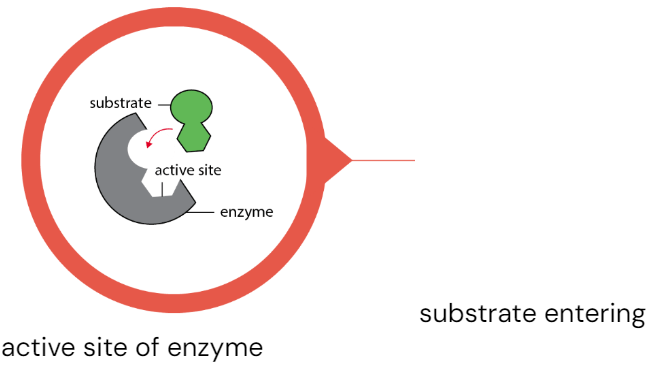 - Substrate have Specific 3D shapes. It has depression called active site - Substrate on which enzyme acts → called substrate | 2. 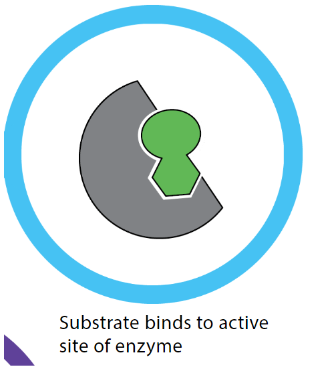 - Only substrate with 3D Shape complementary to that of active site can fit into the enzyme - Results in formation of enzyme - substrate complex - Enzyme = lock, Substrate = Key - Substrate fits into enzymes like how key fits into a lock - Called lock and key hypothesis |
3. 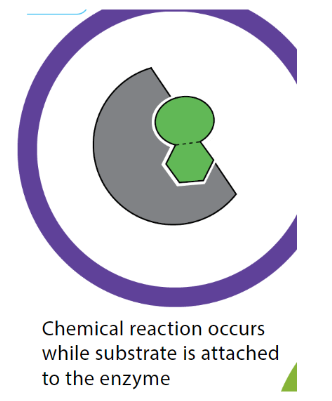 - While Substrate is attached to active site → chemical reaction occurs - Substrates are converted into products | 4. 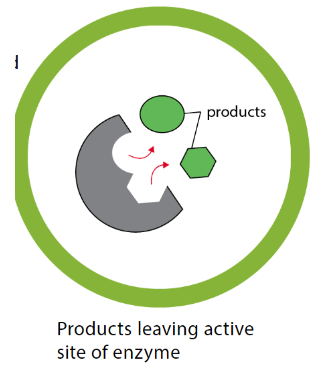 - Products leave active site of enzyme - Enzyme remains unchanged - It can catalyze another reaction. |
Characteristics of Enzymes
Enzymes Speed up Rate of Chemical Reactions
- alter rates of chemical reactions that occur in cell
- speed up chemical reactions by lowering activation energy needed to start the reaction
Enzymes are Specific in Action
- have active sites
- Only substrates with shapes complementary to the active site can fit into the enzyme
- when enzyme binds to its substrate, it forms enzyme substrate complex
- high temperatures - acids, alkalis, can affect shape of the active site of enzyme and affect its function
Enzymes Are required in minute amounts and remain unchanged at the end of chemical reactions
- very efficient molecules
- Remain unchanged in reactions they catalyze → same enzyme molecule can be used over and over again
- small amount of enzymes - can catalyze reaction for large amounts of substrate.