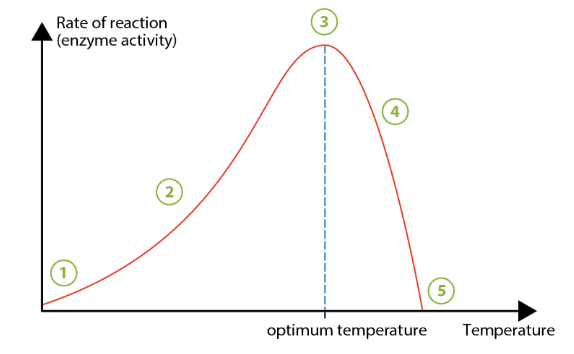
- Enzymes → less active at lower temperatures At low temperatures → kinetic energy of molecules is low → causing them to move more slowly Enzyme and substrate molecules → move slowly
- thus, rate of substrate molecules colliding with enzyme molecules is very low (rate of effective collision is very low)
- Very low rate of enzyme substrate complex formation
- As temperature increases, rate of enzyme reaction increases Increasing temperature → increasing kinetic energy of molecules → causing them to move more rapidly.
- rate of effective collision → increased
- increase rate of enzyme substrate complex formation
-
Optimum Temperature - where enzymes are most active Optimum temp. for humans → 40-45
-
Increasing temperature above optimum temperature causes rapid decrease in rate of enzyme reaction Beyond optimum temperature → Enzyme activity decreases.
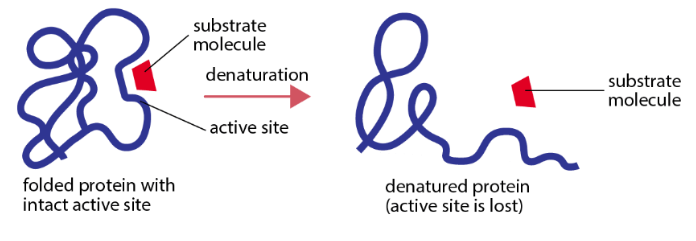
- high temperatures → breaks bonds within the enzyme and active site of enzyme molecule begins to lose its original shape
- Active site of the enzyme is no longer complementary to the shape of the substrate
- active site is no longer able to bind to the substrate.
- No formation of enzyme substrate complex, despite collision between substrate and enzyme molecules Enzyme is now denatured
- all enzyme molecules are denatured here
Definition
Denaturation is the change in 3D structure of the active site of an enzyme or any other soluble protein, caused by heat or chemicals such as acids and alkalis #BiologyDefinitions
substrate can no longer fit into active site. No enzyme substrate complex is formed. No reaction occurs. When enzyme denatured, no longer can act as a catalyst