Related to Structure of a Nephron
Ultrafiltration
first stage in urine formation is ultrafiltration.
Involves the following:
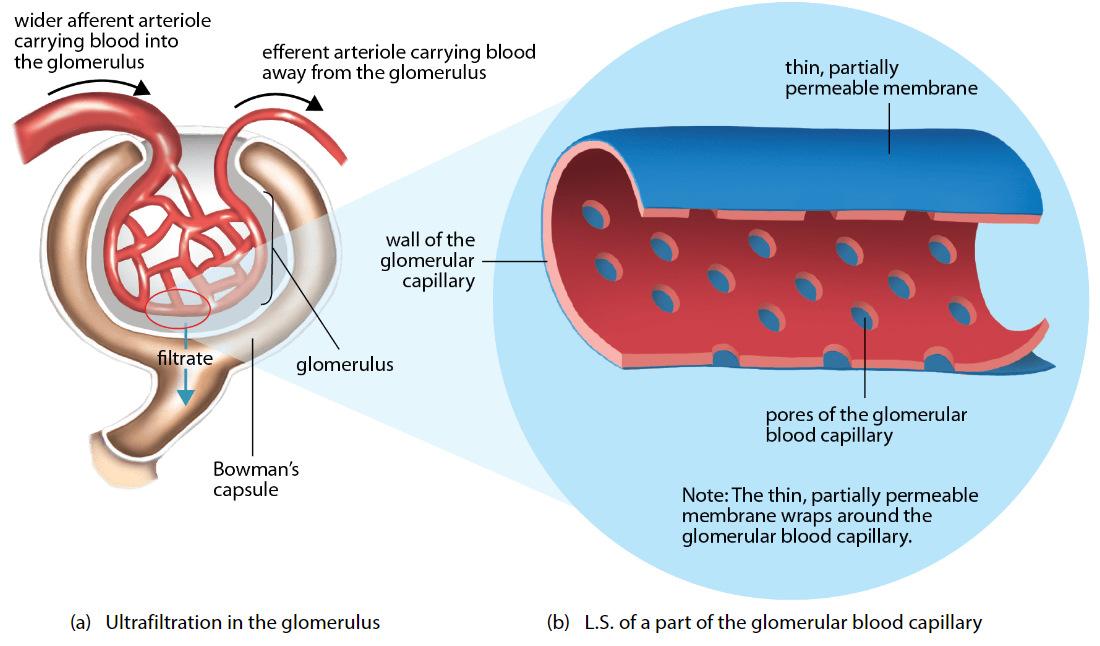
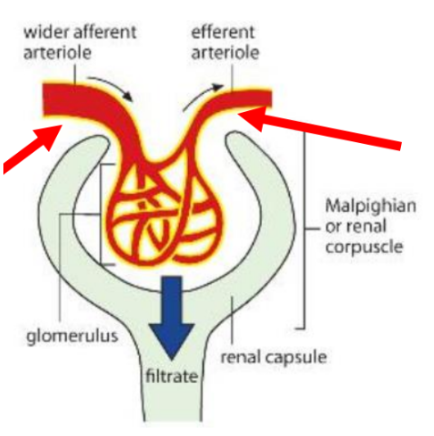
- afferent arteriole being wider than the efferent arteriole creates a high blood pressure in the glomerulus
- Blood plasma ⇒ is forced out of the glomerular filtrate. it contains small, soluble molecules (eg; Salts, water, glucose, amino acids, and waste products such as urea) that are forced into the Bowman’s capsule
Contraction of left ventricle causes ultrafiltration in the kidney tubule (high pressure generated)
How is the Glomerulus Suited to Urine Formation
- Glomerulus ⇒ is a knot or a network of blood capillaries encased in hollow cup shaped structures (Bowman’s capsule/Renal Capsule). They provide a large surface area for the filtration process.
- Blood capillaries have walls which are one cell thick. there are tiny pores on the capillary walls.
- provides a short diffusion distance for xxx xx xxx
- Blood capillaries are covered by a thin partially permeable membrane. It only allows very small soluble molecules or ions to pass through. it is impermeable to blood cells, platelets, and large molecules such as proteins
- Blood is under pressure, and the walls of the capillaries are partially permeable
- Filtrate contains water, urea, glucose, salts, amino acids and some vitamins
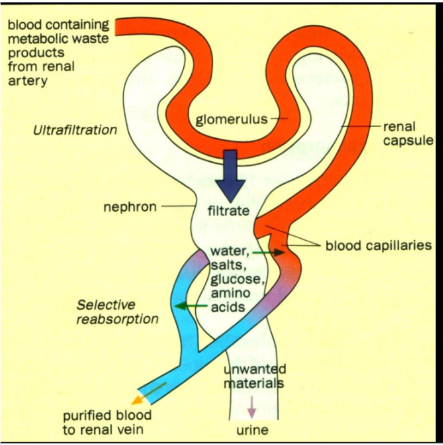
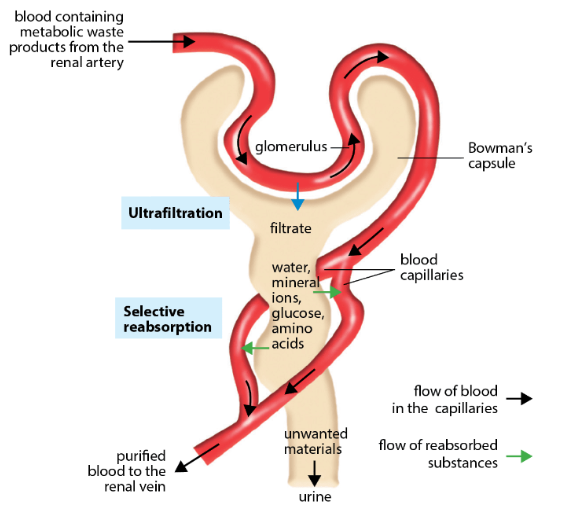
- Blood leaving glomerulus enters blood capillaries surrounding the tubule
- Blood capillaries unite to form a branch of the renal vein
Selective Reabsorption
Normal adult ⇒ about of glomerular filtrate is formed in the kidneys every minute ⇒ if this amount of filtrate were allowed to pass out as urine → the body would lose too much water and other useful substances. ⇒ body would soon become dehydrated
As glomelular filtrate passes along the nephron ⇒ useful substances are reabsorbed into the surrounding blood capillaries (via osmosis) ⇒ this process is called selective reabsorption → because only substances that the body requires are reabsorbed.
In this process, the following occurs:
- Most of the water is reabsorbed by osmosis
- Some salts are reabsorbed by active transport
- All the glucose and amino acids are reabsorbed by active transport Waste products ⇒ such as urea and excess water and mineral salts⇒ are passed out of the nephron as urine
| Process Step |
|---|
| Most fluid filtered will return back to the blood at the proximal convoluted tubule |
| Useful materials (glucose, amino acids, salts) diffused/actively transported back into the blood. |
| Almost 99% water reabsorbed by osmosis |
| Remaining unabsorbed materials ⇒ urine |
| Excess water, mineral salts, nitrogenous waste (eg; urea) → allowed to pass through tubule and into the collecting duct to the renal pelvis as urine |
| Antibiotics/drugs ⇒ remain in filtrate and eliminated in urine |
| Quick and easy way for drug testing |
| Some water is reabsorbed in loop of Henle, distal convoluted tubule, and collecting duct |
| Some salts are reabsorbed in the distal convoluted tubule |
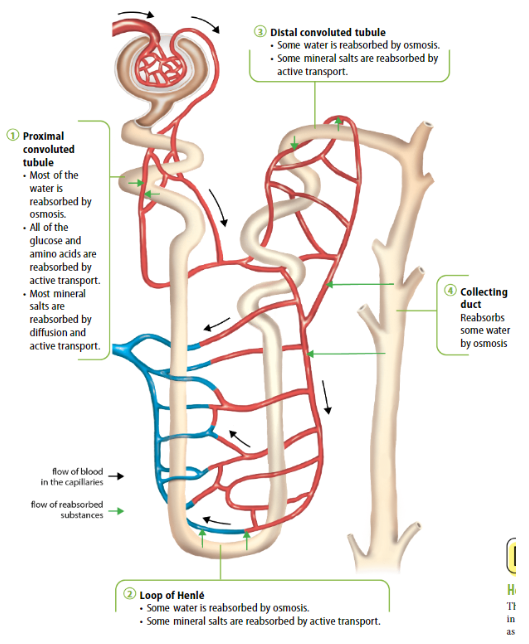
| Part | Elaboration |
|---|---|
| 1. Proximal convoluted tubule | - most of the water is reabsorbed by osmosis - All of the glucose and amino acids are reabsorbed by active transport - Most mineral salts are reabsorbed by diffusion and active transport |
| 2. Loop of Henle | - Some water is reabsorbed as osmosis - Some mineral salts are reabsorbed by active transport |
| 3. Distal convoluted tubule | - Some water is reaborbed by osmosis - Some mineral salts are reabsorbed by active transport |
| 4. Collecting Duct | - Removes some water by osmosis |
Important
for glomerulus → proteins too large to pass thru, amino acids pass thru and are selectively reabsorbed.
Important
Volume of liquids entering kidney = volume exiting kidney + volume of urine sent to urinary bladder in kidney, most of water is selectively reabsorbed, while small amount of water is released in urine. artery entering kidney → artery with full plasma load. vein → leaving kidney → with some water removed in kidneys.