19th century → Gregor Mendel → first explained how hereditary might work.
- carried out breeding experiments on garden pea plants.
first he experimented with plants with 1 pair of contrasting traits, such as:
- tallness and shortness of plant
- plants that either had red or white flowers
- plants which produced seeds that were either yellow or green, or round or wrinkled.
Mendel also used → pure bred varieties of pea plants.
- pure bred plants → are plants which when self pollinated → produce offspring (progeny) → that resemble their parent.
- e.g. when pure bred tall plants self fertilise, they produce only tall offspring
Mendel’s Monohybrid Experiments
| Step | Image |
|---|---|
| 1. In one experiment, Mendel crossed (cross pollinated) → tall pea plants with pollen from dwarf plants and vice versa | 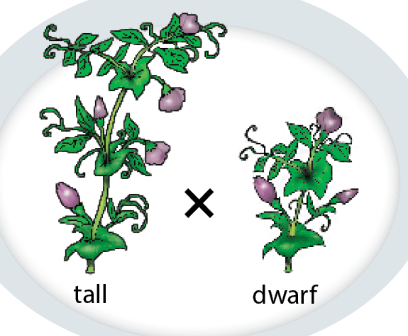 |
| 2. Mendel planted seeds from the cross and observed the traits of the resulting offspring → which were all tall. - Mendel called these offspring (first filial) generation. - generation only applies to the first generation offspring of a set of parents. | 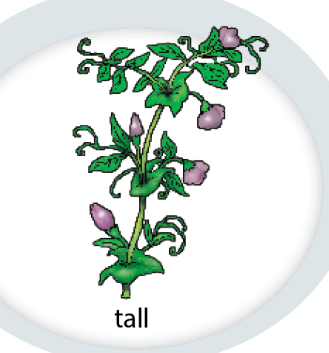 |
| 3. He allowed offspring → to self fertilise and produce seeds. - these seeds gave rise to the (second filial) generation. - in the generation → ratio of about 3 tall plants to 1 dwarf plant was observed. | 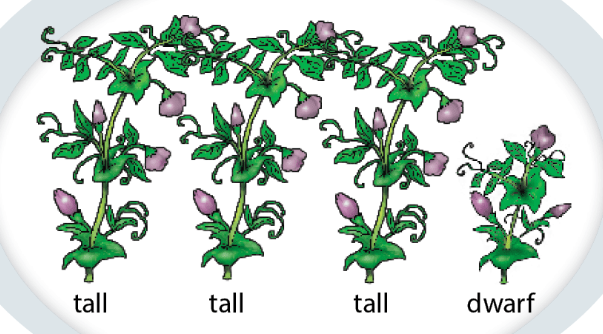 |
In all his experiments → Mendel observed → that 1 trait always appeared in offspring (long stems). Mendel called this trait dominant. The other trait (short stems) → seemed to disappear or recede Mendel called this trait recessive Recessive trait reappeared in about 1/4 of the total number of offspring
Mendel also made crosses using 6 other pairs of contrasting traits in pea plants. results of these crosses:
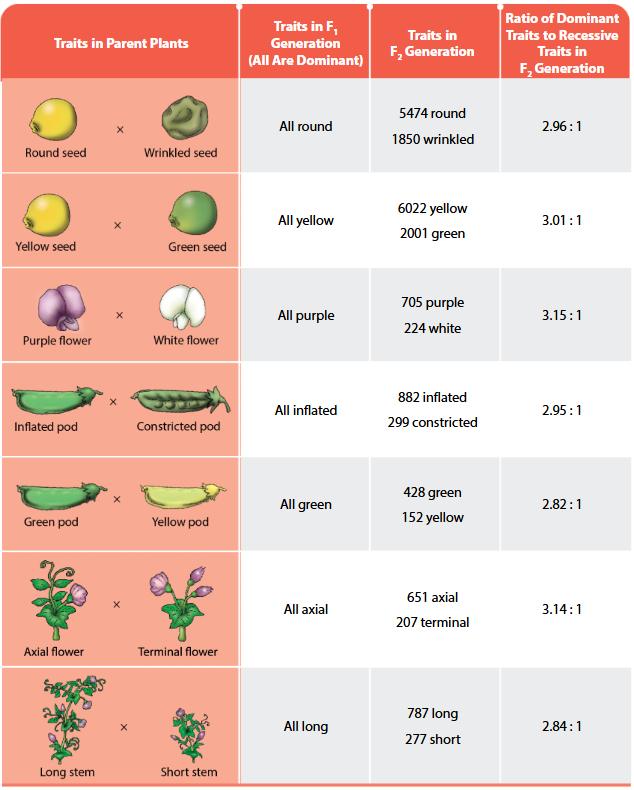
Why does observed ratio often differ from expected ratio
-
in above table → ratio in generation becomes closer to expected ratio of 3 : 1 → when larger number of plants are used in experiment.
-
If smaller number of plants are used → observed ratios for the generation are not accurate.
-
Statistically → ratios are often inaccurate when sample numbers are small.
-
Observed ratio is also based on change and probabilities → due to the random nature of fertilisation.
-
hence → actual number of offspring would be unlikely to match expected ratio precisely
Mendel’s Model of Hereditary
- hereditary factors are responsible → for the transmission of characteristics. These hereditary factors are now known as genes
Definition
Gene is a sequence of DNA nucleotides that control the formation of a single polypeptide. It is also a unit of inheritance. #BiologyDefinitions
-
each characteristic is controlled by a pair of factors in the cells of an organism.
- e.g. height of a pea plant → is controlled by a pair of factors. if the 2 factors differ, only the dominant 1 will show its effect.
- so if a pea plant contains 1 factor of tallness and one for dwarfness, only the tall factor will show its effect
-
the 2 factors → in each pair segregate (separate) → during gamete formation.
- each gamete will now contain only one factor. this is known as Mendel’s first law — Law of segregation
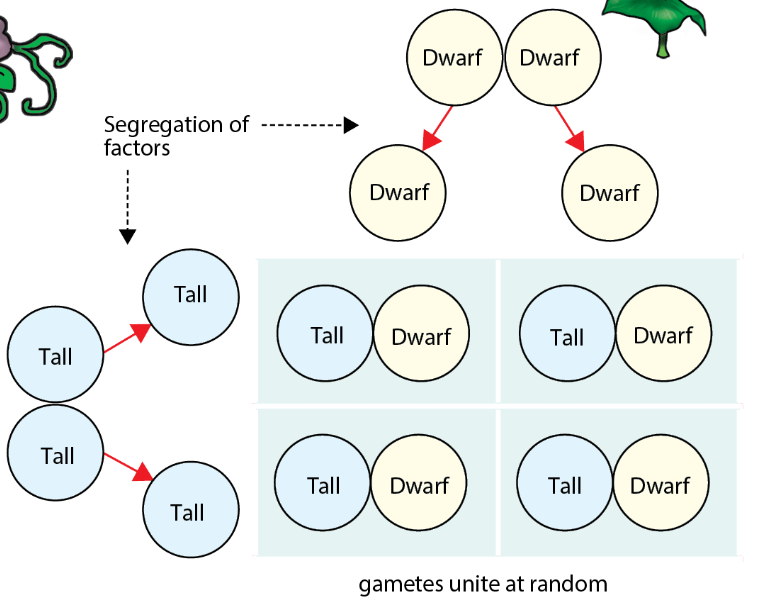
- each gamete will now contain only one factor. this is known as Mendel’s first law — Law of segregation
-
fusion of gametes → at fertilisation → restores the diploid concentration in the zygote → that is, the zygote contains 2 factors (one factor from each parent) ⇒ for a particular characteristic.
-
gametes unite at random → so that the ratio of characteristics among the offspring can be predicted.