What determines sequence/order of amino acids in the polypeptide or protein
There are 4 bases → A C G T → in DNA molecule
→ 3 Bases together make up a Codon
→ Each codon codes for one acid

Suppose DNA strand that determines production of polypeptide or protein has following sequence of codons → CGG CCA CAA TTT → sequence of amino acids in the protein will be: Arginine - Proline - Glutamine - Phenylalanine
However if sequence of Codons is CCA CGG TTT CAA Sequence of amino acids will be: Proline - Arginine - Phenylalanine - Glutamine
Hence showing how sequence of Bases in the DNA determines the sequence of amino acids in a polypeptide*** KEY POINT
- cell cannot directly use the DNA template to make protein
- protein synthesis is a 2 step process (Transcription and Translation)
- Transcription takes place in the nucleus while translation takes place in cytoplasm
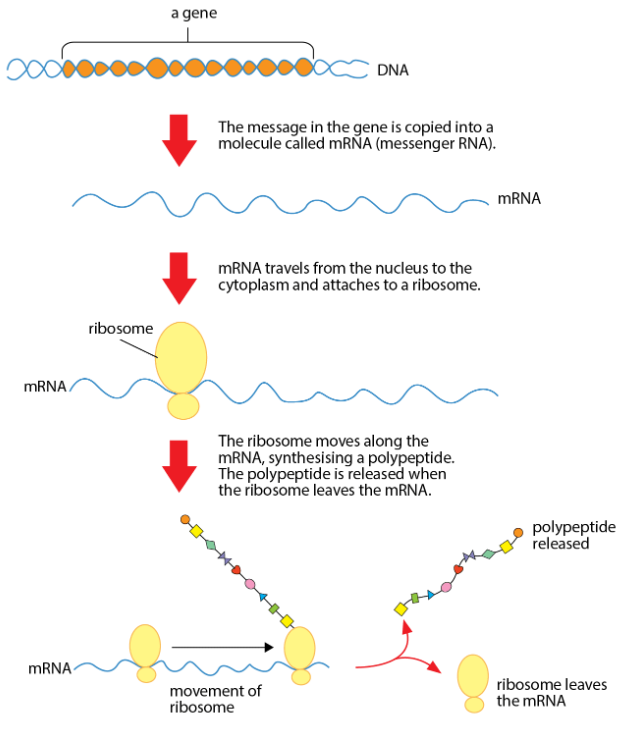
Steps(From Above Image)
- In the nucleus, the message in the gene is copied into an mRNA (messenger RNA) (transcription)
- mRNA travels to cytoplasm and attaches to a ribosome (preparation step for translation)
- As the ribosome moves along the mRNA, it synthesises a polypeptide (translation)
- When the ribosome leaves the mRNA, the polypeptide is released (end of translation, polypeptide is complete and will fold into protein)
Sample
Role of mRNA in protein synthesis
- has a base sequence complementary to that of gene (e.g. insulin)
- Transfers instructions / information from DNA (in the nucleus)to the ribosome in cytoplasm
- Acts as a template for ribosome to carry out translation
- sequence of bases on mRNA determine the order of amino acids on the translated polypeptide