Example: perfume
- Perfume - made up of particles like atoms, molecules, ions
- Individual perfume particles - evaporate from surface and become gas
- Gas particles have very high kinetic energy - constantly moving in all directions at high speeds - bump on top 1 another and move about randomly.
- Cause gas to spread throughout the house, until it reaches the nose.
Concentration Gradient and its Relation to Diffusion
Definition: Concentration gradient: difference in concentration between 2 regions. #BiologyDefinitions
- The steeper the concentration gradient, the faster the rate of diffusion.
- If more than 1 substance is dissolved in the same solvent, the dissolved particles of 1 substance will diffuse independently of the others.
Definition: diffusion is the net movement of particles (atoms, molecules, ions) from a region of higher concentration to a region of lower concentration down a concentration gradient. #BiologyDefinitions
**Diffusion explanation: (describe q)
- Particles of fluid (liquid/gas) → possess kinetic energy
- They are continuously moving about in random directions
- Movement is random → thus particles will move (diffuse) down the concentration gradient and become evenly spaced out after some time. → faster due to heat, particles gain more KE -move faster.
Diffusion: can also occur across a permeable membrane, but not a partially permeable membrane* Permeable membrane - allows both solvent and solute to pass through.
Factors Affecting Rate of Diffusion
-
Concentration gradient - already discussed above*
-
Surface area to Volume Ratio
-
Diffusion Distance
-
Diffusion distance
Time taken for substance to move from 1 point to another - depends on distance between the 2 points. (known as diffusion distance)
-
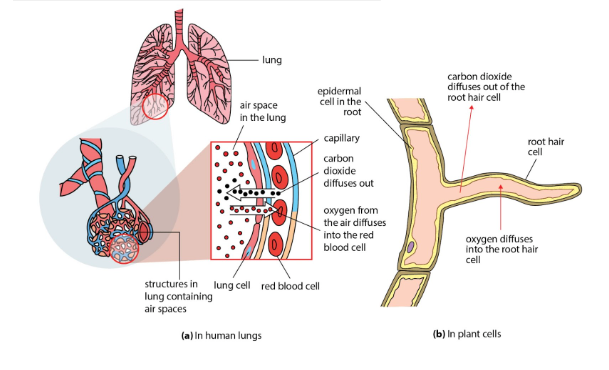
The shorter the diffusion distance, the less time is needed for the substance to travel. (ROD is higher) Diffusion - important way by which O2 and CO2 move in and out of a cell.
-
Diffusion in lungs and root hair cells
-
Diffusion distance is short - allowing faster rate of diffusion.
Note: solute can also diffuse
- Surface area to volume ratio
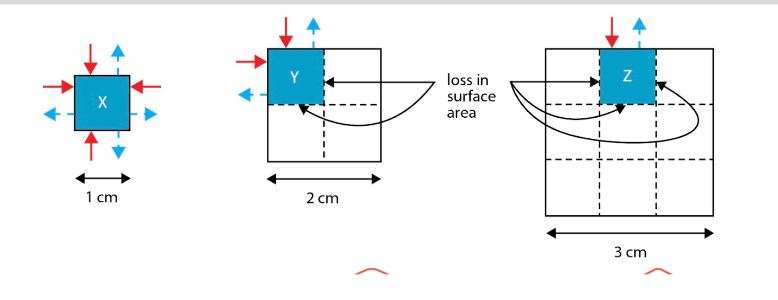
- Rate of movement of substances across cell membranes - depends on how large the cell membrane is.
- For 2 cells of the same volume - one with larger protoplasm allows higher ROD.
Greater surface area to volume ratio of cell - high rate at which substances move in and out of the cell.
as the cell continues to grow in size, growth slows down - stops once it reaches optimum size. Stops growing at optimum size because → when size increases, rate of oxygen and good intake slows down. Thus, it is not beneficial for cells to grow too big. (this is why cells are small) Refer to diagram from your notes*
The larger cell - has more surface area than smaller cell - but less surface area per unit volume of protoplasm compared to smaller cells. → The rate of intake of food and O2 per unit volume is slower in larger cells than smaller cells. How do cells adapt their surface area to volume ratio? Some cells → specifically adapted to absorb substances. Root hair cells, epithelial cells which line the small intestine. Such cells - have long narrow protrusions / folds in their membranes.
Greatly increases the SA to V ratio of cell membrane through which materials can be absorbed into the cell.