Person is looking at a distant object (estimated 7m or more)
-
Light rays reflecting off the object are almost parallel to each other when they reach the eye
-
These light rays → then refracted through the cornea and aqueous humour → into the pupil
-
lens becomes flatter
-
Smaller angle of refraction is needed to focus on retina
-
Ciliary muscles of ciliary body relax and suspensory ligaments are pulled tight, pulling edge of lens.
-
image is focused on fovea.
-
Since rays are almost parallel → lens needs to be thinner as only a smaller angle of refraction is needed.
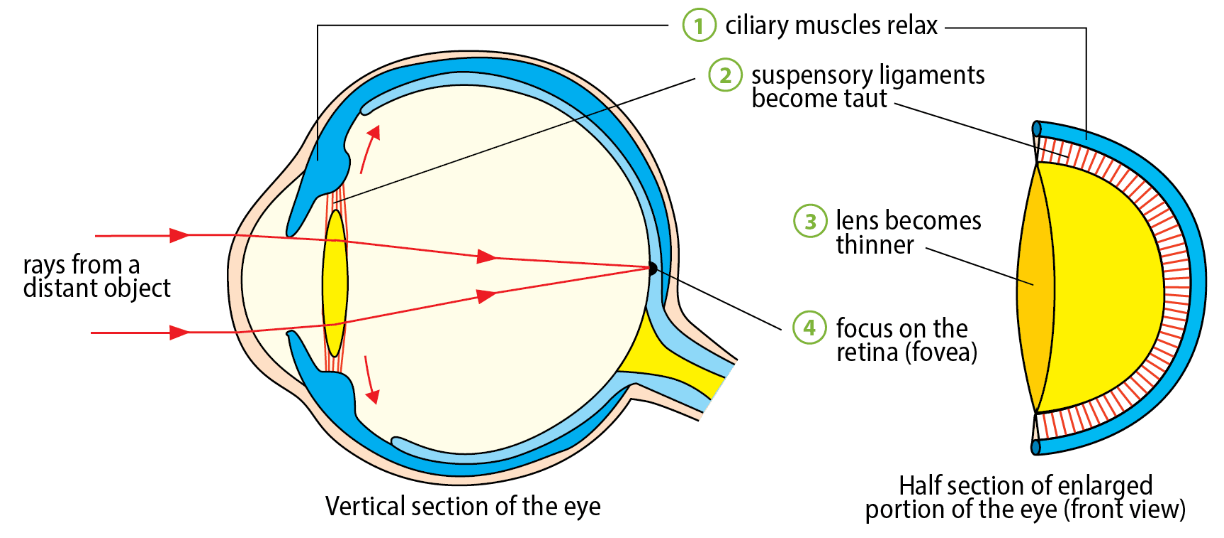
Following Changes occur in the eye when focusing on a distant object:
- Ciliary muscles relax, TIGHTENING THEIR PULL on the suspensory ligaments
- Suspensory ligaments become taut, pulling on the edge of the lens
- Lens → being elastic → becomes thinner and less convex, increasing its focal length. ^80344b (Focal length is the distance between middle of the lens and point of focus on retina)
- Light rays from the distant object → bend less → are sharply focused on the retina (fovea)
- Photoreceptors are stimulated
- Nerve impulses produced → transmitted by the optic nerve to the brain
- Brain interprets nerve impulses → and person sees distant object