When person is looking at near object (eg: when reading a book)
-
Diverging light rays reflecting off the near object are refracted through the cornea and the aqueous humour into the pupil.
-
Since Light rays reaching the eye are diverging → lens needs to be thicker (i.e. more convex) to bend the light rays more.
-
adjustment of lens of eye → so that clear images of objects at different distances are formed on retina.
-
When looking at close object → lens becomes rounder
-
rounded lens → refract light sharply → so image will focus onto retina
-
Ciliary muscles of ciliary body contracts
-
Suspensory ligaments and lens relaxes
-
Near point - object so close - lens can no longer contract and image formed will be blurred
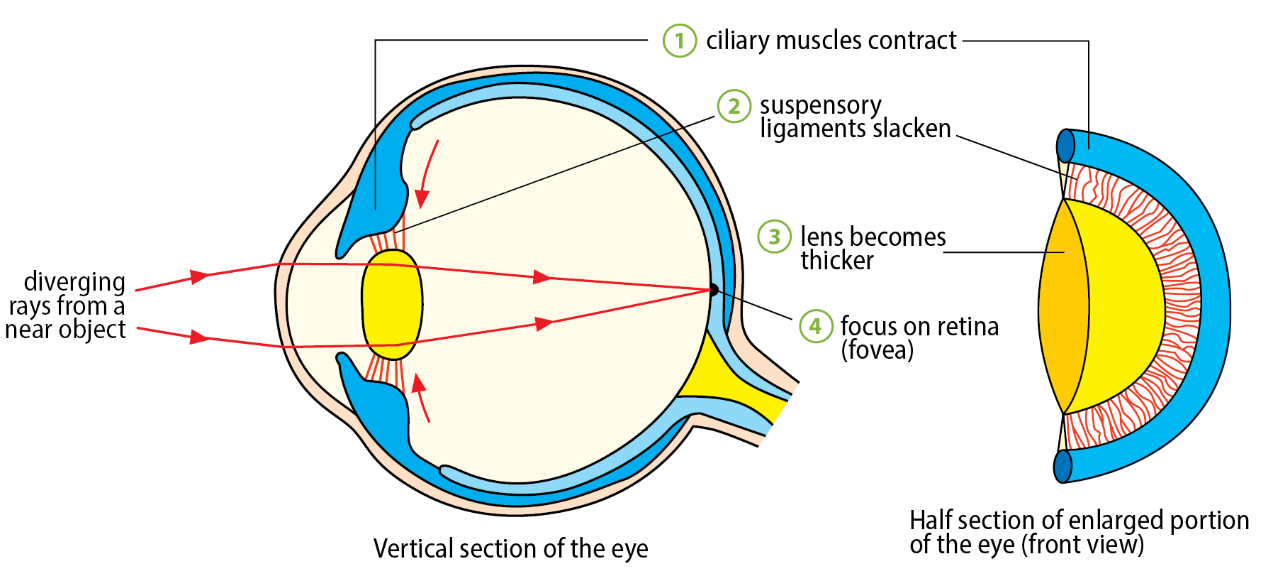
Following Changes occur in the eye when focusing on a near object:
- Ciliary muscles contract → relaxing their pull on the suspensory ligaments
- Suspensory ligaments slacken → relaxing their pull on the lens
- The lens → being elastic → becomes thicker and more convex, decreasing its focal length
- Light rays from the near object → bend more → are sharply focused on the retina (fovea)
- Photoreceptors are stimulated
- Nerve impulses produced → transmitted by the optic nerve to the brain
- Brain interprets the nerve impulses → and the person sees the near object