- Sense organ containing receptors for detecting light stimulus
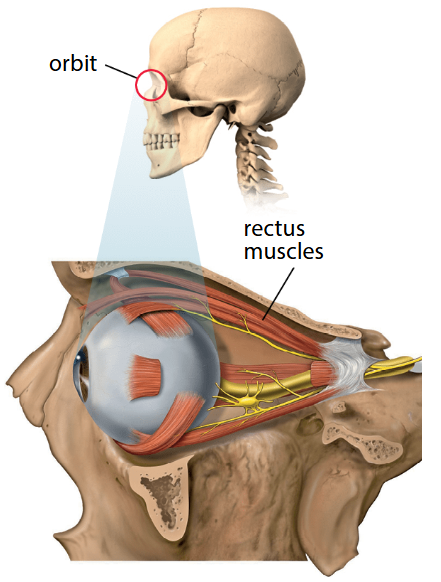
in Humans → each eyeball lies in a hollow in the skull called the orbit
Each eyeball is attached to the skull by the rectus muscles
the rectus muscles → control eye movement.
What Forms the External Structure of the Eye
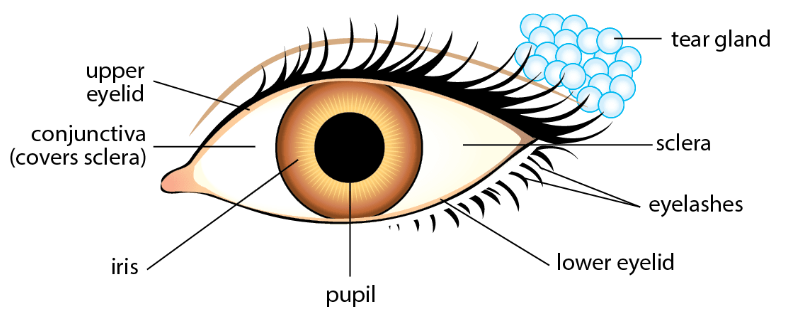
Front part of the eyeball is covered by eyelids.
→ only part of the eyeball can be seen.
| Part | Function |
|---|---|
| Sclera (or sclerotic coat) | → Tough, white outer covering of the eyeball. → It is continuous with the cornea → which is a dome shaped transparent layer at the front of the eye. It protects the eyeball from mechanical damage → Optic nerve is attached to the sclera at the very back of the eye |
| Conjuctiva | Thin transparent membrane covering the sclera in front. It is a mucous membrane. It secretes mucous, thus helping to keep the front of the eyeball moist |
| Eyelashes | Help to shield the eye from dust particles |
| Tear Gland | Lies at the corner of the upper eyelid. It Secretes tears that: - wash away dust particles - Keep the cornea moist for atmospheric oxygen to dissolve so that dissolved oxygen can diffuse into the cornea - Lubricate the conjunctiva, helping to reduce friction when the eyelids move |
| Eyelids | Protect cornea from mechanical damage. They can be partly closed → known as squinting → squinting prevents too much light from entering eyelid and damaging the retina Blinking spreads tears over the cornea and conjunctiva + wipes dust particles off the cornea |
| Iris | Iris is a circular sheet of muscles. → controls size of the pupils and therefore the amount of light entering the eye. → round opening in centre of iris is called the pupil → embedded with tiny muscles that dilate (widen) and constrict (narrow) the pupil size. → flat + divides front of the eye (anterior chamber) from back of the eye (posterior Chamber) → colour comes from microscopic pigment cells → called melanin. Colour, texture, patterns of each persons iris is as unique as fingerprint. |
| Pupil | Pupil is a hole in the centre of the iris. Allows light to enter the eye - size of pupil determines amount of light entering eye. → size controlled by dilator and sphincter muscles of iris. |