Made up of Following:
- Central nervous system (CNS) consisting of:
- brain
- spinal cord.
Understanding
Function of CNS: process and interpret sensory info, controls responses and decision making, coordinates body functions. (for understanding ONLY)
- Peripheral nervous system (PNS) consisting of:
- cranial nerves (from brain)
- spinal nerves (from the spinal chord)
- sense organs
Understanding
transmits signals between CNS and rest of body.
graph TD

Sense_Organs(Receptors) -->|nerve impulses transmitted by nerves| CNS
CNS --> |Nerve impulses transitted by nerves| Muscles(effectors)
Note
Nerves transmit or carry impulses from receptors to relay Neurones in the central nervous system and from there to the effectors.
Sense organs receive stimuli through receptors found in them.
- They inform central nervous system of any change in the surroundings, by producing electrical signals or messages → nerve impulses.
- These nerve impulses → carried or transmitted to the Central nervous system by nerves (cranial nerves and spinal nerves)
- Nerve impulse → transmitted → fraction of a second
Example: 1. when person touches your hand, you feel it almost immediately 2. In response to this stimulus, central nervous system will send nerve impulses to the muscles 3. The muscles will then effect an action. For example; muscles in hand might contract, and the hand is jerked away. Therefore, muscles are known as effectors
Nerves transmit nerve impulses from the receptors to the central nervous system, and from there to the effectors.
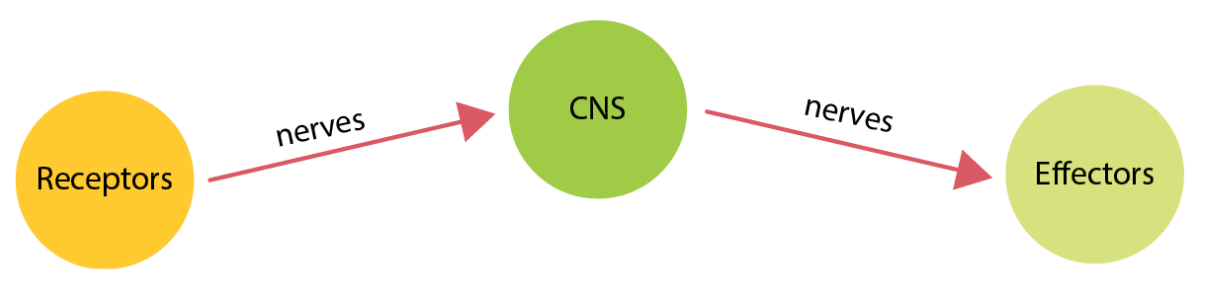 (nervous system is a device for gathering, transmitting, and interpreting information)