In ecosystem → energy does not flow in cycle
- Energy flow is non cyclical (linear)
Living organisms → cannot use heat to do work/ → can only use light and chemical energy
Energy in the form of light → has to be constantly supplied to ecosystem
- Sun is Principle source of energy input to biological systems.
- Sun provides energy in form of light
-
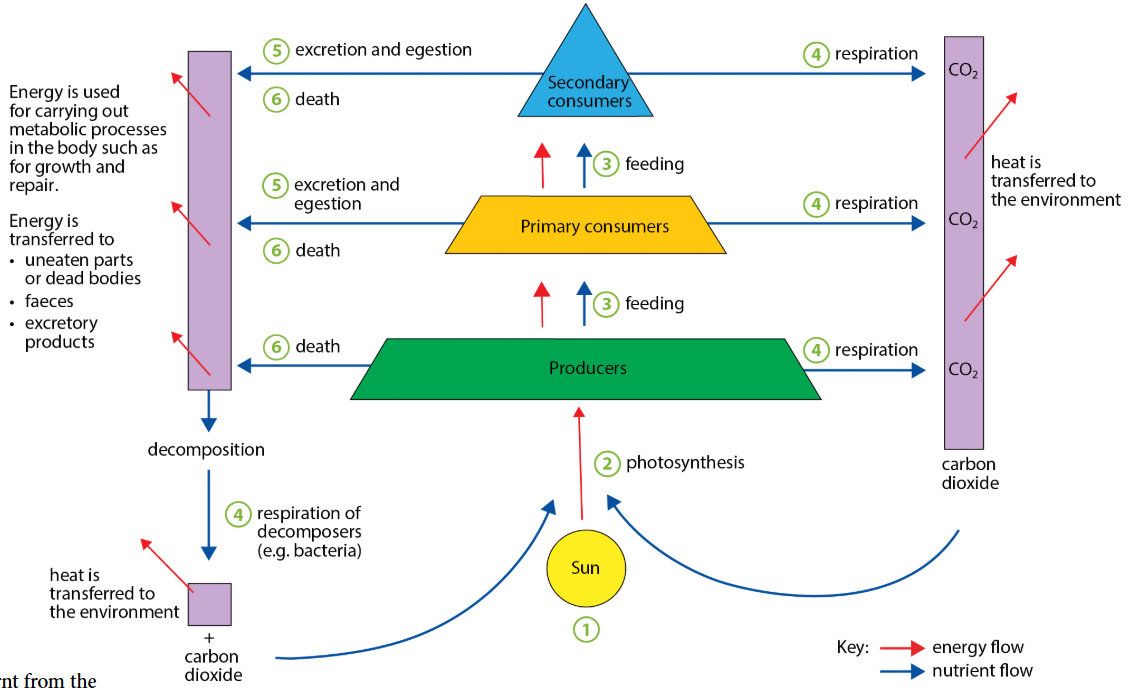
In any ecosystem → principal energy source → is sun
-
During Photosynthesis → energy from sun → absorbed by chlorophyll in producers → transferred to chemical stores of energy → in glucose molecules
-
Energy in producers → passed form 1 trophic level → to another by feeding
- Amount of energy at each trophic level → decreases → as it flows thru ecosystem
- Only some of the energy from one trophic level gets transferred to next level.
- Amount of energy at each trophic level → decreases → as it flows thru ecosystem
-
Rest of energy → largely transferred → to env. → as heat, through respiration.
- Since energy does not return to same system as organism that produced it → it cannot be recycled in ecosystem
- Thus flow of energy through ecosystem is non cyclical
5 and 6: egested and excreted materials and dead organisms → contain trapped chemical energy
- Energy is released through activity of decomposers
- Decomposers use some energy → for their needs.
- Rest of energy is transfered as heat to env.
Short Food Chains → more Efficient in Energy Transfer
-
Large amounts of energy → does not get passed from 1 trophic level to the next → as it lost to env. As heat / transferred to uneaten body parts / faeces and excretory products.
-
Less and less energy available → for organisms at next trophic level → as we move along food chain.
- Thus food chains are short
-
Shorter the food chain → the more the amount of energy available to final consumer → because less energy is transferred to env.
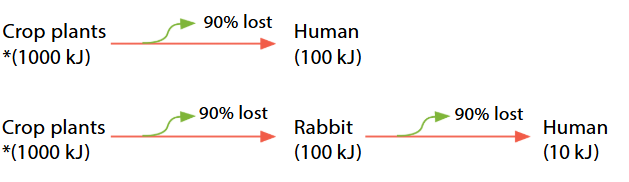
Why do Food Chains have Fewer than 5 trophic levels
- Energy transfer along food chains → inefficient.
- About 90% of energy is lost from 1 trophic level to next
→ energy is transferred to uneaten body parts, faeces, excretory products → energy is also transferred to environment as heat → during respiration
- Thus there is insufficient energy → to support long food chain
Predatory Prey Relationship
Predator - animal that feeds on another animal Prey - animal that is eaten by another animal
fluctuation in population of predators and prey:
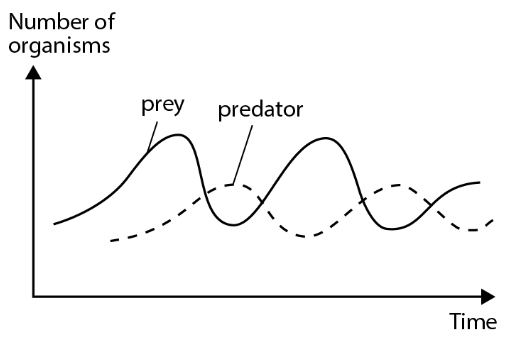
Increase in population size of prey → more food is available for predators → leads to increase in number of population → this causes decrease in population size of prey. → this in turn results in inevitable decrease in population of predators → less food is available. → Decrease in number of predators → increase in number of prey cycle repeats
Cycle of predator prey relationship → repeats over time Increase and decrease in population of predators → follow corresponding increase and decrease in population of prey
- Average size of population of prey → is larger than that of predator
Predation → plays important role in regulating natural populations
Ecosystem → uses both energy and inorganic nutrients
- Energy enters ecosystem → in form of light and heat from sun
- Light from sun → transferred to chemical stores of energy in glucose molecules
- Energy is then transferred from organism to organism → through ecosystem
- Energy that is transferred to env → cannot be recycle.
- Hence energy has to be constantly supplied to ecosystem (thru sun)
Inorganic nutrients → such as carbon / nitrogen → need not be supplied from outside ecosystem
- Obtained from env → and they flow through ecosystem in cycle.
- Thus in balanced ecosystem → nutrients are not lost as they are continually recycled