E.g.
- Grass flowers - usually small and grouped in inflorescences which are dull coloured, scentless, and without nectar
- Grass flowers → usually enclosed + protected → by leaf like structures → called bracts or scales
Structure of Ischaemum Muticum Flower
- grass flower of ischaemum miticum
- specially adapted for cross pollination by wind
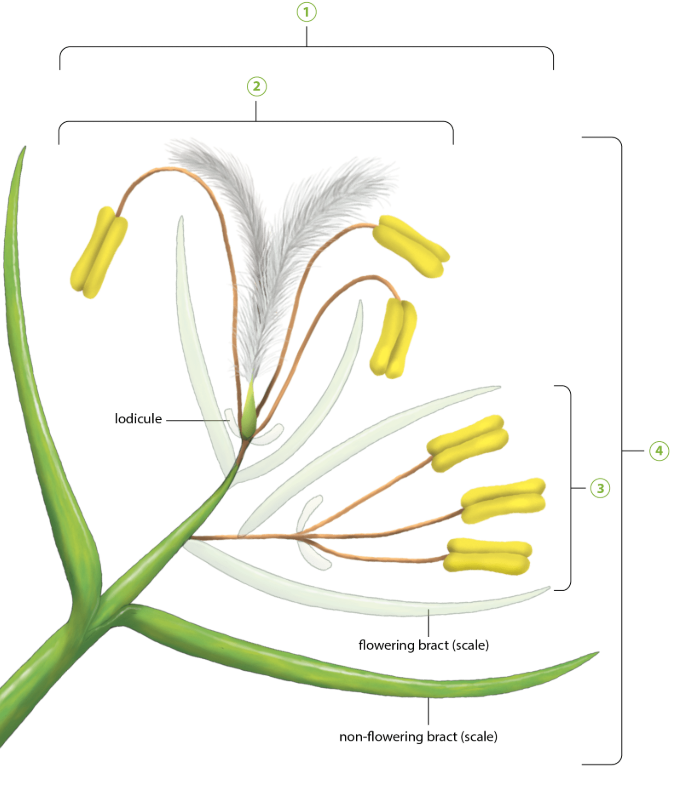
- Pair of Flowers
- Flowers occur in pairs.
- Each flower → enclosed by 2 transparent flowering bracts
- Upper flower (bisexual)
- Upper flower is bisexual
- Consists of ovary with 2 long feathery stigmas, 3 stamens, 2 tiny structures called lodicules at base of ovary
- When ischaemum miticum is ready to reproduce → lodicules swell → force 2 flowering bracts slightly apart
- allows stigmas and anthers to emerge
- Lower flower (male)
- Lower flower is unisexual
- Consists only of 3 stamens with long filaments and 2 lodicules
- therefore it is male
- It has pendulous filaments.
- delicate filaments protrude out of bracts → exposing to wind
- Spikelet
- Each pair of flowers, together with short stalk → forms a spikelet
- At base of each spikelet → there is a pair of empty or non flowering bracts.
- they protect 2 flowers in the spikelet
A few pairs of spikelets make up an inflorescence
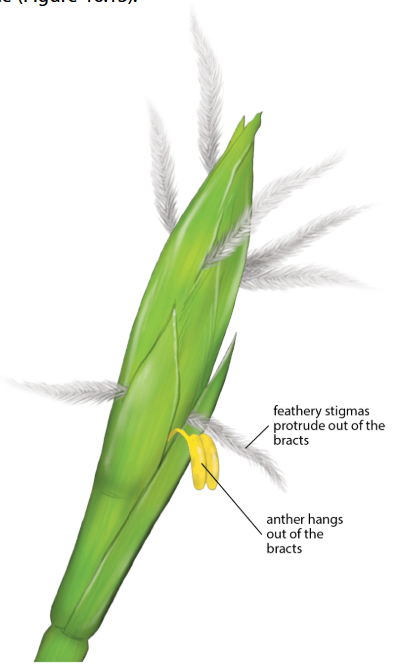
Pollination of Ischaemum Muticum
- stamens have long pendulous filaments
- filaments + anthers protrude out of bracts, exposing to wind
- when filaments sway in wind → dust like pollen is shaken free and dispersed by wind
- stigmas are large, extended, and feathery. mature stigmas project out of bracts. there is larger surface area exposed to air for receiving pollen.