Definition
Atom is the smallest particle that can still have the chemical characteristics of an element #ChemistryDefinitions
Gold and iron - are both metals
- Gold is not very reactive + shiny yellow appearance
- Iron can rust and looks silvery.
Nucleus and electrons are attracted to each other.
Subatomic particles:
- Protons
- Neutrons
- Electrons
(protons and neutrons are grouped together in the center of the atom - the nucleus. They are HEAVIER particles)
Protons + neutrons - collectively known as nucleons Electrons → lighter particles found in electron shells. They are spaced further apart from the center of the atom.
- Chemical reactions involve ONLY ELECTRONS
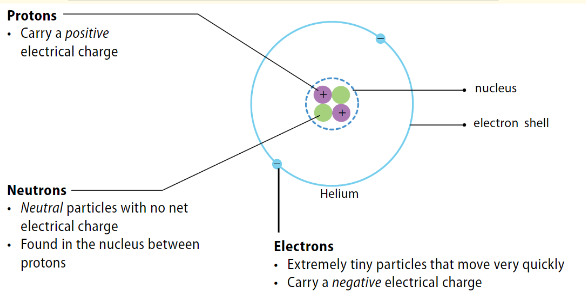 Radius of atom - approx. at least 100000 times larger than the radius of its nucleus.
Atoms are electrically neutral
- number of protons = number of electrons
- total charge of electrons cancels out total charge of protons exactly
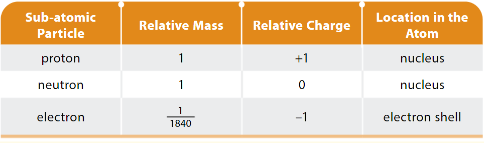 Mass of electrons are said to be negligible
if there are 8 electrons in valence shell and it is the maximum capacity of the valence shell - stable octet configuration if there are 2 electrons in valence shell and it is the maximum capacity of the valence shell - stable duplet configuration
Exam Skills Why are these 2 atoms chemically similar they have same number of electrons which is since chemical reactions involve only electrons, not neutrons or protons, these atoms have similar chemical properties.
How many subatomic particles does an atom have? Proton number(atomic number) → no. of protons in nucleus Nucleon number → total number of protons and neutrons in the nucleus ⇒ also known as mass number - as mass mainly comes from the number of protons and neutrons.
Nuclide notation X → atomic symbol of element Z → proton (atomic) number A → nucleon (mass) number
Ions
Definition
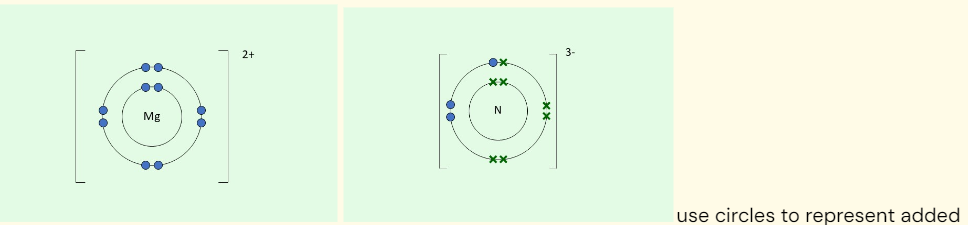
ion is the charged particle formed when an atom or group of atoms gains or loses electrons, but the number of protons and neutrons remain the same. #ChemistryDefinitions
When atoms gain or lose electrons, charged particle is formed
Metals form positive ions (cations) → remove electrons
Non metals form negative ions (anions) → add electrons
(either remove all valence electrons or fully fill valence shell)
Group 18 gasses - noble gasses
- unreactive → already have fully filled valence shells, no ion is formed.
Note: grp. number → number of electrons in valence shell. period number → number of electron shells.
Answering Technique
- whenever relating protons to electrons or describing the atom → always state ‘since atom is electrically neutral’
Isotopes
- Number of protons are fixed for all atoms of a given element
- However, number of neutrons can vary
Definition
Isotopes are atoms of the same element that have the same proton (atomic) number, but different mass (nucleon) numbers. This means that they have a different number of neutrons. #ChemistryDefinitions
Most elements exist naturally as isotopes. Can be represented in nuclide notation as well* Isotopes have the same number of protons and electrons as before
Radioactive Isotopes
- unstable forms of element → release radiation when they break down to become more stable
Properties of Isotopes
- physical properties are affected (eg; melting points are different)
- chemical properties are NOT affected → as number of electrons are still the same (isotopes can still form ions)
Distribution of subatomic particles
Electron shells and energy levels:
- Electrons in innermost shell → closest to nucleus have the lowest energy
- Electrons in valence shell - farthest from nucleus have highest energy
If valence shell is not full - atom is reactive - will participate in chemical reactions When valence shell is full, atom is stable → unreactive (inert)
What is relative atomic mass?
- Average mass of one atom as compared to 1/12 of the mass of a carbon-12 atom
How to find out relative atomic mass?
- Formula for relative atomic mass: ∑ isotope mass x isotope abundance / 100
Answering Techniques
when stating why the ion is positively/negatively charged, compare protons to electrons. Eg: 2 more protons than electrons, thus overall charge is now 2+.
Noble gasses are monatomic gasses. Explain why noble gas atoms do not form bonds with one another. (unreactive, inert) Noble gasses already have either the stable duplet or stable octet electronic configuration; they have the maximum number of electrons in the valence shell. Thus, atoms of a noble gas do not need to lose, gain, or share electrons with another atom through a reaction to achieve a stable electronic configuration. Thus, these atoms will not form bonds with other atoms.