Characteristics of Exothermic Change
Definition
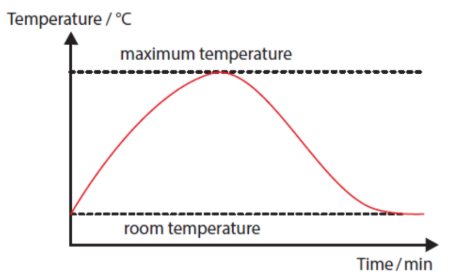
Exothermic Change is when thermal energy is given out to surroundings, leading to increase in temperature of surroundings. #ChemistryDefinitions
- Energy (form of heat and light) releases/given out to the surroundings
- Hence temperature of reaction mixture increases. Container holding reaction mixture feels warmer to touch
Important
Reactants have more energy than the products. There is less energy taken in to break the initial bonds compared to the energy released to form new bonds. Thus there is a negative enthalpy change, as there is net transfer of (thermal) energy from the system to the surroundings.
examples of exothermic changes
| Chemical Reaction | Physical Process |
|---|---|
| - Neutralisation - Combustion - Respiration | - Freezing - Condensation - Deposition of gas to solid (opp. of sublimation) - Dissolution of acids and alkalis in water |
| More Examples of Physical Changes that are exothermic |
|---|
| Dissolving soluble bases (Bases) and sodium carbonate in water. (recall solubility rule of bases) |
| Dissolving concentrated acids in water |
Characteristics of Endothermic Changes
Definition
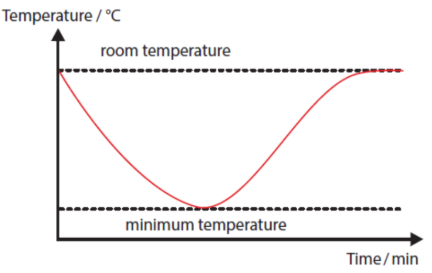
Endothermic Change is when thermal energy is taken in from the surroundings, leading to a decrease in temperature of surroundings. #ChemistryDefinitions
- Energy (often in form of heat and light) → is absorbed/taken in → from the surroundings
- Hence temperature of surroundings decreases.
- Container holding reaction mixture → feels cooler to touch. (Your hand is also part of surroundings)
Important
Reactants have less energy than the Products. There is more energy taken in to break the initial bonds. compared to energy released to form new bonds. Thus there is a positive enthalpy change, as there is net (thermal) energy transfer from the surroundings to the system
examples of endothermic changes
| Chemical Reaction | Physical Process |
|---|---|
| - Thermal Decomposition - Electrolysis of water - Photosynthesis | - Boiling of liquid to gas - Melting of solid to liquid - Evaporation from liquid to gas - Sublimation of solid to gas - dissolution of some ionic compounds in water (e.g. sodium chloride, ammonium chloride and barium nitrate) |
Reaction Phases
In chemical reaction → there are usually 2 reaction phases - bond breaking and bond making
- conversion of reactants into products in chemical reaction → first involves the breaking of bonds in the reactants
- this is followed by making of bonds between the particles to form the products.
→ Bond breaking - absorbs energy → Bond making - releases energy (usually in form of thermal energy)
Note
- usually all bonds need to be broken. example case: N2 + 2O2 → 2NO2
- in O2 they exist as double bonds but NO2 they exist as single bonds
- thus all need to be broken not just N2.
Bond Energy
Definition
Bond energy is the amount of energy absorbed to break one mole of a chemical (covalent) bond. It is also the amount of energy released when one mole of that bond is formed.
- heat must be absorbed from surrounding to break bond between 2 atoms in a molecule → thus bond breaking is endothermic
- Heat is released to the surroundings when a covalent bond is formed between the 2 atoms → thus bond making is exothermic. each chemical bond has a specific bond energy associated with it*
Multiple bonds are stronger than single bonds. However double bonds are not exactly twice as strong as single bonds between the same atoms.
Activation Energy
Substances do not always react spontaneously when mixed (non spontaneous reaction)
- this is because reactants need to have enough energy before they can start reacting
Definition
Activation energy is the minimum amount of energy that colliding reactant particles must possess to react with each other
Key
bonds must be broken before new ones can be made. hence reactants must possess certain amount of energy before reaction can begin
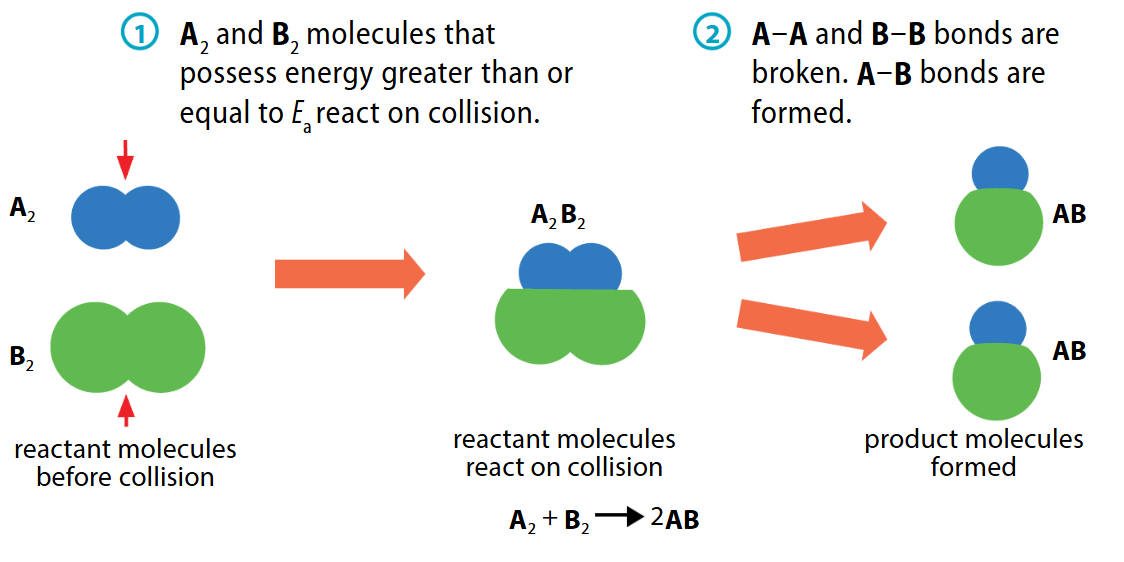
When reactant particles with sufficient energy (i.e. energy greater than or equal to activation energy) collide → they are able to break their bonds to form new bonds
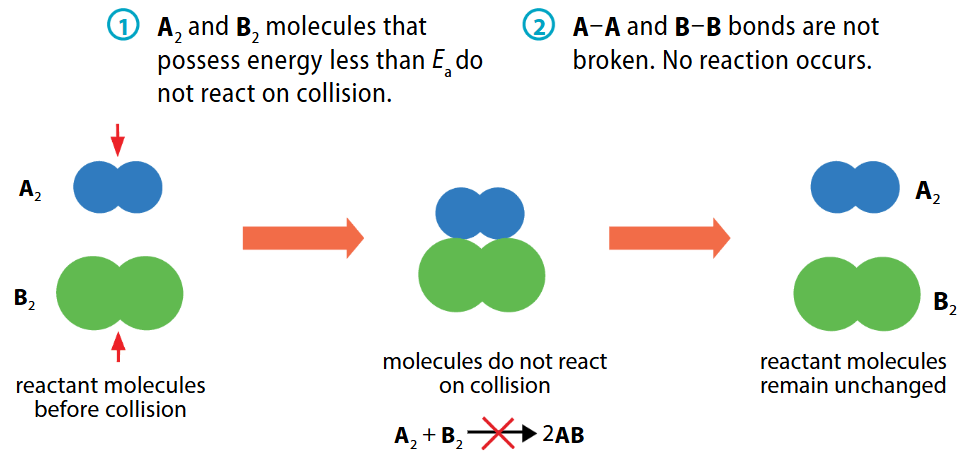
When reactant particles with insufficient energy (i.e. energy less than activation energy) collide → they are unable to break bonds. Hence no chemical reaction occurs.