- Device which uses chemical reactions to generate electricity. Energy conversion:
- chemical energy → electrical energy
battery is made up of simple cells. chemical reactions occurring in simple cells produce electricity → which is used to drive non spontaneous redox reactions in electrolytic cells. thus battery is not found in the set up of simple cell.
Parts of Simple Cell
- bulb/voltmeter
- negative electrode (anode)
- similar to negative terminal of battery
- more reactive metal electrode
- positive electrode (cathode)
- similar to positive terminal of battery
- less reactive metal electrode
- connecting wires (connect bulb/voltmeter to anode and cathode)
- electrolyte (3 common types)
- aqueous solution of compounds of grp 1 metals (salt solution of grp 1 metals)
- aqueous solution of the compound of the less reactive metal which is used to make cathode (e.g. salt solution of less reactive metal)
- dilute acids
Unlike electrolytic cell → negative electrode in a simple cell is the anode, while the positive electrode is the cathode. like electrolytic cell → reduction takes place at cathode and oxidation takes place at anode.
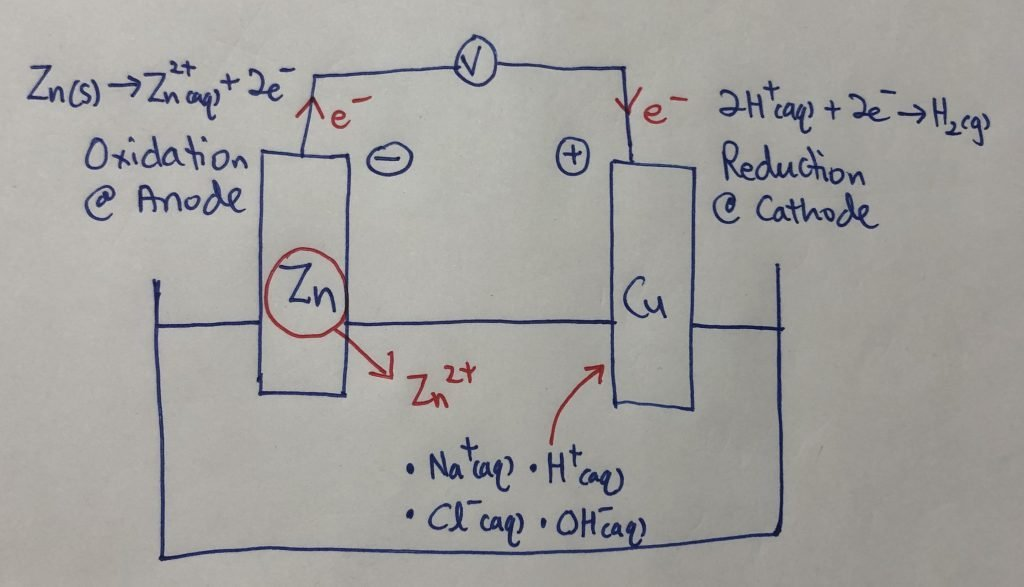
In order for simple cells to generate electricity, there must be a difference in reactivity of metals used to make anode and cathode
- greater the difference in reactivity between the 2 metal electrodes → the greater the potential difference (or voltage) produced in simple cell
- → the greater the amt of electricity generated and the brighter the bulb
Why is anode the more reactive metal electrode (negative electrode)
- more reactive metal loses electrons more readily → to form positive ions → than less reactive metal
- thus more reactive metal electrode → is anode → as oxidation occurs at anode
- since negative charged electrons produced at anode → it is the negative electrode
Why is cathode less reactive metal electrode (positive electrode)
- negatively charged electrons produced → will flow from negative to positive. since electrons are produced at anode → the anode is the negative electrode → while cathode is positive electrode
- electrons will flow thru external circuit → from the more reactive metal electrode (anode: site of oxidation) to the less reactive metal electrode → where it will be involved in the reduction of cations. thus less reactive metal is the cathode as cathode is the site of reduction
Concept of Selective discharge of cations still applies
- as cations are reduced at cathode
Concept of selective discharge of anions does not apply
- as anode → which is reactive electrode → will undergo oxidation instead of anions
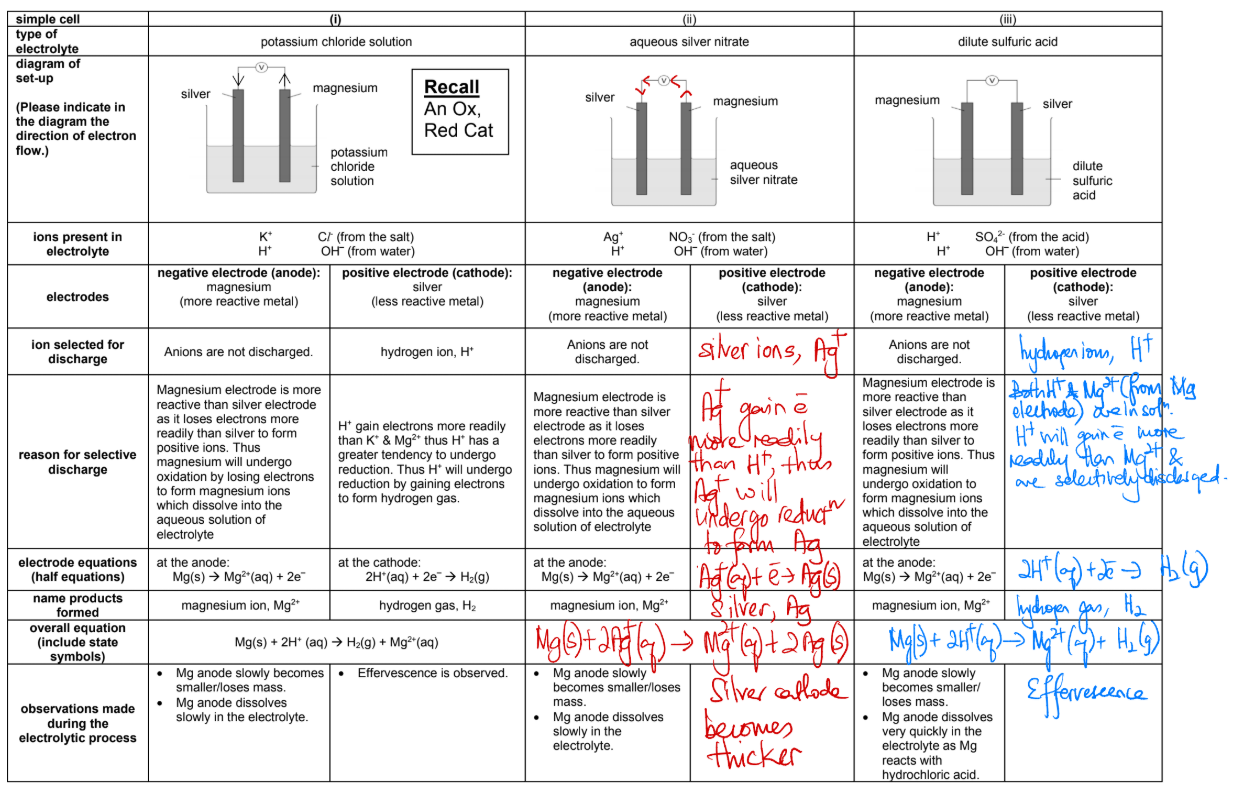
Comparison of 3 simple cells which have diff electrolytes
- potassium chloride solution
- aqueous silver nitrate
- dilute sulfuric acid → these cells used magnesium and silver electrodes
Batteries
| Advantages | Disadvantages |
|---|---|
| portable source of electrical energy and can be used in places where there is no connection to power supply from the mains | expensive |