Alkanes do not have a functional group → thus they are not as reactive as other homologous series.
Alkanes are generally unreactive → as they consist only of strong carbon-carbon single bonds (C-C) and strong Carbon-Hydrogen (C-H) bonds
- These bonds are hard to break
→ however still able to undergo following reactions.
- react with reactive non metals such as oxygen gas / halogens under certain conditions.
Combustion
when there is source of ignition → e.g. spark or flame → alkanes can undergo combustion
i) Complete Combustion of Alkanes Alkanes burn in excess oxygen to produce carbon dioxide and water.
- reactants: alkanes (fuel) and oxygen gas
- condition: excess supply of oxygen
Equation
E.g. butane burns in excess oxygen:
butane + oxygen → carbon dioxide + water
ii) Incomplete Combustion of Alkanes when there is insufficient oxygen → incomplete combustion takes place instead of carbon dioxide → carbon monoxide and soot are formed.
- reactants: alkanes (fuel) and oxygen gas
- condition: insufficient / limited supply of oxygen
Equation
E.g. butane burns in insufficient oxygen: butane + oxygen → carbon monoxide + carbon + water
General Word Equation: Alkane + Oxygen gas → carbon monoxide gas + water OR Alkane + Oxygen gas → carbon monoxide gas + water + soot
During incomplete combustion → some of the alkanes might not undergo combustion → resulting in release of unburnt hydrocarbons to env.
Substitution Reactions
alkanes react with halogens → such as chlorine and bromine → in the presence of UV light
-
called substitution reactions
-
1 hydrogen atom of an alkane (or halogenoalkane) is/are replaced with 1 halogen atom in the presence of UV light.
Reactants: alkanes (fuel) and halogens such as chlorine/bromine (in gasoue state) Condition: presence of UV light.
General Equations
i) Alkane + Halogen → halogenoalkane + hydrogen halide
Equation
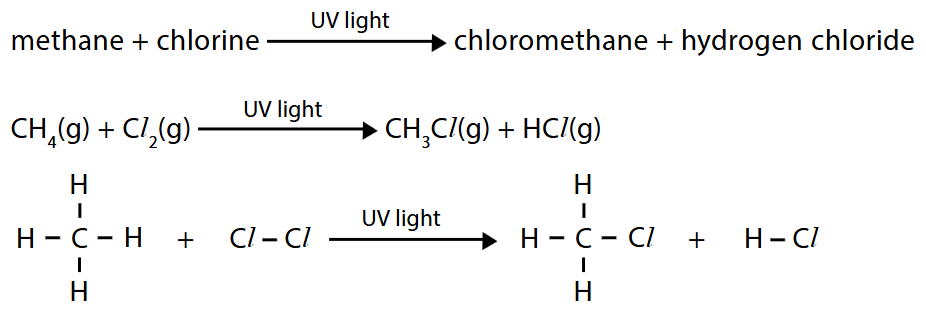
in this reaction → hydrogen is substituted by chlorine atom to form chloromethane. hence reaction is called substitution reaction hydrogen chloride is also produced.
ii) Halogenoalkane + halogen → halogenoalkane + hydrogen halide
Equation

More hydrogen atoms can be replaced with chlorine atoms to form other compounds such as dichloromethane.
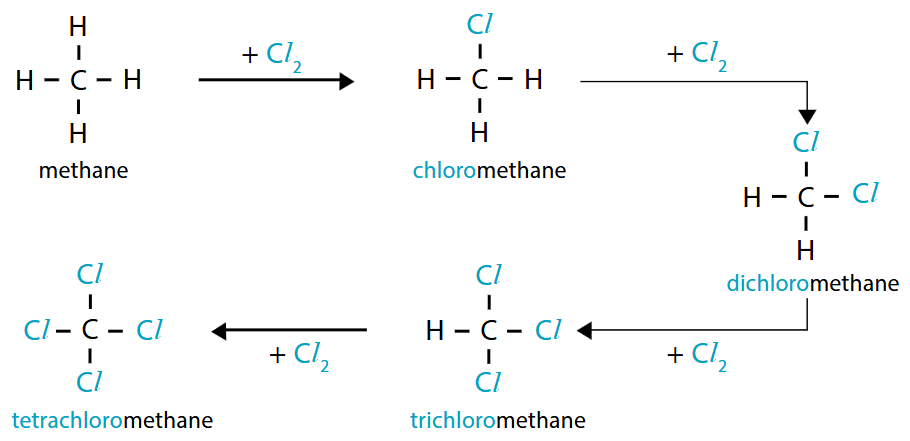
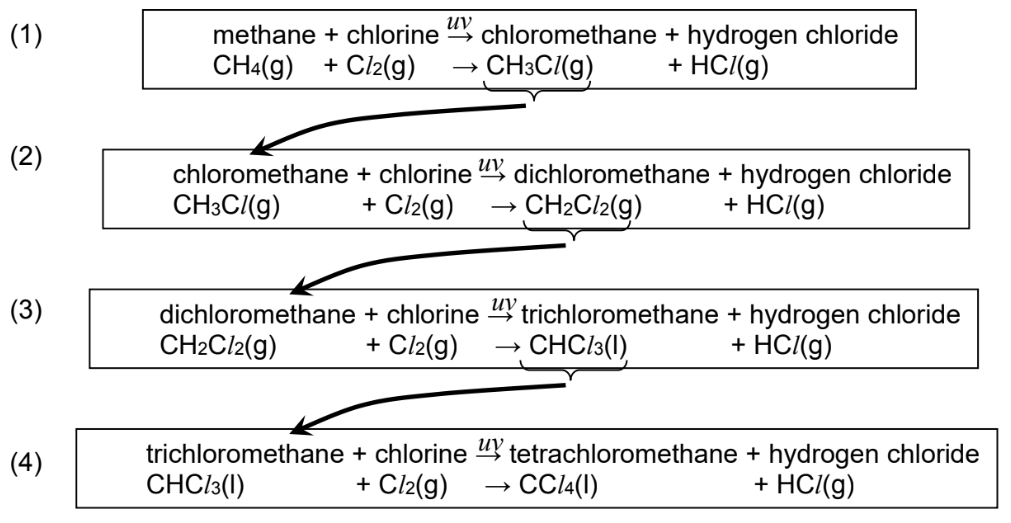
Halogenoalkanes such as tetrachloromethane, an organic solvent, cannot be produced from a single substitution reaction of methane
- 4 successive substitution reactions must take place to produce from
like chlorine, bromine reacts in similar way with alkanes but reaction is extremely slow
- this is because bromine is a less reactive halogen compared to chlorine.