/___ Carbon-12: is taken as the standard atom. all other atoms are compared with this standard atom.
Relative Atomic Mass
Definition
Relative Atomic Mass of an element is the average mass of one atom of that element relative to the mass of an atom of carbon-12 #ChemistryDefinitions
Relative Atomic Mass =
Relative Atomic Mass is represented by and has NO unit (found in periodic table)
Calculating Relative Atomic Mass of elements with Isotopes
some elements found in nature as a mixture of isotopes ⇒ with different atomic masses
thus relative atomic mass if determined by the average atomic mass of the isotopes.
Eg: relative atomic mass of chlorine ⇒ given in decimal form. → this is because there are only 2 stable isotopes of chlorine - chlorine 35 and chorine 37 sample of chlorine usually has 75% chlorine-35 and 25% chlorine-37
Relative atomic mass of chlorine → (75/100 * 35) + (25/100 * 37) = 35.5
Relative Molecular Mass
Definition
Relative molecular mass, of a molecular substance is the average mass of one molecule of that substance relative to the mass of an atom of carbon-12 #ChemistryDefinitions
Relative molecular mass of covalent substance =
Relative molecular mass is represented by and has NO unit
To find relative molecular mass of a substance, we add together the relative atomic mass of all the atoms in its chemical formula. Example:
- ⇒ = (1 14) + (3 1) = 17
Relative Formula Mass Ionic compounds do not exist as molecules (they are made up of cations and anions) we use the term relative formula mass to refer to the relative mass of an ionic compound.
Definition
Relative formula mass of an ionic compound is the average mass of 1 unit of that compound relative to the mass of an atom of carbon-12 #ChemistryDefinitions
⇒ relative formula mass of ionic compound is also represented by and has NO unit ⇒ calculated in the same way as relative molecular mass.
*Applications of and
- relationship between (or ) and the rate of diffusion of a gas.
- As the (Or ) of a gas increases, its rate of diffusion decreases (some gasses exist as atoms, eg noble gasses)
2 types of experiments that can be conducted to show how rate of diffusion of a gas is affected by its
Experiment 1:
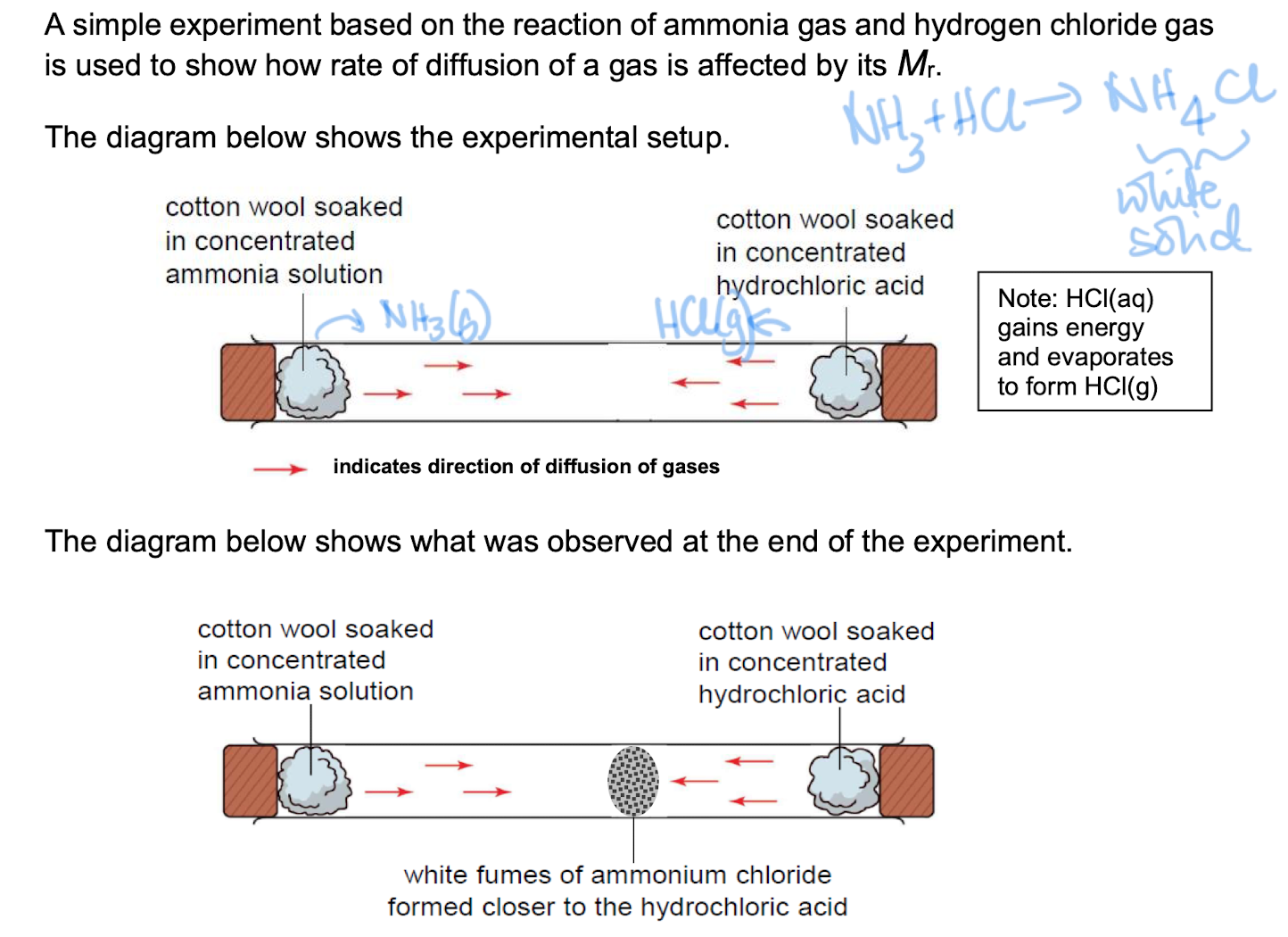 Explain why the white fumes of ammonium chloride formed closer to the end with concentrated hydrochloric acid
- of and of HCl is 36.5
- which has a lower diffuses faster than HCl which has a higher
- hence in a fixed duration of time, will travel a longer distance than HCl and thus the reaction between and HCl which produces ammonium chloride takes place closer to the end with hydrochloric acid.
Experiment 2:
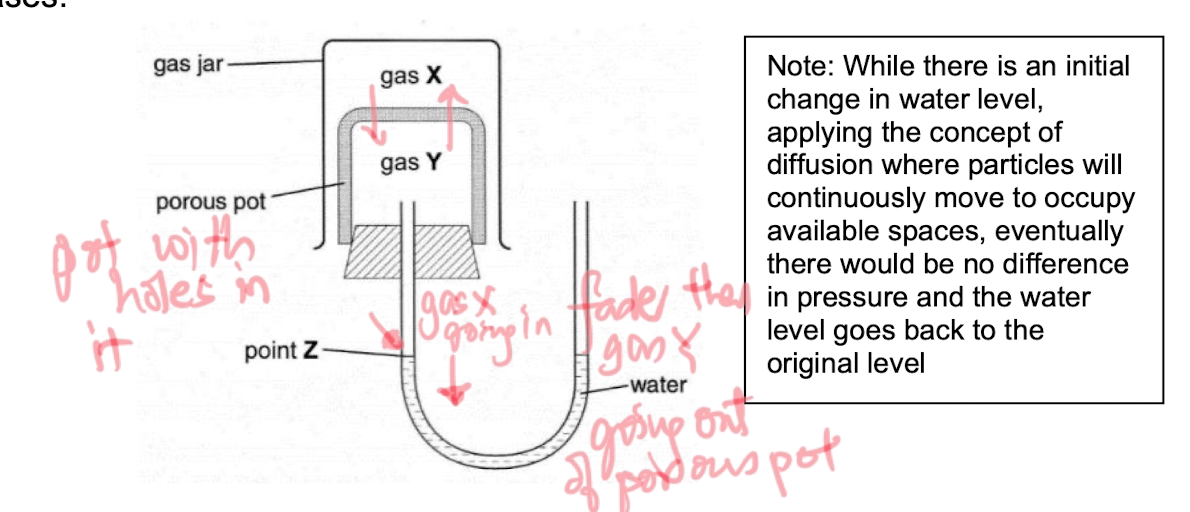
| EXPT NO. | Gas X | Gas Y | Level of water at point Z after sometime | Explanation |
|---|---|---|---|---|
| 1 | carbon dioxide | nitrogen | rise (move up towards the porous pot) | - of is 28 which is lower than the of - will diffuse out of the porous pot faster than diffusing into of the porous pot - pressure inside the porous pot is lower than pressure outside ht pot thus causing the water level in the tube at point Z to rise. |
| 2 | Nitrogen Monoxide | ethane | remain unchanged | - Gas inside and outside the porous pot are nitrogen monoxide and ethan respectively which has an of 30 each. - thus rate of diffusion of both gasses in and out of the porous pot is the same. - since volume of methane in the porous pot remains unchanged, pressure inside the porous pot is the same as pressure outside the porous pot thus causing water level in tube at point z to remain unchanged. |
Methods for collecting gasses, with relation to mole
this is related to Method for collecting gasses
- Gasses with (or ) < 30 are less dense than air ⇒ can be collected by upward delivery
- Gasses with (or ) > 30 are more dense than air and can be collected by downward delivery
Percentage Composition of Compounds
- refers to percentage by mass of each element in a compound.
- allows us to determine chemical formula of the compound
Formula Important Note
- Do NOT present working and final answers in the form of fractions but decimals
- when dealing with non exact numerical final answers (with decimals) ⇒ correct value to 3 significant figures. Work with 5 S.F beforehand.
Mole and Molar Mass
What is Mole ⇒ Amount of substance containing Particles (One Mole represents Particles)
Unit of Mole → mol
Recall ⇒ 6 main types of particles.
- atoms
- molecules
- ions
- subatomic particles
- electrons
- protons
- neutrons ⇒ note that one mole of any substance will only have the specified number of particles ⇒ regardless of whether there are atoms, molecules, ions, and even sub atomic particles such as electrons, protons, neutrons. Example 1 mol of Helium (He) ⇒ has 1 mol of He Atoms ⇒ and that is
Formula for Mole
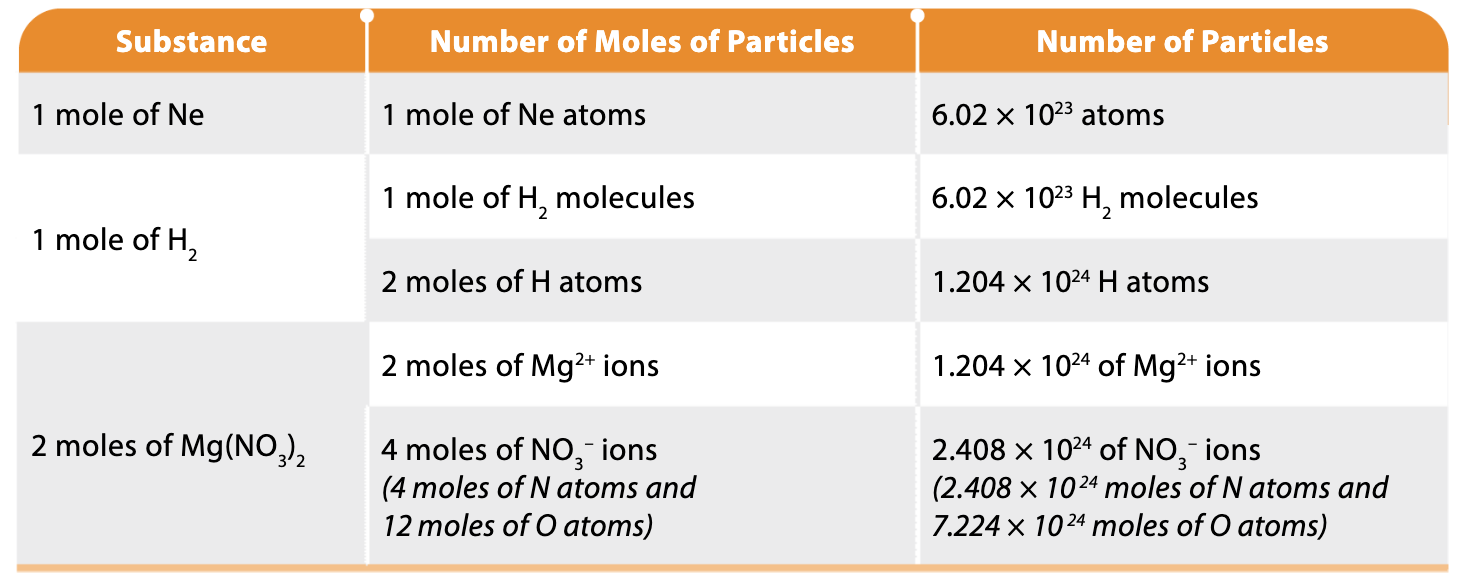 Note: this value is also known as the Avogadros constant
Important Note
Note: this value is also known as the Avogadros constant
Important Note
- Do NOT present working and final answers in the form of fractions but decimals
- when dealing with non exact numerical final answers (with decimals) ⇒ correct value to 3 significant figures. Work with 5 S.F beforehand.
Molar Mass
Definition
One Mole of Any substance has a mass equal to its relative atomic mass (), relative molecular mass () or relative formula mass () in grams This is the Molar Mass Molar mass is the mass of 1 mole of any substance* #ChemistryDefinitions
unit: g/mol
Calculation of Molar Mass of an element
- Molar mass of an element is the mass of one mole of atoms (or molecules) of the element
- since molar mass of element is equal to relative atomic mass () or relative molecular mass () ⇒ calculation of molar mass of an element is the same as the way you would do it to calculate its or
Calculation of Molar Mass of a Compound
- Molar Mass of compound is the mass of one mole of molecules (or formula units) of the compound
- Molar Mass of compound is equal to its relative molecular mass () or relative formula mass ()
- thus ⇒ calculate the molar mass of compound in the same way you would calculate its
Formula 1: ⇒ Mass must be in grams (convert if others) ⇒ Do not present working and final answers in form of fraction ⇒ give non exact final answers to 3S.F
Mole and Molar Volume of Gasses
→ According to Avogadro’s Law ⇒ equal volumes of all gasses ⇒ under the same conditions of temperature and pressure ⇒ contain the same number of particles.
Definition
Volume occupied by 1 mole of any gas at room temperature and pressure is equal to #ChemistryDefinitions
1dm = 10cm ⇒ 1000
Deduce Relationship between number of moles of gas and volume of gas
- Equal number of mol of any gas occupies the same volume
Formula 1 ⇒ volume must be in (conversion required) 1dm3 = 1000cm3 1l = 1000ml = 1000cm3 = 1dm3 ⇒ do not present working and final answer in fraction ⇒ give non exact numerical final answers correct to 3s.f.
Mole and Concentration of Solution
⇒ concentration of solution is the amount of solute dissolved in unit volume of solvent 2 units used ⇒ g/ and mol/
- to prepare aqueous solution of substance ⇒ substance (in any physical state) ⇒ is dissolved in water ⇒ substance is called the solute and water is called the solvent.
- resulting mixture is called aqueous solution
| Steps to prepare 250 of aqueous solution of copper(II)sulfate using a 250ml of volumetric flask in laboratory |
|---|
| electronic balance to measure mass of solute weigh out 39.9g of copper(II)sulfate crystals transfer the crystals into the 250ml volumetric flask. add deionised water and swirl to dissolve the solute in the solvent(water) add deionised water until solution just reaches calibration mark on the neck of the volumetric flask. this indicates that the volume of solution is 250 |
| Concentration of solution |
|---|
| ⇒ mass/number of mol of solute per unit volume (in Dm3) of solution |
- in chapter 8 ⇒ acids and Bases (pH scale) ⇒ we expressed concentration of an aqueous solution of acid in terms of number of particles of acid which dissolved in a fixed volume of water (solvent.)
- particles are extremely small and numerous thus when preparing aqueous solutions with different concentrations in laboratory it is not so meaningful to express concentration of aqueous solution in terms of number of particles in the solute that dissolved in a fixed volume of water.
Thus concentration is expressed in 2 ways
| concentration in g/Dm3 | concentration in mol/Dm3 (molar concentration) |
|---|---|
| Basicity of Acids | |
| Define Basicity of acid (in mol) | |
| ⇒ No. of mol of ions formed per mol of acid ionised in solution | |
| Acids | |
| Calculations involving concentration of solutions |
Formula 1 Formula 2 Formula 3
Empirical and Molecular Formula of a Compound
Definition
Simplest ration of elements in a compound is called its empirical formula (Empirical formula is the simplest formula of a compound) #ChemistryDefinitions
⇒ Molecular formula is a multiple of the empirical formula → molecular formula of a compound reflects the exact number of atoms of each element found in one molecule of the compound
Molecular formula/chemical formula ⇒ are sometimes used interchangeably. → However the term ‘molecular’ → only refers to covalent substances. → hence the term molecular formula refers only to the chemical formula of covalent substance
Note: Some elements have the same empirical formula and molecular formula
What does empirical formula of a compound show
- elements in a compound
- the simplest ratio of the different types of atoms (elements) in the compounds
The Molecular Formula is the actual formula of a compound
What does Molecular Formula of a compound show
- elements in a compound
- the Actual Number of the different types of atoms (elements) in the compound
Calculating Empirical Formula using mass of elements compound. Y contains 39.1g of carbon, 8.7g of hydrogen and 52.2g of oxygen. calculate the empirical formula of Y.
Steps:
- find mass
- find molar mass/
- no. of moles/mol
- by smallest ratio
- Obtain simplest ratio
| Element | C | H | O |
|---|---|---|---|
| mass/g | 39.1 | 8.7 | 52.2 |
| molar mass/g/mol (OR relative atomic mass/) | 12 | 1 | 16 |
| No. of Moles/mol | |||
| by smallest no. | |||
| Simplest Ratio (Make it a whole number) | 3: | 8: | 3 |
| Simplest Ratio: 3:8:3 | |||
| (recall percentage of each compound is directly proportional to its mass in grams. Thus, mass of each element in 100g of the compound is its % in the compound.) | |||
| (Recall molecular formula is the formula that shows the exact number of atoms of each element in a molecule) |
The molecular formula is a multiple of the empirical formula if the molecular formula and the empirical formula of a compound is different.
Thus to determine molecular formula we need to know the:
- Empirical formula of the compound
- Relative molecular mass of the compound
Molecular formula of a compound = (from this, we can tell that molecular formula is a multiple of the empirical formula)
Calculating Empirical Formula using Percentage Composition by Mass of Elements
example 1: Caffeine is a compound found in coffee and tea. ⇒ percentage composition of caffeine is 49.5% carbon. 5.1% Hydrogen, 16.5% oxygen and 28.9% Nitrogen.
Determine empirical formula of caffeine
| Element | C | H | O | N |
|---|---|---|---|---|
| Percentage/% | 49.5 | 5.1 | 16.5 | 28.9 |
| Molar mass/g/mol (OR Relative atomic mass/) | 12 | 1 | 16 | 14 |
| No. of Moles/mol | ||||
| by smallest no. | ||||
| Simplest Ratio | 4.01 4: | 4.95 5: | 1 1: | 2 2 |
| Empirical formula of caffeine is |
Given that mass of 1 mole of Caffeine is 194g/mol ⇒ determine the molecular formula of caffeine
Calculations from Chemical Reactions
what important info does a balanced chemical equation tell us:
- mole ratio ⇒ the ratio of the number of moles of the reactants and the products
- Physical state of the reactants and products
What is stoichiometry ⇒ relationship between number of moles of the reactants and the number of moles of the products involved in that chemical reaction. ⇒ Stoichiometry is based on the fact that particles in matter cannot be destroyed or created in a chemical reaction. in a chemical reaction, the particles in reactants simply changed into another form in the products. thus, sum of mass of reactants is the same as sum of mass of products.
⇒ consider the reaction between nitrogen gas and hydrogen gas
| + | + | |
|---|---|---|
| 1 molecule 1 mol | 3 molecules 3 mol | 2 molecules 2 mol |
| → this balanced equation can be read as 1 mol of nitrogen gas reacts with 3 mol of hydrogen gas to produce 2 mol of ammonia gas. |
| No. of moles of = 1 mol | No. of moles of = 3 mol | No. of moles of = 2 mol |
|---|---|---|
| Mass of = 1 mol (2 * 14) = 28g | Mass of = 3 mol (2* 1) = 6g | Mass of = 2 mol [14 + (3 * 1)] = 34g |
| Total mass of reactants = 28 + 6 = 34g | Total mass of reactants = 28 + 6 = 34g | Total mass of product = 34g |
Calculations from Chemical Reactions**
- Calculating masses of reactants and products ⇒ by using balanced chemical equation, mass of any reactants used up or mass of any product formed in a reaction. (reactants and products in any physical state as well)
Worked Example
- copper metal can be extracted from copper(II)oxide by reacting 8.0g of copper(II)oxide with carbon. Copper and carbon dioxide gas are produced in this reaction. calculate:
- mass of carbon, C that will react with 8.0g of copper(II)oxide
- mass of copper produced, Cu
- Volume of carbon dioxide gas produced, in this reaction
Solution
| (i) |
|---|
| Step 1: Write a Balanced Equation for this reaction (include state symbol) 2CuO(s) + C(s) → 2Cu(s) + (g) |
| Step 2: Identify the reactant/product whose quantity is provided in the question. Convert the quality of the substance to number of moles - in this question ⇒ mass of CuO is provided - Convert mass of CuO to number of moles of CuO - |
| Step 3: Compare Mole ratio from balanced chemical equation Compare Mole ratio ⇒ Hence: Number of moles of C = Mole ratio No. of moles of CuO from step 2 = 0.5 0.1 = 0.05mol |
| Step 4: Convert Mole to Molar Mass Mass of C = No. of mole of C molar mass of C = 0.05 12 = 0.6g |
| (ii) |
|---|
| Step 1: Comapre Mole ratio from balanced chemical equation: compare mole ratio, Hence ⇒ no. of moles of Cu = mole ratio no. of moles of CuO from step 2 in (i) = |
| Step 2: Convert mole to mass: Mass of Cu = no. of mole of Cu molar mass of Cu = 0.1 64 = 6.4g |
| (iii) |
|---|
| Step 1: Compare mole ratio from balanced equation: Compare mole ratio, Hence, no. of moles of = mole ratio no. of moles of CuO from step 2 in (i) = = 0.05 mol |
| Step 2: Convert mole of gas to volume of gas Volume of = no. of mole of molar volume of gas at r.t.p = 0.05 24 = 1.2d |
- Thermal Decomposition of some metal carbonates produce metal oxide and carbon dioxide gas. Calculate the mass of calcium carbonate which decomposed upon heating to produce 4.8 of carbon dioxide at r.t.p
| Solution |
|---|
| Step 1: Convert volume of carbon dioxide gas to number of moles no. of moles of = |
| Step 2: compare mole ratio Compare mole ratio: no. of moles of = |
| Step 3: Convert moles to mass mass of = no. of moles of molar mass of = 0.2 100 = 20g |
Calculations from Chemical Reactions
- Calculating Volumes of gaseous reactants and Products ⇒ recall: one mole of any gas occupies 24 at room temperature and pressure. Equal volumes of gasses ⇒ under same conditions of temperature and pressure, contain same number of particles. ⇒ means that volume of gas is proportional to number of moles of a gas.
| Consider chemical reaction between Nitrogen gas and hydrogen gas balanced chemical equation can be read ⇒ as 1 mol of nitrogen gas reacts with 3 mol of hydrogen gas to produce 2 mol of ammonia gas |
|---|
| continued on the next table |
| No. of moles of = 1mol | No. of moles of = 3 mol | No. of moles of = 2mol |
| Volume of = 1 mol 24 = 24 | Mass of = 3mol 24 = 72 | Mass of = 2mol 24 = 48 |
| Continued here: | ||
| Mole ratio of gaseous reactants and products: | ||
| : : | ||
| 1 : 3 : 2 |
Volume ratio of gaseous reactants and products: : : 24 : 72 : 48 1 : 3 : 2 Thus, balanced equation for this reaction can also be read as 1 volume of nitrogen gas reacts with 3 volume of hydrogen gas to produce 2 volume of ammonia gas
> Thus, for chemical reactions that involve gaseous reactants and products, mole ratio of gases is the same as the volume
Using relationship between mole ratio and volume ratio of gases ⇒ volume of any gaseous reactant used up or the volume of any gaseous product formed in a reaction can be determined using mole ratio of gases provided by a balanced chemical equation.
Calculations from Chemical Reactions
- Titration in volumetric analysis
- Calculating Concentration of aqueous solutions of reactants and products
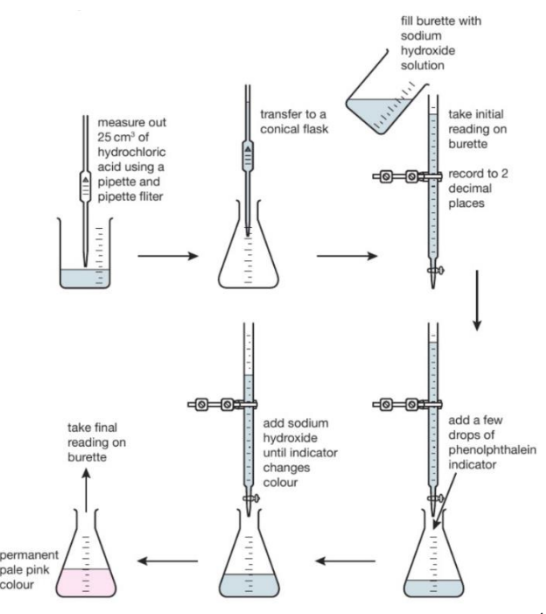
Volumetric analysis ⇒ titration is a method used to prepare some soluble salts. ⇒ titration can also be used to determine concentration of an aqueous solution by reacting it with a solution of known concentration (standard solution). known as volumetric analysis
Titration involves:
- Solution with unknown concentration (titre)
- Solution with known concentration (titrant)
Example: Acid base titration ⇒ we can find out volume of titrant (alkali) required to react with fixed volume of titre (acid with unknown concentration)
Steps:
- Pipette 25.0 of acid (titre) into a conical flask
- Add a few drops of suitable indicator eg: methyl orange
- Fill the burette with the alkali (titrant). Measure and record the initial burette reading.
- Run the alkali into the conical flask, swirling the flask in the process (to ensure proper mixing of reaction mixture)
- Titration is stopped at the end point, i.e. when indicator has changed color permanently.
- Measure and record final burette reading. calculate volume of alkali (titrant) added
- Titration is repeated until consistent results are obtained.
- Average titrant volume is calculated
- Volume is used to calculate unknown concentration of the solution
 Worked Example
Question: 25.0 of NaOH is needed to neutralize 20.0 of 0.5mol/ of solution. calculate concentration of NaOH solution in (i) mol/ and (ii)g/
Worked Example
Question: 25.0 of NaOH is needed to neutralize 20.0 of 0.5mol/ of solution. calculate concentration of NaOH solution in (i) mol/ and (ii)g/
| Solution 1 |
|---|
| Step 1: write balanced chemical equation, include state symbols. |
| Step 2: Calculate no. of moles of sulfuric acid used from values given: No. of moles of (aq) = Conc(mol/) Vol = 0.5 = 0.01mol |
| Step 3: Compare mol ratio (from equation) to find the no. of moles of NaOH used in the reaction: compare mole ratio, = No. of moles of NaOH = = mol (This is the no. of moles of NaOH in 25 of solution) |
| Step 4: Convert no. of moles in 25 of solution to no. of moles in 1 of solution i.e. concentration in mol/ 25 = 0.025 Concentration of NaOH (mol/) = concentration of NaOH solution = = 0.8mol ii) concentration of NaOH (g/ ) = concentration of NaOH (mol/) molar mass of NaOH = 0.8 (23 + 16 + 1) = 32g/ |
| Solution 2 |
|---|
| Formula for acid base titration calculation: = = = concentration of NaOH = 0.8mol/ other than acid base titration ⇒ this formula can be used for redox titrations. Change A and B to the types of reagents used. Note: if you want to use this formula, please include the legend as well. M = Conc(mol/ ) V = Vol() A = Acid () B = Base (NaOH) = no. of moles of acid, (from eqn) = no. of moles of base, NaOH (eqn) ii) concentration of NaOH (g/ ) = concentration of NaOH (mol/) molar mass of NaOH = 0.8 (23 + 16 + 1) = 32g/ |
| Other than acid-base titration ⇒ this formula can be used for redox titrations, change A and B to the types of reagents used. |
| Note: if you want to use the formula, include legend as well |
Calculations from Chemical Reactions
- Calculate the amount of product formed in a reaction with limiting reactant
What is a Limiting Reactant
- is used up in a chemical reaction. when it is used up, reaction stops What is a Reactant in Excess
- Not used up in reaction so at the end of the reaction there is some left Hence, state importance of limiting reactant
- quantity of product obtained is decided by quantity of limiting reactant
Worked Example 1
when 6g of hydrogen is allowed to react with 32g of oxygen, water is produced i) identify limiting reactant in this reaction ii) calculate mass of water formed
i) Step 1: write balanced chemical equation for this reaction (include state symbols)
Step 2: Calculate number of moles of reactants provided for this reaction no. of moles of provided for the reaction = = 3 mol no. of moles of provided for the reaction = = 1 mol
Step 3: Determine limiting reactant by calculating the actual amount of each reactant required for complete reaction using mole ratio
| Method 1 | Method 2 |
|---|---|
| Compare mole ratio, No. of moles of required: = = 1.5 mol 1.5 mol of is required to react completely ⇒ with 3 mol of Since ⇒ only 1 mol of is provided for this reaction, is the limiting reactant and is in excess | Compare mole ratio. No. of moles of required = = 2 mol 2 mol of is required to react completely with 1 mol of . since ⇒ 3 mol of is provided for this reaction, is in excess and is the limiting reactant |
| ii) | |
| Use limiting reactant to calculate amount of product | |
| in this reaction ⇒ is the limiting reactant. | |
| Compare mole ratio, | |
| = no. of moles of | |
| = | |
| = 2 mol |
mass of = no. of moles of molar mass of = = 36g
Percentage Yield and Percentage Purity
yield ⇒ refers to the amount of product formed in a reaction
Define theoretical yield:
Definition
- Maximum quality of product that can be obtained calculated value from equation #ChemistryDefinitions
In reality, amount of products produced experimentally produced in most reactions is always less than that produced theoretically (by calculation from balanced equation) WHY?
- use of reactants which are impure (contains impurity)
- Incomplete reaction as some reactants did not react completely
- Poor handling of reactants and products ⇒ when conducting experiments ⇒ which resulted loss of reactants or products.
Define Actual Yield:
- Actual quantity of product obtained (equal to or less than theoretical yield)
Actual yield < theoretical yield
Percentage Yield ⇒ shows relationship between actual yield and theoretical yield Formula:
Worked Example 1
128g of sulfur dioxide, was reacted with oxygen to produce Sulfur Trioxide, 148g of was produced in the reaction. Calculate Percentage yield of
Step 1 write balanced chemical equation for this reaction (include state symbol)
Step 2 Identify the actual yield of the product which is provided in the stem of the question Actual Yield of = 140g
Step 3 Calculate theoretical yield of product. No. of moles of = = = 2mol
compare mol ratio, of moles of = mass of = no. of moles of molar mass of = 2 80 = 160g
Step 4 Calculate percentage yield of product
Percentage yield of =
=
= 87.5
Percentage Purity
Often ⇒ percentage yield of a product is less than 100% because reactants are not pure
What is relationship between purity of the reactant and the percentage yield of a product
- If purity % reactant increases, % yield of product % and vice versa
Calculating Percentage Purity of a Substance ⇒ if percentage purity of substance (sample) is 100% ⇒ we can deduce that the sample is pure
If percentage purity of the substance (sample) is less than 100% → we can deduce that sample is impure
Worked Example
3.2g of impure impure copper was heated in air. 3.8g of copper(II)oxide was formed. i) what was the percentage purity of the copper sample ii) what assumption was made when calculating the percentage purity of impure copper sample.
Step 1 Write a balanced chemical equation for this reaction. (include state symbol)
Step 2 identify mass of sample in which is provided in the stem of the question Mass of impure copper = 3.2g
Step 3 Calculate mass of pure substance in sample. = = 0.0475 mol
Compare mol ratio, No. of moles of pure Cu = = 0.0475 mol
Mass of pure Cu = no. of moles of Cu molar mass of Cu = = 3.04g
Step 4 Calculate percentage purity of sample Percentage purity of copper sample = = $\frac{3.04}{3.2} \times 100$$ = 95.0%
Assumption: copper is the only substance that will react to give CuO. eg: if was an impurity, heating could have given off CuO as well
if mass is same on both sides, then mol ratio is 1 : 1
Important
mol ratio can exist between compounds only.