Group Properties - Group 18 Elements - Noble Gasses
Physical Properties
- Poor conductors of heat and electricity
- Low melting and boiling points
- Colourless gasses at r.t.p
- Insoluble in water
- Unreactive (Inert)
Sample
Explain why group 18 elements are gasses at r.t.p
- Only a small amount of energy is required to overcome the weak Van Der Waals forces of attraction between atoms of group 18 elements {1}
- Thus these elements have low melting and boiling points. {1}
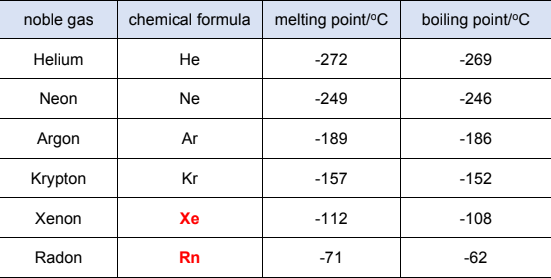
Going down the group → from helium to radon → a trend is observed in the physical property of halogens
- melting and boiling points of noble gasses increase
Sample
By making reference to atomic structure, explain the trend in melting and boiling points of noble gasses.
- Going down group 18 → melting and boiling points increase down the group {1}
- As atomic size of noble gasses increases → due to increasing number of electron shells, the strength of Van der Waals forces of attraction between atoms in the elements increases {1}
- Thus amount of energy required to overcome these forces to melt and boil group 18 elements increases down the group {1}
Chemical Properties
-
Group 18 elements are called noble gasses.
-
The atoms of these elements → have fully filled valence shells
-
Their atoms have 8 electrons in the valence shell → except for helium, which has 2 electrons in outer shell
-
Since these elements have stable electronic configuration → they exist as individual atoms thus they are classified as motatomic elements
-
due to their stable electronic structures → these elements do not react easily as they do not lose, gain, or share electrons to form compounds.
- Thus far only krypton, xenon, radon → able to form compounds, mainly with fluorine. Helium Neon and Argon do not form compounds
-
They are so unreactive that they are called inert gasses
Note
Uses of Noble Gasses
- Helium → safe and much lighter than air → used for balloons
- Neon is used to make coloured lamps
- In the manufacture of steel, argon is mixed with oxygen and blown through molten steel to remove excess carbon