Simple Covalent Molecules
Simple covalent molecules like bromine - atoms in molecules are held by strong covalent bonds.
- In each molecule - atoms are chemically combined together by strong covalent bonds,
However - molecules are held together by weak intermolecular forces of attraction.
At low temperatures -some simple covalent molecules can form lattices.
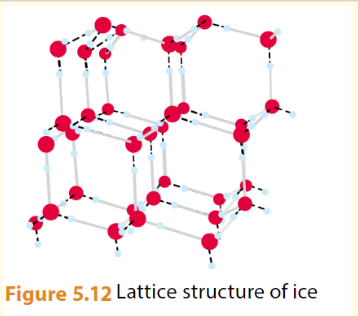
Melting and Boiling Points
Weak intermolecular forces of attraction between molecules - easily overcome with a small amount of energy. Thus, simple covalent molecules have low melting and boiling points.
Some evaporate easily - described as volatile. → Exist mostly as gasses or liquids at room temperature.
As molecules get larger - intermolecular forces of attraction are stronger → melting and boiling points are higher.
Solubility
Most simple covalent substances - insoluble in water and soluble in organic solvents. (tetrachloromethane, dichloromethane, hexane)
Electrical Conductivity
Since simple covalent substances - typically exist as neutral molecules - they do not have any mobile charge carriers to conduct electricity.
However - some simple covalent substances dissociate in water - resulting in solutions that conduct electricity. Hydrogen chloride - dissolves in water to form H+ and Cl- ions which are mobile. Thus, the solution is electrical conductors
Answer Techniques for Simple Covalent Molecules
Explain in terms of structure, why chlorine is a gas at R.T.P
- Chlorine (or Cl2) is a covalent substance that exists as simple covalent molecules.(1)
- In this structure, there is only weak intermolecular forces of attraction between chlorine molecules (or Cl2 molecules).(1)
- Only a small amount of energy is required to overcome these weak forces to melt and boil Cl2. Hence Cl2 has low melting and boiling points (1) and is a gas at r.t.p.
Explain in terms of structure, why ethanol is volatile at R.T.P
- Ethanol (or C2H5OH) is a covalent compound that exists as simple covalent molecules.(1)
- In this structure, there is only weak intermolecular forces of attraction between ethanol molecules (or C2H5OH molecules).(1)
- Only a small amount of energy is required to overcome these weak forces to melt and boil C2H5OH. As ethanol has low melting and boiling points, (1) it is a volatile liquid as it evaporates quickly at r.t.p.
Explain why pure water is a poor conductor of electricity
- Pure water consists of simple covalent water molecules that are electrically neutral. Pure water does not have freely moving (mobile) ions or delocalized electrons to carry charges(act as charge carriers) to conduct electricity. (Type of particles : (1))
Even for hardness, covalent substances always write energy and never force
Giant Covalent Structures
-almost always in the solid state - because they consist of many atoms that are all connected to one another by strong covalent bonds. (very different from simple covalent molecules, that have weak intermolecular forces of attraction)
Diamond and graphite - examples of giant covalent molecules
Diamond and graphite - allotropes of carbon - different forms of the same element with different structural arrangement of atoms.
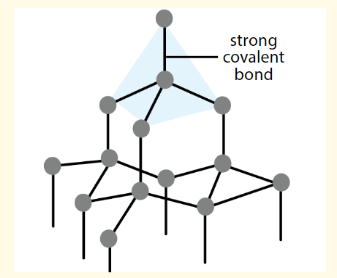 Each carbon atom forms covalent bonds with 4 other carbon atoms Throughout the structure.
Gives a 3D network structure of carbon atoms in a tetrahedral arrangement.
Each carbon atom forms covalent bonds with 4 other carbon atoms Throughout the structure.
Gives a 3D network structure of carbon atoms in a tetrahedral arrangement.
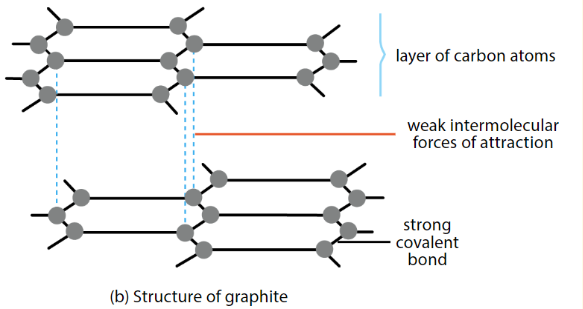 Each carbon atom - forms covalent bonds with 3 other carbon atoms throughout each layer of atoms.
This gives a layered structure consisting of hexagonal rings of carbon atoms.
Each carbon atom - forms covalent bonds with 3 other carbon atoms throughout each layer of atoms.
This gives a layered structure consisting of hexagonal rings of carbon atoms.
Definition
- Different bonding and structure of carbon allotropes - affect their properties
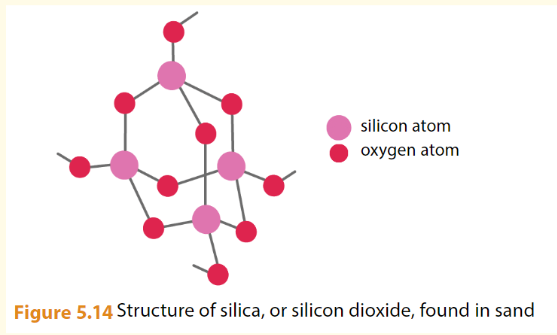
- Each silicon atom is covalently bonded to 4 oxygen atoms and each oxygen atom is covalently bonded to 2 silicon atoms throughout the structure.
- Tetrahedral arrangement of silicon and oxygen atoms in the structure.
Silicon dioxide - consists of many silicon and oxygen atoms linked to each other by strong covalent bonds. Atoms - joined to each other in regular arrangement - forming a giant covalent structure. Overall ratio of silicon to oxygen atoms is 1:2. Formula for silicon dioxide - SiO2
Structural Properties
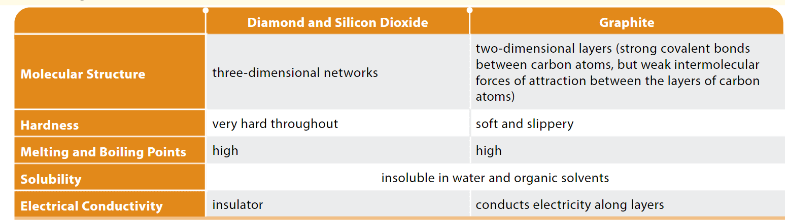
Giant covalent structures - numerous bonds holding atoms together - making them very rigid and able to withstand large forces. Diamond - one of the hardest substances known.
Graphite - layered structure.
- Strong covalent bonds found within each layer - but weak intermolecular forces of attraction exist between the layers.
- Means that graphite layers can be easily separated from each other, but each layer is hard to break apart.
Hardness
| Covalent Substance | Diamond | Graphite | Silicon Dioxide |
|---|---|---|---|
| Structures | Giant covalent structure | Giant covalent structure | Giant covalent structure |
| Types of forces of attraction between particles | Large number of strong covalent bonds between carbon atoms throughout the structure | Hexagonal layers of carbon atoms - held loosely together by weak intermolecular forces of attraction. Layers of carbon atoms can slide over each other easily. | Large number of strong covalent bonds between silicon atoms and oxygen atoms throughout the structure. Tetrahedral arrangement of carbon and oxygen atoms throughout the structure. |
| Amount of energy needed to overcome the forces of attraction/break bonds | large | small | large |
| Hardness | Hard | Soft and Slippery | Hard |
| Uses | Make tip of drills, cutting edge of tools | Dry lubricants, mixed with clay to make pencil lead | Raw material for glass |
Melting and Boiling Points (Volatility)
| Covalent Structure | Diamond | Graphite | Silicon Dioxide |
|---|---|---|---|
| Structures | Giant covalent structure | Giant covalent structure | Giant covalent structure |
| Types of forces of attraction between particles | Large number of strong covalent bonds between carbon atoms throughout the structure. | Large number of strong covalent bonds between carbon atoms throughout the structure. | Large number of strong covalent bonds between silicon atoms and oxygen atoms throughout the structure. |
| Amount of energy needed to overcome the forces of attraction/break bonds | Large | Large | Large |
| Melting and Boiling Points | High | High | High |
Electrical Conductivity
| Covalent Substance | Diamond | Graphite | Silicon Dioxide |
|---|---|---|---|
| Physical state at R.T.P | Solid | Solid | Solid |
| Giant molecular/covalent structure | Carbon atoms are electrically neutral and all the valence electrons of each carbon atom are involved in covalent bonding. There are no delocalised electrons that can move freely throughout the structure to act as charge carriers | In each layer of carbon atoms, each carbon atom has one valence electron that is not used to for covalent bonds. These valence electrons are delocalized and can move freely throughout the layers of carbon atoms in the structure to carry charges | Silicon atoms and oxygen atoms are electrically neutral. There is no delocalized electrons that can move freely throughout the structure to act as charge carriers |
| Electrical conductivity | Poor | Good | Poor |
| Uses | - | as insert electrodes in electrolysis of molten compounds for extraction of metals from their ores | - |
Solubility
Most giant covalent substances Insoluble in water and in organic solvents
Summary
Answer Techniques for Giant Covalent Molecules
Why does graphite have a high melting point?
- Graphite has a giant covalent structure with a large number of strong covalent bonds between carbon atoms that extend throughout the structure(forming a large network of bonds), hence a lot of energy is required to break these strong covalent bonds, resulting in graphite having a high melting point.
Why is diamond hard? Diamond has a giant covalent structure with a large number of strong covalent bonds between carbon atoms that extend throughout the structure(forming a network of bonds). Hence lot of energy(ORFORCE??) is required to break these strong covalent bonds, making diamond hard. \
Why is graphite soft and slippery? Graphite has a giant covalent structure with weak intermolecular forces of attraction between the hexagonal layers of carbon atoms, hence little energy is required to overcome these forces of attraction, resulting in the layers of carbon atoms to slide past each other easily and graphite being soft and slippery.
Why can graphite conduct electricity while diamond cannot? Diamond Has no mobile electrons to carry electrical charges as all outer electrons in each carbon atom is used for bonding, while each carbon atom in graphite is bonded to 3 other carbon atoms, leaving 1 electron not bonded and able to move, hence graphite has free mobile electrons to carry electrical charges.
Explain why silicon dioxide is insoluble in water.
- Silicon dioxide (or SiO2) is a covalent substance with a giant covalent structure.(1) In this structure, all the silicon atoms and oxygen atoms are held together by strong covalent bonds throughout the structure.(1)
- The forces of attraction between the giant covalent structure and water molecules are not strong enough to break the strong covalent bonds within the silicon dioxide structure. Thus silicon dioxide cannot dissolve in water. (1) (opposite for soluble in water)
Macromolecules
Polymers are macromolecules Polymer → consists of many covalent molecules joined together into chains of much larger molecules. Natural polymers: silk, wool, starch, rubber Man-made polymers: polyester, nylon, polystyrene and many other plastics
Structural Properties
Polymers - vary greatly in their hardness and flexibility because they exist in so many different combinations of atoms Allow them to be made into many different products.
Melting and Boiling Point
Because of large size of polymers → most are solids at R.T.P However - polymers may be formed by molecules of a range of sizes Thus, polymers do not have a fixed melting or boiling point
- Instead, they typically soften over a range of temperatures when the weaker intermolecular forces of attraction are overcome by molecular vibrations with higher kinetic energy.
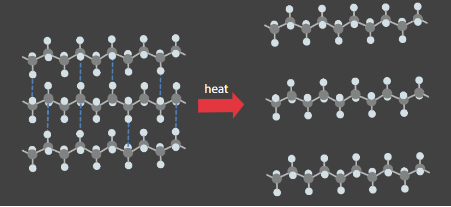 note* heating the polymer will overcome the weak intermolecular forces of attraction between molecules
poly(ethene) - is a polymer with weak intermolecular forces of attraction between the molecules.
Hence melting and boiling points of poly(ethene) are low
note* heating the polymer will overcome the weak intermolecular forces of attraction between molecules
poly(ethene) - is a polymer with weak intermolecular forces of attraction between the molecules.
Hence melting and boiling points of poly(ethene) are low
Solubility
Most Macromolecules are insoluble in water and soluble in organic solvents
Electrical Conductivity
Most macromolecules are unable to conduct electricity in any state as they do not have mobile ions or electrons