Summary of the comparison of the effect of electrical components arranged in series and parallel on the resistance, current and P.D of circuit
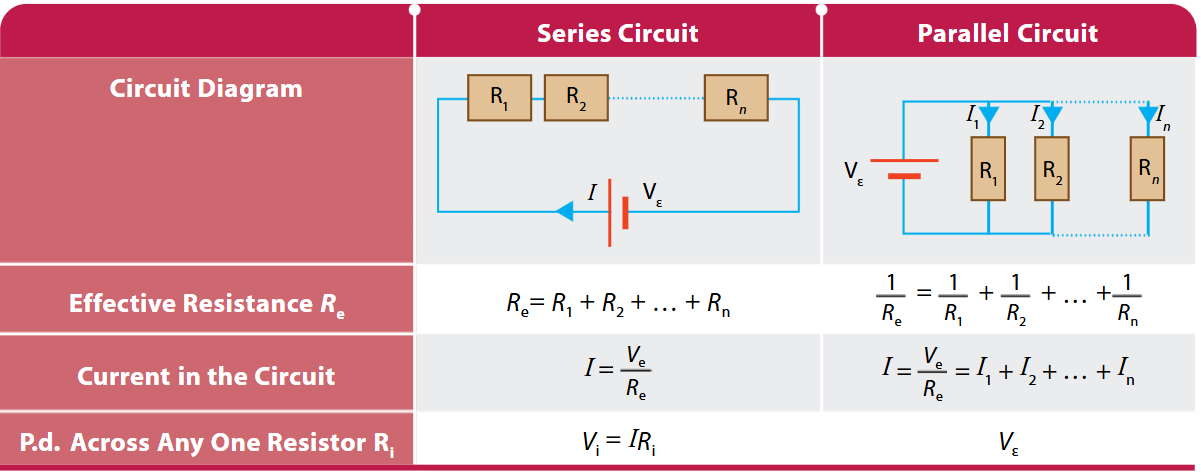
Circuits are connected in series and parallel to meet the voltage and current requirements.
- most flashlights (modern) use light emitting diode (LED) bulbs
- older flashlights use filament bulbs that work on 3V → when 3V applied to these bulbs → they light up at their desired brightness → if less than 3V applied to bulbs then they are less bright most dry cells rated 1.5V → need to connect 2 in series to supply required 3V
Effective resistance of circuit changes → if electrical components are arranged diff.
- connect resistance in series to achieve higher resistance
- connect in parallel to achieve lower resistance
| Series Circuits | Parallel Circuits | Summary |
|---|---|---|
| voltage across bulbs in the series connection is half the voltage of the electromotive force of the dry cells. voltage across each bulb = | Voltage across each bulb → identical to each other Voltage across each bulb = | Bulbs in parallel will be brighter than bulbs in series |
| Current is the same at every point of the circuit. Current through each bulb = | Current splits across different parallel branches Current through each bulb = | if more parallel branches are added → could result in overdrawing of current from the power source. power source is depleted more quickly. Circuit requires constant current → then parallel connections should be avoided. |
| If one of the bulbs blows, the electrical path would be open and other bulb will not light up. | If one bulb blows, the other bulb will remain lit | Parallel connections ensure that if 1 bulb blows, rest of bulbs are not affected. |