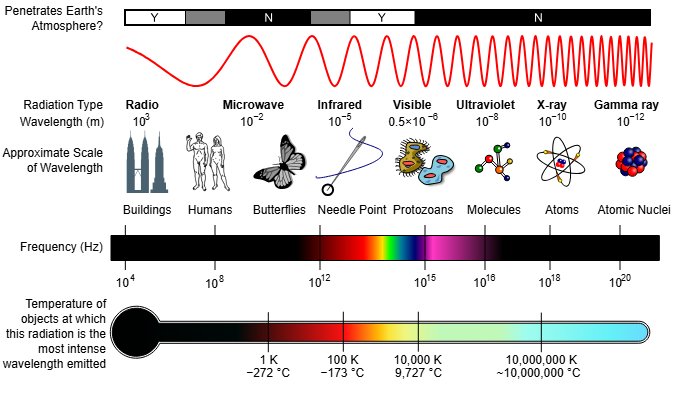
Nature of Electromagnetic waves
sunlight ⇒ can be split into a continuous spectrum of colors. ⇒ rainbow spectrum is just one small section of electromagnetic waves.
the continuous electromagnetic wave spectrum covers a large range of wavelengths and frequencies.
- All electromagnetic waves are transverse waves
- Electromagnetic waves are made up of oscillating electric and magnetic fields. They do not carry electric charges
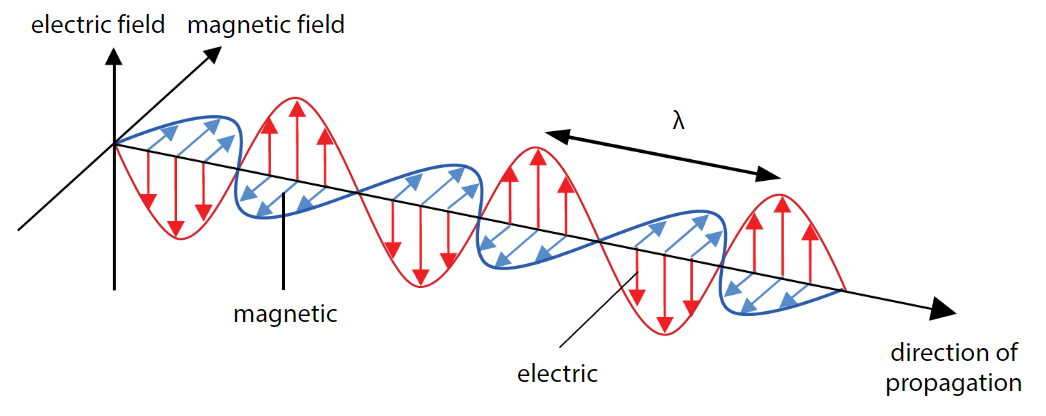
- All electromagnetic waves can travel without a medium, with the same speed of ⇒ AKA in a vacuum
- Wave speed equation, , applies to all electromagnetic waves
- When an electromagnetic wave travels from a vacuum to other media, wave speed and wavelength decreases. The decrease in speed is different for different frequencies. However, frequency stays the same as at the source when the wave goes into a different medium.
- Electromagnetic waves undergo reflections and refractions
- Electromagnetic waves transfer energy
- Ionizing waves ⇒ are those with higher frequencies and hence higher energies. They can eject electrons from atoms and molecules to create ions. the ions can cause harm by disrupting cell functions and even killing them.
- All material bodies ⇒ emit range of electromagnetic waves. In general, Higher temperature bodies tend to emit more and higher frequency electromagnetic waves.
Uses and Dangers of EM Waves
Uses of EM Waves Dangers of EM Waves