- have seen that a current carrying conductor can produce a magnetic field.
- when this magnetic field interacts with another magnet field → magnetic attraction / repulsion can take place
- if forces of attraction or repulsion are large enough → they will cause a motion. this effect can be demonstrated using this set up:
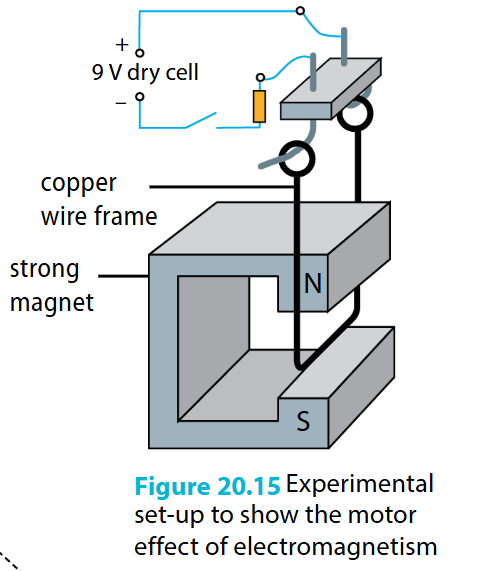
when the power supply is switched on, the copper wire frame immediately swings (a)
if the current is increased, a larger swing is produced. (b)
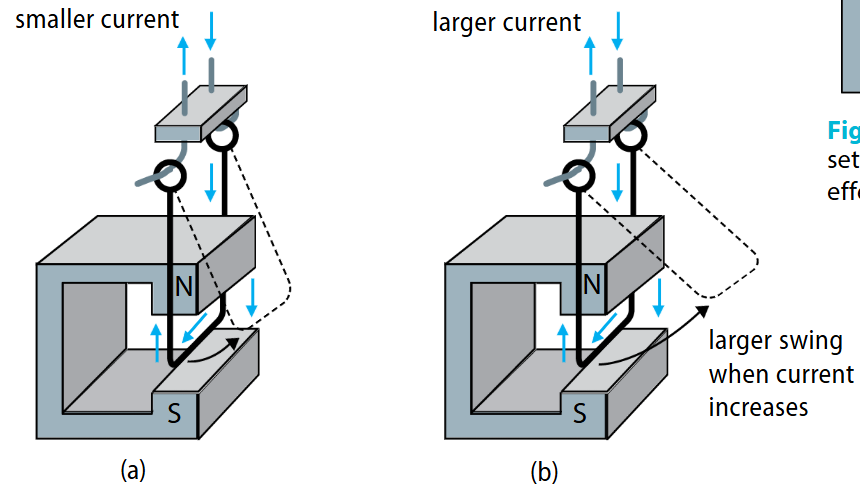
if we increase the strength of the magnetic field by adding more magnets → a larger swing is also produced.
if the connection of the terminals is reversed → the copper wire frame swings in the opposite direction. the copper wire frame will also swing in the opposite direction if the polarity of the magnet is reversed.
Summary
In summary, following conclusions can be made:
- increasing the current produces a larger swing
- increasing a strength of magnetic field produces a larger swing
- reversing the direction of current induces a swing in the opposite direction
- reversing the polarity of the magnet also reverses the direction of the swing
The motion that is created is also known as the motor effect or catapult effect when current carrying conductor → is placed inside a uniform field → the magnetic fields interact in a manner similar to the pulling of the elastic band of a catapult. The current carrying conductor experiences a force that pushes it out.
since the copper wire frame in the set up is pivoted, it appears to swing out.
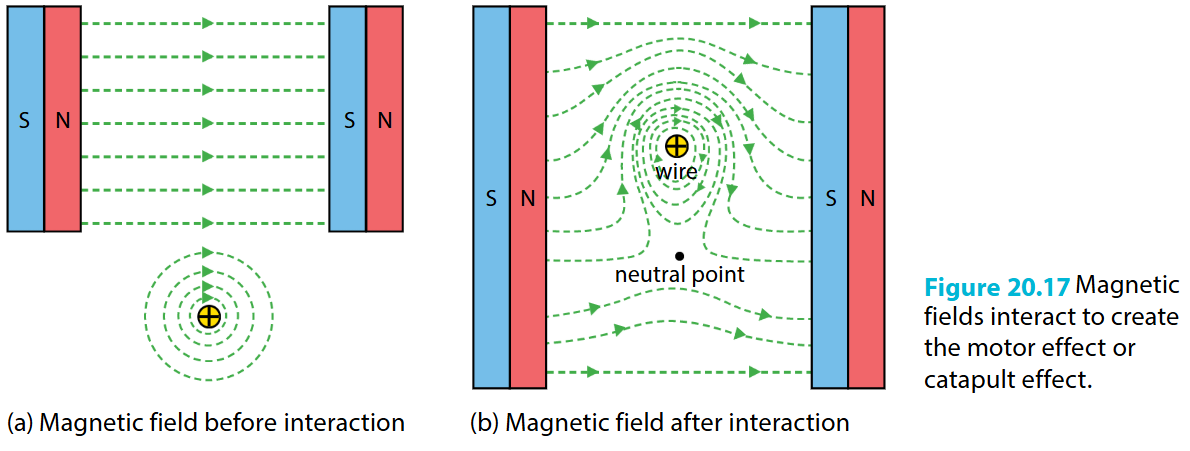
this phenomenon can also be explained in terms of strength of magnetic field
- magnetic field lines are closer together at the top when they are at the bottom of the conductor. (b)
- this means that the strength of magnetic field is stronger at the top and weaker at the bottom. the wire experiences a force that pushes it downwards.
direction of force can be determined using Flemings left hand rule.
- first finger is oriented in the direction of the magnetic field from north to south, and the second finger in the direction of conventional current.
- the resultant force that is induced by current carrying conductor will be given by the direction the thumb is pointing to.
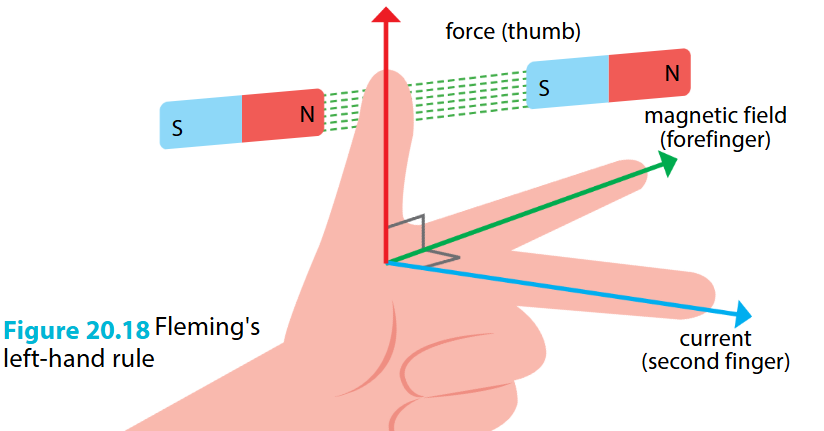 Flemings left hand rule is used to find either the direction of the force, magnetic field or current when the direction of 2 of these are known.
direction of force, magnetic field or current are at right angles to one another
Flemings left hand rule is used to find either the direction of the force, magnetic field or current when the direction of 2 of these are known.
direction of force, magnetic field or current are at right angles to one another
force on a wire can be increased by:
- using larger current
- using stronger magnetic field
- using greater length of wire in the field