Sound ⇒ longitudinal wave travelling in air.
forward and backward vibration ⇒ is passed on to air particles ⇒ like how spring is pushed and pulled repeatedly.
⇒ causes alternate regions of the air particles to be compressed and extended.
⇒ compressed regions are called compressions, extended regions are called refractions.
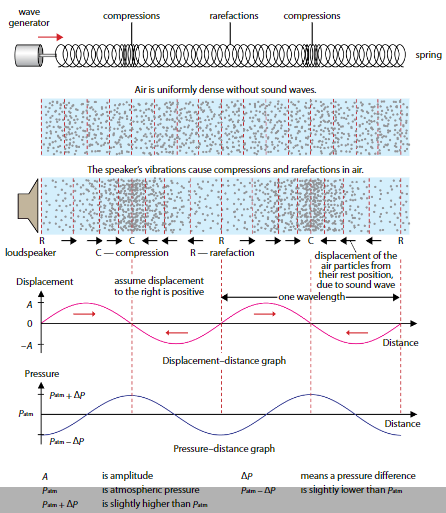
Since sound waves relies on the passing on of motion from a group of molecules to another group through collisions ⇒ it cannot propagate in a vacuum.
How do we relate Loudness to Amplitude and Pitch to Frequency
Loudness and Amplitude device that gives objective number ⇒ indicating loudness ⇒ called sound level meter. using sound level meters ⇒ you can tell that with age, sense of hearing generally declines due to biological changes.
Sound level meter ⇒ also gives a standardized reading when exposed to sound waves of same amplitude ⇒ Loudness is related to amplitude. ⇒ larger amplitude = louder the sound ⇒ lower the amplitude, the l
Pitch and Frequency Similarly ⇒ pitch refers to human perception of sound. (often described as high pitch or low pitch) Higher the frequency, higher the pitch.
pitch and frequency are related, but only frequency is a measurable physical quantity. ⇒ as people age, they are less able to hear sounds with high frequencies.
Audible and Inaudible Sounds human ears ⇒ can hear sounds of frequency from 20Hz to 20,000Hz (20kHz) → known as our audible range → frequencies below 20Hz are called infrasound and frequencies above 20,000Hz are called ultrasound.
How is Sound Useful (Pure Only)
Reflection of Sound
⇒ sound is reflected ⇒ echo
Echolocation ⇒ distance from emitter to the reflecting surface can be easily calculated ⇒ called echolocation
Animals such as bats and dolphins are able to use echoes to locate objects and prey around them ⇒ ability is very useful when dolphins are deep in the water when there is very little light.
Humans do not naturally have ability to echolocate ⇒ but we have electronic devices that can do so. (such a device is commonly installed in the rear bumper of cars)
Ultrasound
⇒ ultrasound is sound with frequencies above upper limit of human range of audibility. ⇒ ultrasound frequencies are above 20kHz
Sonar Technologies
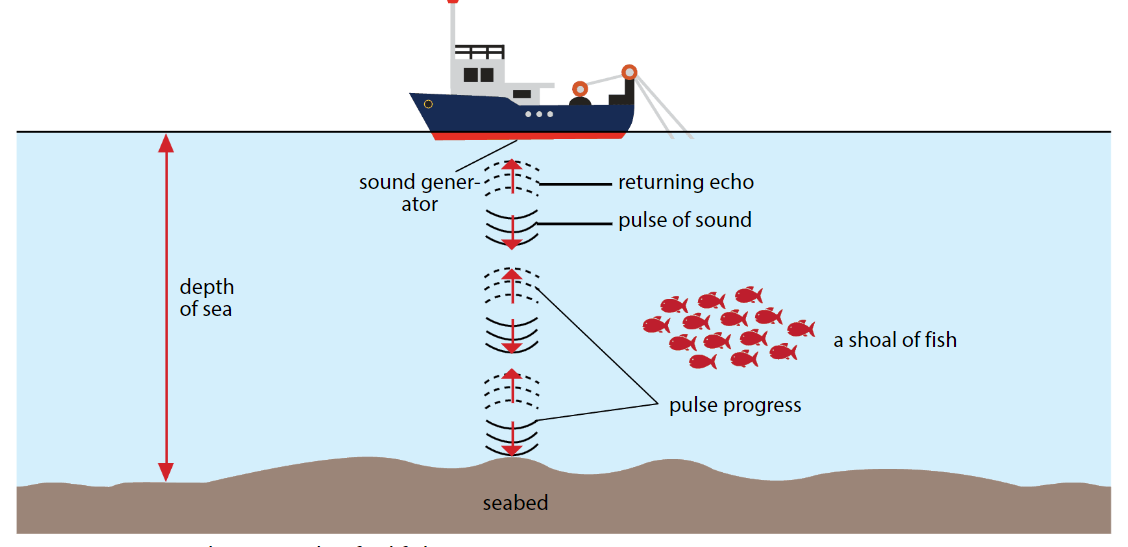
Commercial fishing boats often use sonar (Sound, Navigation And Ranging) ⇒ which emits an ultrasound pulse into the water and listens for reflected pulse.
⇒ reflected pulses will come from the shoal of fish and the sea floor.
⇒ strength of the reflected pulses will differ according to the distance and characteristics of the reflecting objects.
For Imaging internal organs ultrasound has many medical applications. ⇒ basic principles are similar to its usage in finding fish in the sea. By detecting strength, direction and timing of the reflected pulses ⇒ computer can process data very quickly to generate image of internal organs. Unlike low frequency sound, higher frequency ultrasound can be manipulated into thin beams, just like laser beams. +++
For breaking up kidney stones and cancer treatment ⇒ when ultrasound beam is focused onto a kidney stone ⇒ high intensity vibrations can break up the stone into smaller pieces so that they can be naturally expelled in urine
High intensity focused ultrasound can also be used to kill cancer or tumor cells. ⇒ advantage: is safe and non invasive method compared to surgery and other methods.
Important
speed of sound in:
- water - 1500m/s
- steel - 5000m/s
- (approx only)