Definition
Refractive index n of a medium is defined as the ratio of the speed of light in a vacuum to the speed of light in that medium. #PhysicsDefinitions
Formulae
Where, c = speed of light in a vacuum v = speed of light in the medium
Speed of light in vacuum is constant over all frequencies. → However in different media → speed of light varies with the frequency of light.
- hence values of refractive index is different for different media
For light ray passing from vacuum into a given media → refractive index n of medium is also given by this ratio.
Formulae
Where, i = angle of incidence in a vacuum r = angle of refraction in the medium
- Usually → not practical to find refractive index by measuring speed of light, thus we use the second formula above ^
- Another difficulty is that angle of incidence is in a vacuum.
- since speed of light in a vacuum and air is almost same → we can measure angle in air or in a vacuum.
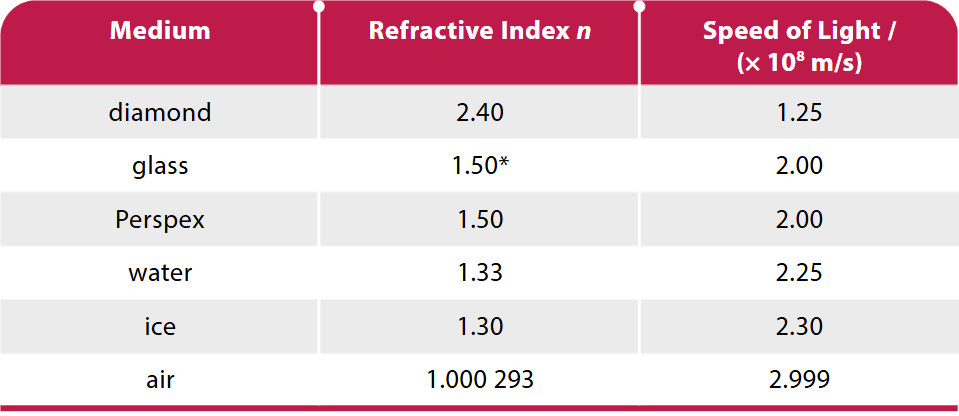
- materials with higher refractive indices → cause light to slow down more.
- Angle of refraction is smaller as light bends more towards normal
- they are described as having higher ‘optical density’
- higher optical density does not always mean that material has higher density
Summary
- higher refractive index → slow down more → bend more towards normal
- lower refractive index → slow down less towards normal → bend less towards normal
Note
An object with higher refractive index basically allows light to stay in the medium for a higher angle of incidence compared to an object with lower refractive index before total internal reflection occurs
Common Refractive Indexes
Note
Refractive index of medium → is always greater than 1 → since light travels slower in any medium than it does in a vacuum
- Air: 1.0003
- Glass: 1.5