Glass Prisms in Binoculars
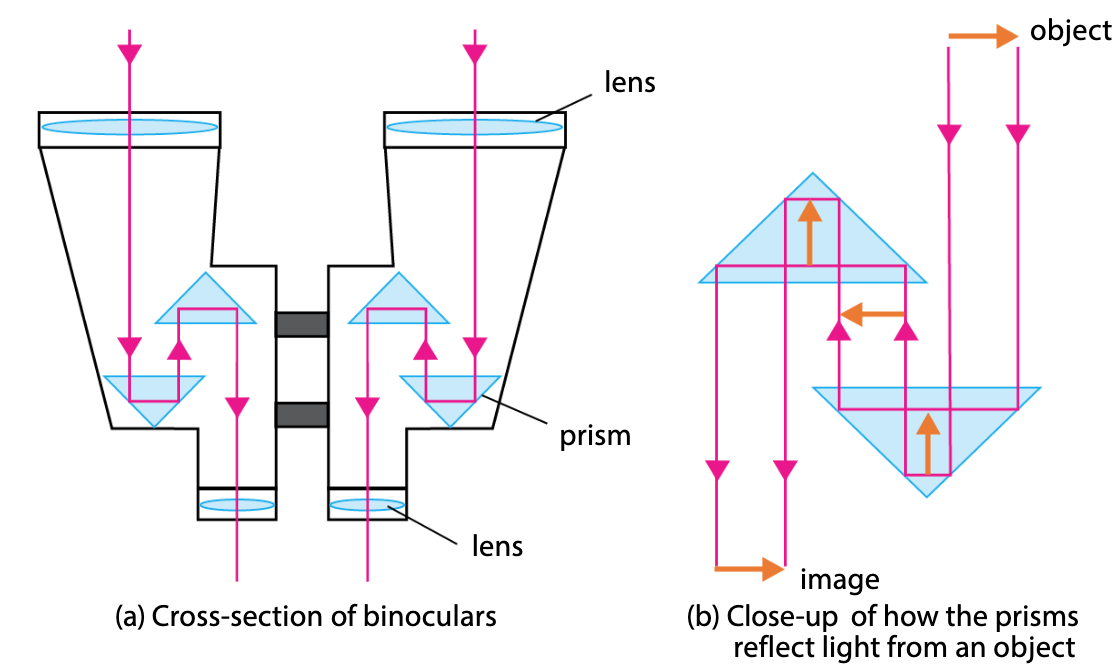
Glass Prisms → used to reflect light in binoculars Good quality binoculars → use prisms instead of mirrors
- Prisms are more durable + have better image quality
After 2 total internal reflections due to prisms → resulting image is same orientation as object
Optical Fibres
- Made of glass or plastic
- Carry information in the form of coded light pulses.
- Rely on total internal reflection of light to transmit signals
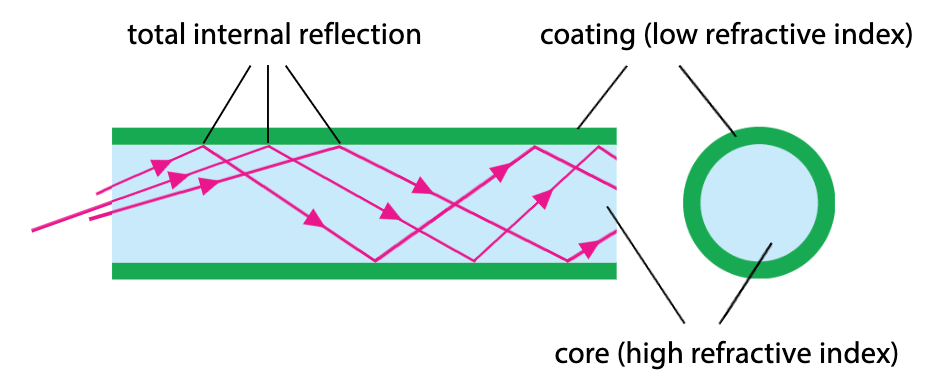
- Optical fibres are thin and flexible
- Used in telecommunication and medicine
Telecommunications
For transmission of large amounts of data → optical fibres → can be bundled to form thicker cables. Larger + longer undersea cables → span thousands of kilometres → used as communication links across continents
Advantages of using optical fibres over copper wires in telecommunications:
- Data transfer rate → tens to thousands of times faster → compared to using copper wires, radio waves, microwaves
- There is less signal loss → compared to copper cables
- Optical fibres are lighter + cheaper → compared to copper cables of similar length
Medical use
Endoscope → used to inspect insides of hollow organs → such as digestive track. → it has number of channels avaialble for surgical instruments → such as laser and camera. Being flexible → optical fibres are ideal to be used in endoscope to transmit light → for illumination and to capture images inside organs
Optical fibres also play important role in laparoscopy.
Laparoscope → small tube → with light source + camera.
- Images captures are transmitted to monitor.
- Small size and flexibility of optical fibres → make it ideal → for use in laparoscope → to transmit light. Laparoscopy → greatly reduces pain, bleeding, recovery time of patients.
Advantages of optical fibres in medicine:
- Thin and light → endoscopes and laparoscopes → kept small → for minimally invasive examination and surgery
- Flexible → endoscopes and laparoscopes → can curve around obstacles → when taking images inside body
Rain Sensor
Small device → attached to inner side of glass windshield When windshield is dry → infrared light → emitted diode (LED) → is able to reach the photodiode detector. When there are raindrops on windshield → less infrared light → reflected to photodiode detector. Thus → sensor connected to photodiode detector → will turn on windshield wiper.