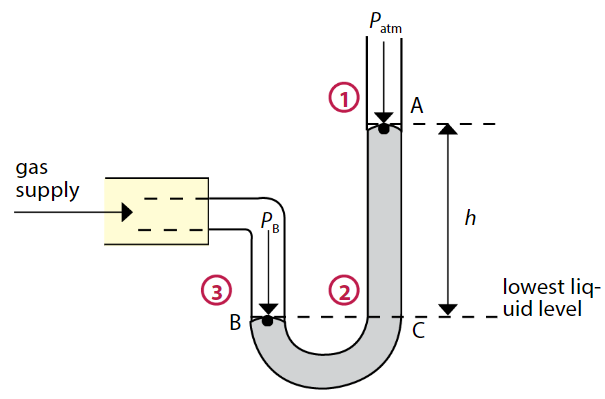
- Liquid at A is exposed to atmosphere. Thus, pressure at A is the atmospheric pressure
- When gas supply is turned on, gas will exert pressure on liquid at B. As is higher than the atmospheric pressure, liquid at A will rise until pressure at C, which is on the same horizontal level as B, equals the gas pressure. Pressure at C is given by
- Since and , we determine pressure of gas to be:
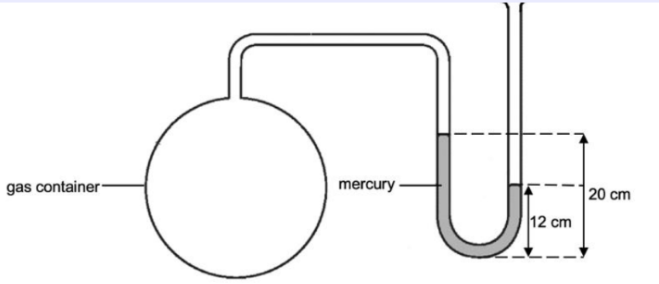
For manometer with gas pressure < atmospheric pressure
→ formula is
→
-
if both ends are exposed to atmospheric pressure ⇒ then liquids will be at the same level. Calculate the average of both heights, that is the height of both sides now
-
Explain why water cannot be used
- Water has a much lower density than mercury. This means that a very long tube needs to be used in the manometer and this is not practical. +++
Level of liquid in manometer ⇒ is independent of cross sectional area of tube