Nuclear Fission
neutron no charge can get close to positively charged atomic nucleus without being repelled scientists use neutrons to probe nuclei of various elements
Definition
nuclear fission is a process in which nucleus of an atom splits (usually into 2 parts) and releases a HUGE amt of energy #PhysicsDefinitions
- during nuclear fission → original atom becomes atoms of 2 different elements.
- this is type of nuclear reaction
- processes releases a large amt of energy
- can be represented by nuclide equation
original atom called parent nucleus
parent nucleus decays to form other atoms called daughter nuclei
daughter nuclei might be stable or may decay further
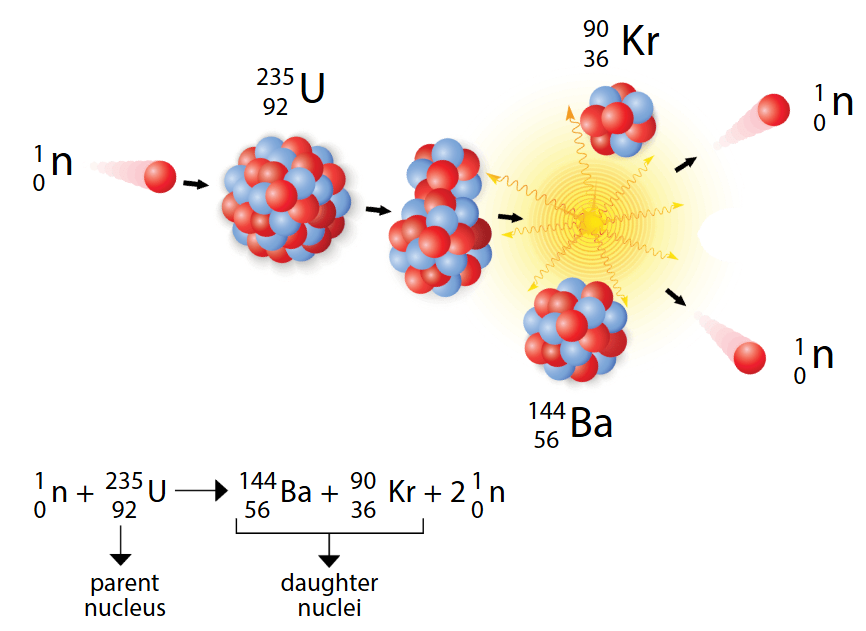
in nuclear fission → there are several possible fission products.
therefore there are several possible nuclide equations
 imp to check → total number of nucleons and total relative charge before and aft reaction is same
Nuclear Fusion
Definition
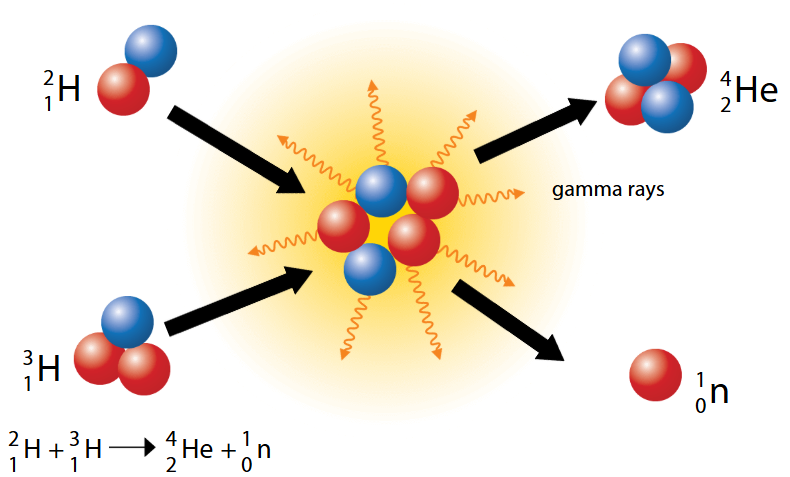
Nuclear fusion is a process in which 2 light atomic nuclei combine to form 1 heavier atomic nucleus and releases a huge amt of energy #PhysicsDefinitions
2 atoms join to- become another bigger atom of diff elements
Energy Changes During Nuclear Process
nuclear fuel → material used in nuclear power stations
- some e.g. of nuclear fuel are uranium and plutonium
- nuclear fuels undergo nuclear reactions to release energy
most nuclear fuels → can undergo and sustain nuclear fission
- isotopes like uranium-233, uranium-235, plutonium-239 are commonly involved in nuclear fission
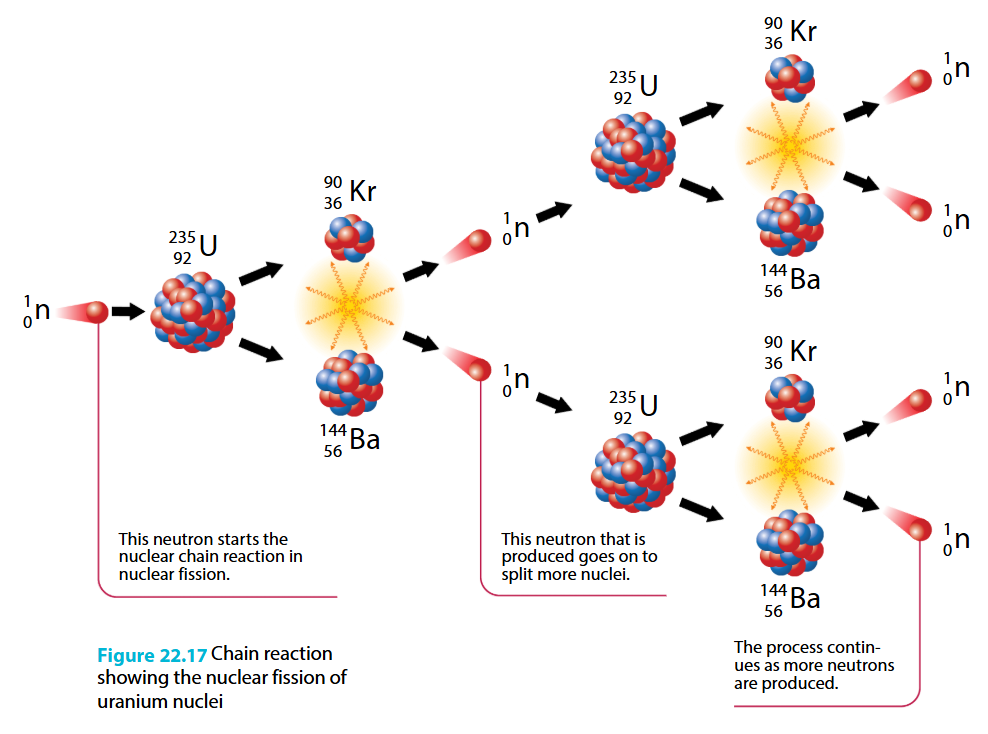
when unstable nuclei of these atoms are hit by slow moving neutron - they split
- thus 2 daughter nuclei and 2 or more neutrons are created
During nuclear fission energy is transfered from nuclear store of unstable nucleus to:
- kinetic, internal and nuclear stores of the daughter nuclei and neutrons
- internal store of surroundings
internal store of surr. → used to heat water → changes into steam.
- steam turns turbine to generate electricity
neutrons produced in nuclear fission → will go on to split more nuclei this creates self sustaining chain raection that is controlled in nuclear reactor. processes involve in mining, refining, purifying, using and disposing of nuclear fuels are collectively known as nuclear fuel cycle
not all types of nuclear fuel generate electrical power from nuclear fission
electricity can also be generated from nuclear fusion: During nuclear fusion, energy is transferred from the nuclear stores of the two nuclei to: • the kinetic, internal and nuclear store of the bigger nucleus • the internal store of the surroundings.
The internal store of the surroundings can be used in the electrical power generation process.
The nuclei of atoms are positively charged.
- Since like charges repel, it is difficult for two positively charged nuclei to combine, but once combined, nuclear forces hold the nucleus together.
- A lot of work is done to overcome the repulsive forces between the nuclei during nuclear fusion.
Nuclear fusion cannot happen at low temperature and pressure as the two nuclei cannot come into close range of each other due to the repulsive forces.
Hence, nuclear fusion requires very high temperatures and pressures and is currently not used in nuclear power plants.
Nuclear fusion can take place in the sun where temperature and pressure are high. Scientists and engineers are working on reactors where nuclear fusion can take place in a safe and controlled manner