Electric Charge
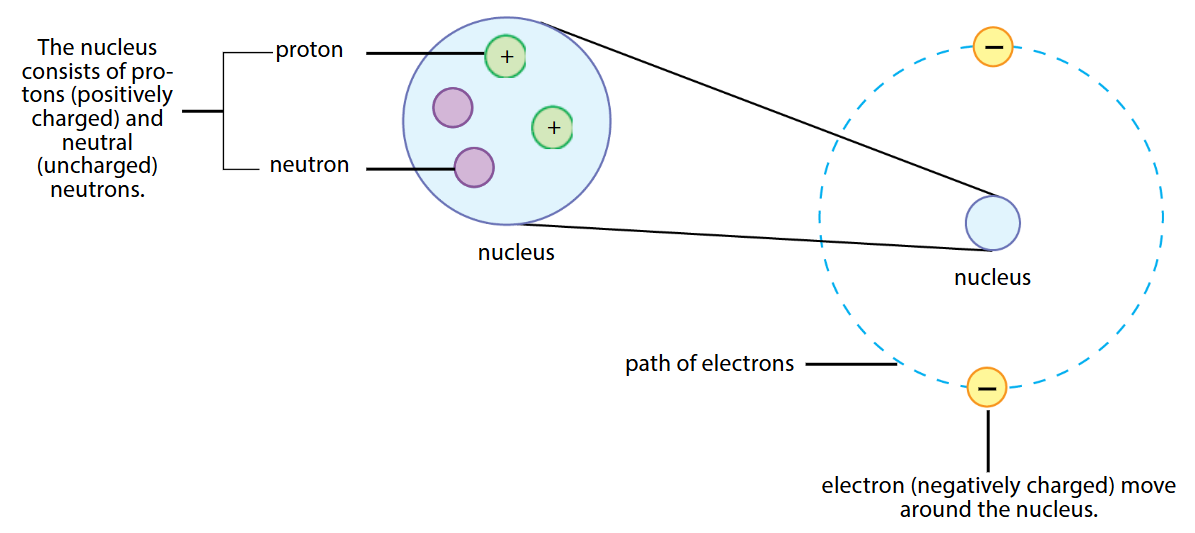
- Atom consists of electrons → orbiting a nucleus → made up of neutrons and protons
 ”Charge” → like mass → is property of object
Electron → negative charge, Proton → positive charge
”Charge” → like mass → is property of object
Electron → negative charge, Proton → positive charge
SI Unit of Charge: Coulomb (C)
Important
Each electron or proton → has same amount of charge of
electrons
Atom → equal number of protons and electrons → thus neutral.
2 charged particles - brought together - they produce attractive/repulsive forces
Note
Like charges repel each other while unlike charges attract each other
Electric Field
Electric charge - can exert force on another nearby charge.
- Known as electric force
- Can be attractive or repulsive
→ electric force gets weaker as nearby charge moves further away
Definition
Electric Field is a Region in which an electric charge experiences an electric force #PhysicsDefinitions
If we have 2 charged metal spheres X and Y → how to know nature of electric fields.
- With help of very small and light positive charge sphere (called test charge) → attached to very thin and light thread
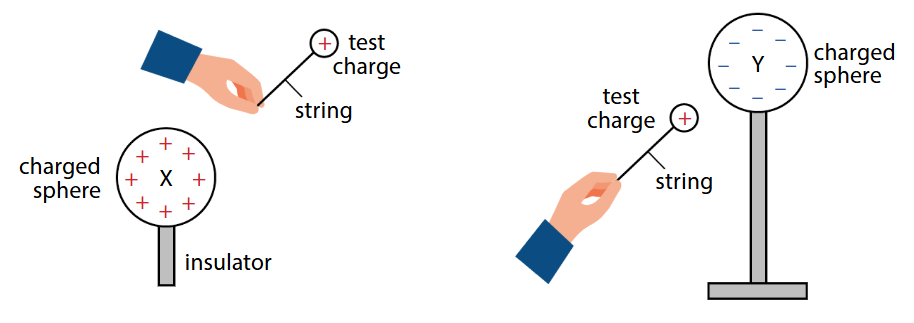 First figure → string will always be pointing radially outward from centre of X → as that is direction of electric force on the test charge.
Second figure → string will always be pointing radially toward centre of sphere → due to direction of electric force
Reality → string would not be perfectly radial due to weight of string and test charge
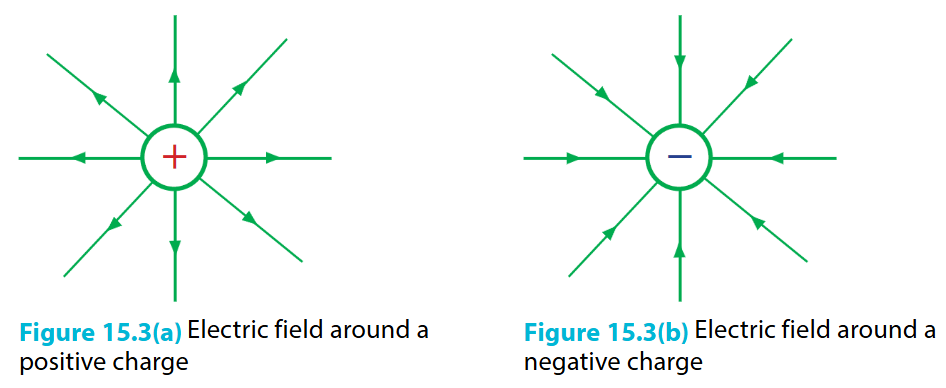
Repulsive and attractive forces of 2 electric fields → illustrated using electric field lines
- Arrowheads on lines → represent direction of electric field
First figure → electric field lines point radially outward - from positive charge.
- Positive test charge → in electric field → will be repelled by positive charge.
Second figure → electric field lines point radially inward
- Positive test charge in electric field → attracted by negative charge.
Note that field direction → has been standardised → to be direction of the force on a positive test charge
Electric field for any arrangement of charges → represented → using electric field lines according to these guidelines:
- Arrow always points towards negative charge and away from positive charge
- Lines are closer together when electric field and electric force are stronger
- Field lines never cross one another
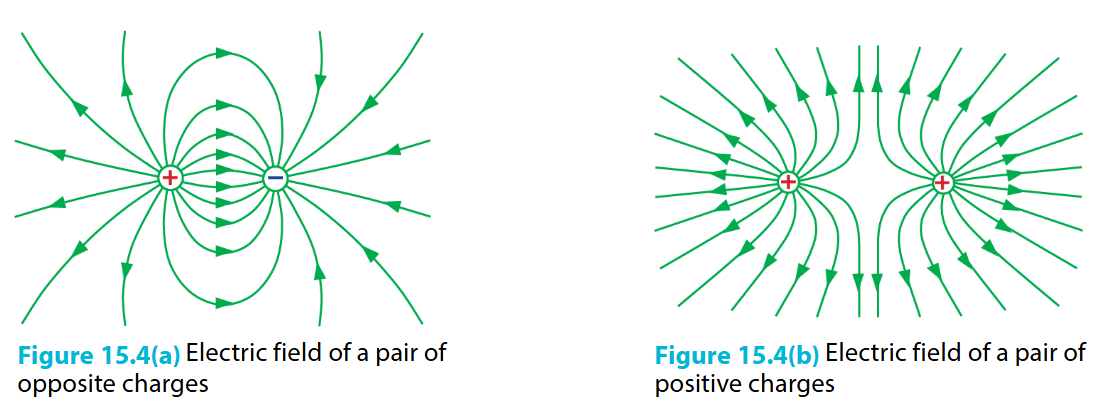
- the region in the centre for 2 like charges is known as → neutral point
- no electric field there.
Important
- when drawing electric fields → only the line along horizontal axis is straight, rest is curved (perpendicular to charged sphere along horizontal axis)
Sample
State what is shown by direction of electrical field
- shows direction of movement of a positive charge placed at that point (in the field) Note: ALWAYS is positive charge
Sample
Oil drop in the middle of 2 oppositely charged plates, suggest why it does not move up or down
- upward force on drop due to electric field/charge on plates = weight of drop Identification of forces with direction, (direction for weight is optional) magnitude of forces on the drop is equal/same and hence no resultant force
What happens when oil drop starts to evaporate?
- decrease in weight/mass of drop/ lighter Upward force due to electric field is greater than the weight of the drop oil drop moves upwards
Sample
direction of electric field is defined as the direction that a positive test charge would move if placed in the field