Human Transport System
Most common heart disease is coronary heart disease
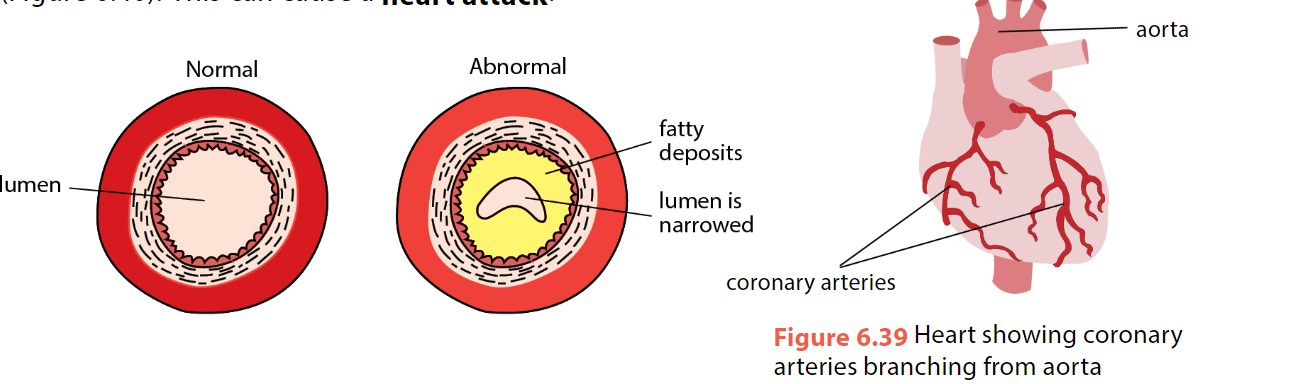
→ coronary arteries lie on the outside of the heart branching from the aorta.
they carry blood to the muscles in the walls of the heart.
Blood supply to heart muscles → is greatly reduced due to blockage of the coronary arteries.
→ can cause heart attack.
What Happens during Heart Attack → blood flow to particular part of the heart may be completely blocked due to blocked blood flow → that part of the heart does not receive sufficient oxygen and nutrients. region of heart muscle dies → extensive heart muscle damage is often fatal → as heart is no longer able to pump blood to various parts of the body.
Causes of Coronary Heart Disease Fatty substances → such as cholesterol and saturated fats > may be deposited on inner surface of coronary arteries. → called Atherosclerosis → narrows the lumen of these arteries and increases blood pressure such an affected artery→ develops rough inner surface. increases risk of blood clot being formed in the artery. → if this occurs in coronary artery → supply of Blood and O2 to heart muscles may be completely cut off. O2 is need in aerobic respiration → to release energy for activities of muscle cells./ Without oxygen → heart muscle cells may be damaged - heart attack occurs.
Risk Factors of Heart Disease
-
Smoking cigarette smoke → contains carbon monoxide and nicotine → which can increase risk of coronary heart disease. Nicotine → increases blood pressure and risk of blood clotting in arteries. Risk of smokers developing coronary heart disease → much higher than non-smokers.
-
Unhealthy diet Diet high in cholesterol, saturated fats, salt content, increases risk of high blood pressure and heart attack
-
Age Risk of heart attack increases with age. Majority of people → suffering from coronary heart disease are 65 or older
-
Sedentary lifestyle Lack of exercise and being inactive → leads to build up of fatty deposits that block the arteries. → increase risk of getting coronary heart disease.
What can we do to reduce risk of coronary heart disease
- Healthy diet → reduces the risk of atherosclerosis. Animal fats in the deity should be substituted with polyunsaturated plant fats, which do not stick to the inner surface of the arteries. Such a diet will lower cholesterol level in the blood
-
Smoking is harmful to the body and should be avoided. Cigarette smoke → contains nicotine and carbon dioxide that increases risk of getting coronary heart disease
-
Regular physical exercise has long term beneficial effects on the circulatory system. → strengthens the heart and maintains the elasticity of arterial walls. → risk of high blood pressure or hypertension can be reduced.**
Human Respiratory System
Effects of tobacco smoke on human health
Nicotine
- Increases heartbeat rate and blood pressure
- Increases risk of blood clots in the arteries, which leads to increased risk of coronary heart disease.
- Increases the risk of arteries to narrow
- In a pregnant mother, narrow arteries decrease the amount of food substances reaching the fetus, thereby affecting fetal development and may cause miscarriage.
Carbon Monoxide
- Reduces ability of blood to transport oxygen as carbon monoxide binds permanently with hemoglobin.
- Thus there will be less hemoglobin available to transport oxygen.
- In a pregnant mother, less oxygen reaches fetus through placenta which may affect fetal development
- Increases risk of coronary heart disease.
Tar
- Increases risk of cancer in lungs as tar can cause uncontrolled cell division
- Increases risk of chronic bronchitis and emphysema
- Tar paralysis the cilia lining the air passages.
- Hence dust particles trapped in mucus lining cannot be removed.
Diseases caused by tobacco smoke
Chronic Bronchitis
- prolonged exposure to irritant particles that are found in tobacco smoke may cause chronic bronchitis.
- epithelium lining of air passaged (airways) - for example bronchi becomes inflamed
- excessive mucus is secreted by epithelium
- cilia on epithelium are paralyzed, mucus and dust particles cannot be removed.
- air passages become blocked, making breathing difficult
- in order to breathe, persistent coughing occurs to clear the air passages. increases risk of lung infections.
Emphysema
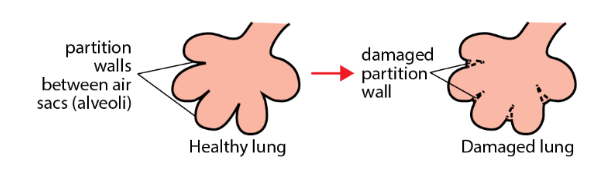
persistent and violent coughing due to bronchitis may lead to emphysema
- partition walls between alveoli break down due to persistent and violent coughing
- results in a decreased surface area for gaseous exchange
- lungs lose their elasticity and become inflated with air
- breathing becomes difficult, wheezing and severe breathlessness result.
→ when person has chronic bronchitis and emphysema - he is said to suffer from chronic obstructive lung disease.
Lung cancer
risk of lung cancer - when person smokes tobacco
smoking also increases risk of cancer of mouth, throat, pancreas, kidney, and urinary bladder
Nutrition in Humans
Harmful effects on the digestive system
- Alcohol → stimulates acid secretion in the stomach
- Excess stomach acid → increases risk of gastric ulcers.
- Prolonged alcohol abuse → may lead to cirrhosis of the liver.
- Cirrhosis → is a disease in which liver cells are destroyed and replaced with fibrous tissue, making the liver less able to function.
- Patients with alcoholic cirrhosis → may hemorrhage in the liver.
- This can lead to liver failure and subsequently death
Harmful effects on the nervous system
-
Depressant Alcohol is a depressant. Slows down some brain functions. Effects vary from one person to another.
-
Reduced self control Under influence of alcohol → a person can become carefree as alcohol takes away his self control. With self control reduced → he may do things that he may regret after the effects of alcohol have worn off.
-
Effects on reaction time As a person drinks more alcohol → other observable effects of intoxication, such as slurred speech, occur. Blurred vision, poor muscular coordination → makes him clumsy and unable to walk steadily. His judgment deteriorates → and he tends to underestimate speed. If he drives → he may drive faster and with less caution + his reactions become slower. Drunk drivers → have a higher tendency to be involved in traffic accidents.
-
Long term effects of alcohol consumption on the brain
- ‘Wet brain’: type of dementia caused by brain damage. ⇒ alcohol interferes with the absorption of vitamin B1 (thiamine) in small intestine Vitamin B1 → part of an enzyme needed to break down sugar to release energy for brain activities. Eg: in the conduction of nerve impulses.
- Shrinkage of brain volume: brain becomes smaller than normal → especially the region associated with memory and reasoning.
- Heavy consumption of alcohol during pregnancy → may interfere with the development of the fetus’ brain, which may lead to lifelong physical, mental and behavioral problems
Social implications ⇒ can become addicted to alcohol if he drinks alcohol frequently. He is unable to stop drinking until he is drink His body becomes dependent on alcohol and he becomes an alcoholic. Alcoholics may cause a lot of problems to society
- May neglect work and family
- May exhibit violent behavior → especially towards family members
- People under the influence of alcohol may tend to commit crimes.
Homeostasis (Diabetes Mellitus)
⇒ disease in which body cannot control its blood glucose concentration in order for it to remain within normal limits. ⇒ result ⇒ Blood glucose concentration can rise to a level that exceeds Kidneys ability to completely reabsorb all glucose. ⇒ glucose that is not reabsorbed is excreted in urine
Type 1 Diabetes: develops early in persons life ⇒ hence it is known as juvenile or early onset diabetes. in type 1 ⇒ islets of Langerhans are unable to produce or secrete sufficient insulin. it is inherited. Type 2 Diabetes: occurs later in persons life and hence is called late onset diabetes. Overweight people ⇒ more likely to develop type 2 diabetes. Type 2 diabetes develops when target cells ⇒ such as muscle cells ⇒ do not respond well to insulin
Signs and symptoms of diabetes:
- persistently high blood glucose level
- presence of glucose in the urine
- healing of wounds is slow or difficult
- frequent urination
- weight loss
- thirst
Treating Diabetes
diabetics ⇒ have to measure their blood glucose concentration and test urine regularly ⇒ must also watch diet carefully ⇒ making sure that they do not take in too much carbohydrates
People with type 1 diabetes ⇒ have to inject insulin regularly into fat tissue under the skin (eg into abdomen) if they use too much insulin, excersise too much or eat too little, blood glucose concentration can drop too low. ⇒ severe cases ⇒ blood glucose concentration may cause them to into a coma. Hence they always need to be ready with supply of sugary foods such as glucose sweets.
Diabetics ⇒ should also take medication that increases uptake of glucose from bloodstream into cells.
Risk factors of type 2 diabetes
in type 2 diabetes⇒ liver and muscles do not respond well to insulin. called insulin resistance unable to take in excess glucose in the blood.
hence blood glucose level remains high. ⇒ it is more common in older adults.
- Obesity: main risk
- Age: Risk is higher as you get older
- Family History: If you have family members with diabetes, you are more likely to develop this disease
- Blood Lipid levels: Risk is increased if you have high levels of ‘bad’ cholesterol or LDH and low levels of ‘good’ cholesterol or HDL in the blood
- Sedentary Lifestyle: Less active you are, the greater your risk. Physical activities help to control your weight. they use up the excess glucose to provide energy for muscular contractions and make the liver and muscle cells more sensitive to insulin
healthy lifestyle can reduce risk of getting type 2 diabetes
- eat healthily: consume foods that are low in calories and high in fiber. eat more fruits and vegetable
- Engage in more physical activities
- avoid being inactive for long periods of times, eg sitting for too long.
- Maintain a healthy body weight, based on your age and height.
HIV/AIDS
disease spread / transmitted → through sexual intercourse → called sexually transmitted infections (STIs)
- STIs → can result in irreversible physical damage/death
- caused by bacteria or viruses.
bacteria or viruses carried in bloodstream of infected person may be transmitted to uninfected person in following ways:
- through semen when it comes into contact with mucous membrane in vagina
- through fluid in the vagina when it comes into contact with the mucous membrane of the urethra
- when blood from infected person gets into bloodstream of an uninfected person
HIV
HIV →Stands for human immunodeficiency virus
- this virus → destroys the body’s immune system → the system that protects person against infection
- HIV infection might develop into AIDS in later stages
AIDS → stands for Acquired Immune Deficiency Syndrome
-
most widely known STI caused by virus
-
Normally when foreign particles → such as bacteria or viruses → enter bloodstream → white blood cells (lymphocytes) → able to identify them
-
white blood cells → then stimulated → to produce antibodies to destroy the bacteria and viruses
-
in this way ⇒ immune system protects bodies against many diseases.
-
HIV destroys persons immune system → by destroying WBC.
-
body unable to produce sufficient antibodies → to protect person against many other diseases.
-
therefore infections which are mild → may prove to be fatal to person with AIDS
Signs and Symptoms of AIDS
-
takes months/years before HIV infection develops into AIDS.
-
Pneumonia
-
Brain infection
-
Chronic or Persistent fever
-
Widespread tuberculosis (lung disease) affecting many organs at same time
-
Severe diarrhoea lasting for months
-
Kaposi’s sarcoma → cancer of blood vessels.
How is HIV Transmitted
- sexual intercourse with an infected person
- through sharing hypodermic needles with infected person
- e.g. when drug addicts share needles
- needles used for tattooing, acupuncture, or ear piercing may also transmit disease if not sterilised properly
- through blood transfusion with blood from infected person
- WHO recommends that all blood donations be screened for evidence of infection before use.
- in SG → usually not problem because all donated blood is carefully screened before use
- through pregnancy
- virus may pass from infected mother to fetus
Prevent + Control HIV Transmission
- keep to 1 sexual partner or abstain from having sexual intercourse
- males should wear condom if they are not sure whether partner(s) or themselves are infected with AIDS. this reduces risk of infection.
- do not share instruments that are likely to break skin and be contaminated with blood. e.g. razers / toothbrushes.
- go to reliable operators if you require acupuncture treatment, ear piercing or tattooing. make sure needles used are sterilised or insist on using disposable instruments. sterilisation removes living microorganisms such as bacteria and viruses from instruments