Definition
Carbohydrates are organic molecules made of the elements carbon, hydrogen, oxygen. hydrogen and oxygen atoms are present in the ration 2:1 #BiologyDefinitions
- Glucose:
- Sucrose (Cane sugar):
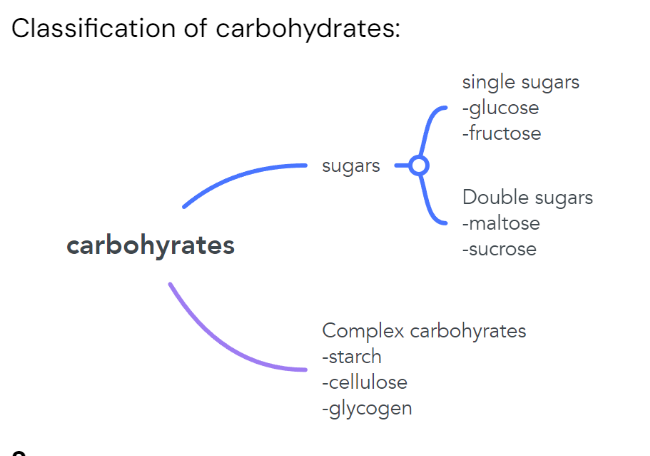
Sugars:
- sweet and soluble in water
- when dissolved in water ⇒ it lowers WP of solution
- sugars provide us with the energy to do work and carry out activities
Single Sugars (Monosaccharides) → basic unit of a carbohydrate → can pass through cell membrane and be absorbed into cells
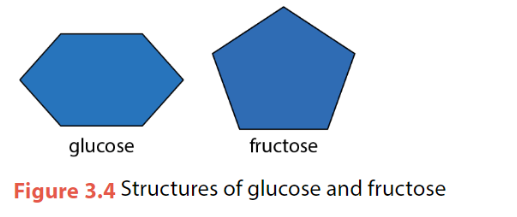
common single sugars: glucose and fructose Both have chemical formula of ⇒ atoms are arranged differently within molecules ⇒ diff. arrangement gives rise to different chemical and physical properties
Glucose ⇒ found in both plants and animals Fructose ⇒ common plants, rare in animals
Double Sugars (Disaccharides) ⇒ formed when 2 single sugars join together common double sugars ⇒ maltose and sucrose
maltose (malt sugar)⇒ occurs in germinating grains
formed when 2 glucose molecules bond together

Sucrose molecule ⇒ made up of 1 fructose and 1 glucose molecule joined together
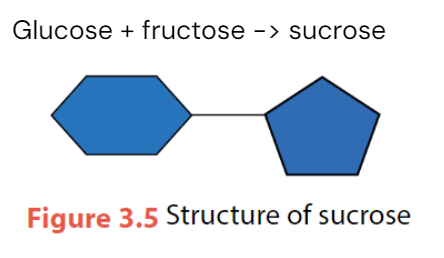
Double sugar ⇒ can be split into 2 single sugars molecules ⇒ using an organic molecule called enzymes.

How can we test for sugars? ⇒ we can use benedict’s test to test for sugars. refer to → Food Tests
Complex Carbohydrates (Polysaccharides)
→ made up of many similar molecules of simple sugars joined together to form a large molecule
Starch, glycogen, cellulose ⇒ complex carbohydrates made up of numerous glucose molecules.
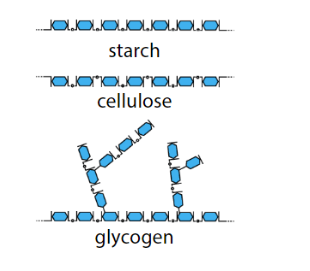
- glucose molecules linked in different ways ⇒ giving rise to diff structures
- thus they also have diff chemical and biological properties
- also have diff roles
| Complex Carbohydrate | Structrure | Role | Occurance |
|---|---|---|---|
| Starch | made up of several thousand glucose molecules joined together in long straight chains | → storage form of carbohydrates in plants → when required it can be digested to form glucose to provide energy for cell activities. | → storage organs of plants ⇒ potato, tubers, tapioca |
| Cellulose | cellulose molecules are made of many glucose molecules joined together ⇒ made up of straight chains of glucose. ⇒ bonds between glucose units are different from that in starch | → cellulose cell wall prevents cells from bursting or damage. → cellulose cannot be digested in our intestines → serves as dietary fibre that prevents constipation. | Present in cell wall of plant cells |
| Glycogen | glycogen is a branched molecule. → chains of glucose that are highly branches | Storage form of carbohydrates in mammels. ⇒ when needed it can be digested to glucose to provide energy for cell activities. | muscles and liver of mammels |
Glycogen and starch are stores of glucose plants → store glucose in the form of starch animals → cannot make or store starch in their bodies (however, they get most carbohydrates from plants in form of starch)
animals main store of energy → glycogen.
- stored mainly in liver and muscles
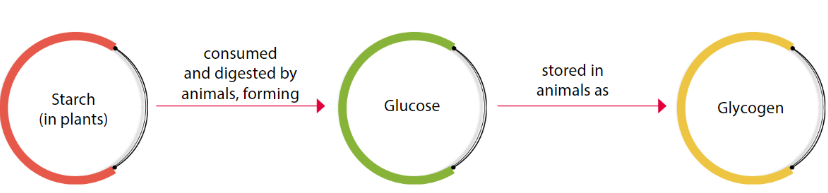 glucose and starch are suitable storage materials in cells as:
- they are insoluble in water ⇒ do not reduce WP of cells
- large molecules ⇒ cannot diffuse through cell membranes of cells ⇒ will not be lost from cell
- Easily broken down into glucose when needed ⇒ eg: tissue respiration
- molecules have compact shapes ⇒ occupy less space that all the glucose molecules that make up glycogen or starch molecules.
Function of Carbohydrates Functions of Biological Molecules Quick Reference:
- substrate for respiration to provide energy for cell activities(immediate source of energy)
- Formation of nucleic acids - DNA
- form supporting structures - cell walls in plants
- converted to other organic compounds like proteins and fats
- synthesize lubricants ⇒ mucus ⇒ which is made up of a carbohydrate and a protein
- synthesize nectar in some flowers
Test For Starch Refer to: Food Tests