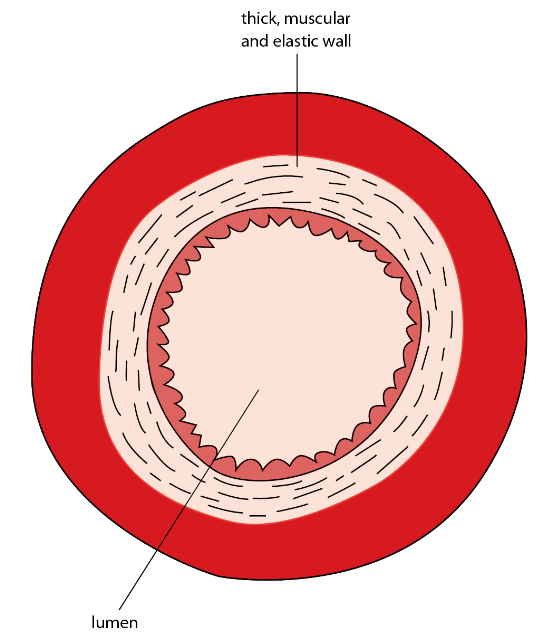
→ receives blood directly from the heart. → Transport blood away from the heart
→ they need to be able to withstand high pressure of blood forced out of the heart. Blood that flows in the arteries is fast moving
- thus arteries have walls that are thick, muscular and elastic
- Elastic layer is much thicker in arteries nearest to the heart.
These elastic layers → enable arteries to withstand high blood pressure in the artery.
- elasticity enables artery walls to stretch and recoil or spring back
- this helps to push blood in spurts along the artery and also gives rise to the pulse
Contraction and relaxation of muscles in the arterial wall → brings about constriction and dilation of the artery.
- when artery constricts → lumen becomes narrow and less blood flows through it per unit time.
- when Artery Dilates → lumen becomes wider and more blood flows through per unit time. → this enables smooth and continuous blood flow.
Arteries → carry oxygenated blood (except for pulmonary arteries which carry deoxygenated blood from the Heart to the lungs. )
Arteries Branch to form arterioles.