Deoxyribonucleic Acid (DNA) → carries genetic information.
- information carried by DNA → important for ALL cellular functions
- e.g. cell division, cell differentiation (process by which unspecialised cells develop into specialised cells, with distinct structures and functions)
Cells → cannot carry out vital functions → without DNA
- Thus almost all cells contain DNA inside nuclei.
- About 2m of DNA inside each cell nucleus
How Is DNA Organised Inside Cells
How is DNA Organised Inside Cells
How is DNA, Chromosomes, Genes Related
Relation Between DNA, Chromosomes, Genes
What are Genes
How Can Genes Be Transferred Between Organisms
Transfer of Genes Between Organisms
Considerations Surrounding Genetic Engineering
Considerations Surrounding Genetic Engineering
Sample
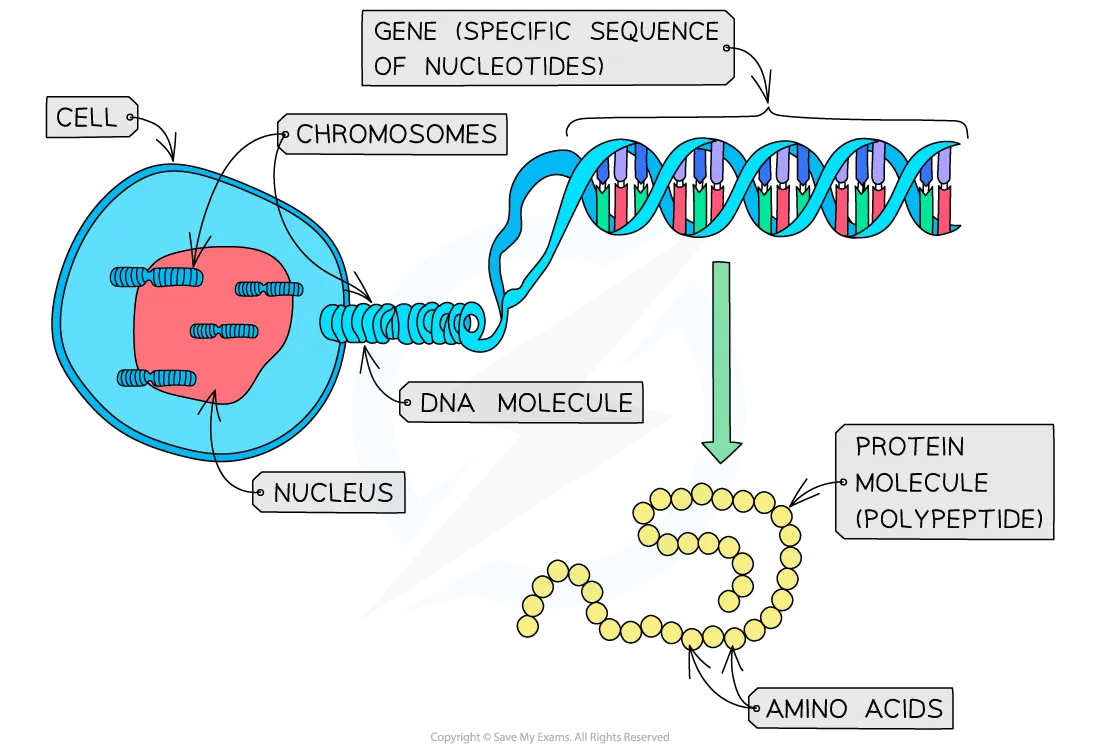
Outline the Relationship among DNA, genes and chromosomes
- gene is a specific/short length/sequence/segment/section of DNA, encoding a single polypeptide/protein
- Gene occupies a position on a chromosome
- a molecule of DNA is wrapped around proteins to form a single chromatin thread. During cell division, chromatin threads coil / condense tightly into chromosomes in the nucleus
Sample
Describe the structure of DNA
- Basic unit of deoxyribonucleic acid is a nucleotide
- Each nucleotide is made of a deoxyribonucleic sugar, a phosphate group, and a nitrogenous base
- the 4 possible nitrogenous bases are adenine, thymine, guanine, cytosine
- nucleotides join via covalent bonds to form a polynucleotide chain
- 2 polynucleotides are held together via hydrogen bonds between the nitrogenous bases
- according to the complementary base pairing rule i.e. adenine is complementary to thymine + guanine is complementary to cytosine
- bases of one chain are bonded to those of the opposite chain via the complementary base pairing rule
- the 2 polynucleotide chains are anti parallel to each other
- the 2 polynucleotides twist to form a double helix structure, which is DNA
- DNA molecule is made up of 2 polynucleotide strands