Basic Units of DNA
- Basic Unit of DNA is called nucleotide Each nucleotide is made up of:
graph TB
	Nucleotide --> Phosphate_Grp
	Nucleotide --> Sugar_Deoxyribose
	Nucleotide --> Nitrogenous_Base
Nitrogenous Bases
4 Different Nitrogenous bases
- Adenine (A)
- Cytosine (C)
- Guanine (G)
- Thymine (T)
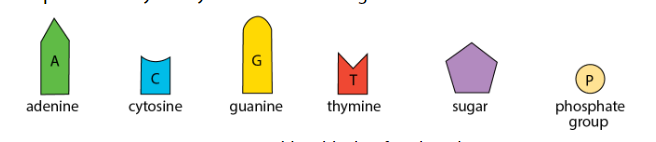
Putting Nucleotides Together
Sugar, Phosphate group, One of the 4 bases can combine to form a nucleotide as shown below.
Important
Nucleotides are the building blocks of DNA Phosphate grp + deoxyribose + nitrogen containing base = nucleotide
 nucleotides can be joined together to form long chains → called polynucleotides
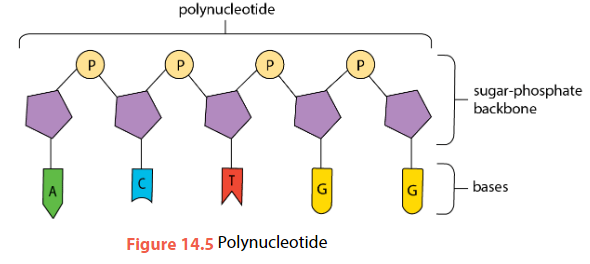
Each Gene → made up of a sequence of Nucleotides. Sequence of Nucleotides (bases) can vary.
- this results in many different genes Refer to What Are Genes
Note
since there are 4 diff nucleotides, then a gene of n number of nucleotides will have different combinations
Rule of Base Pairing
DNA molecule → made up of 2 polynucleotide chains Sugar-phosphate backbone → found on the outside of DNA molecule, while bases are found on the inside of DNA molecule. Bases of one chain are bonded to those of the opposite chain according to rule of base pairing
- Adenine (A) is bonded to Thymine(T)
- Cytosine(C) is bonded to Guanine(G)
→ called complementary base pairing → because A has shape complementary to that of T and C has shape complementary to that of G
- complementary bases are held by hydrogen bonds
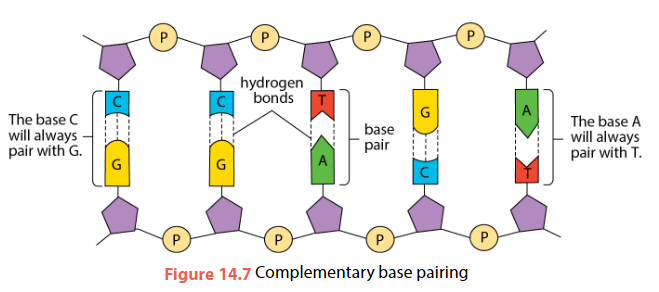
In DNA molecule: ratio of adenine to thymine (A:T) and cytosine to guanine (C:G) are ALWAYS 1:1