Path of water through the plant → colored water and celery stem. leaves becomes colored
How can we Study Path Food Substances Take Through a Plant
Definition
Translocation is the transport of manufactured food substances, such as sugars (sucrose) and amino acids, from the leaves to the other parts of the plant via phloem #BiologyDefinitions
⇒ it is bi directional → food substances can move either down phloem tissues of the shoots to the top roots, or up phloem tissues of shoots to the leaves/flower buds
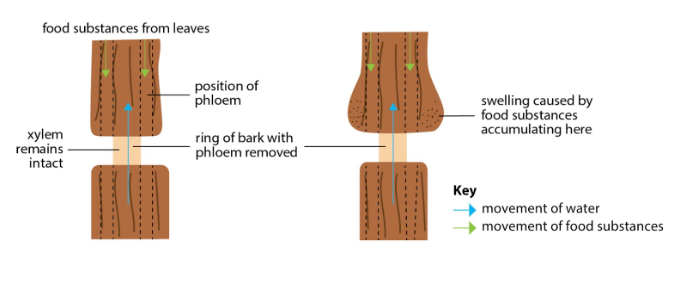
Ringing Experiment Rings of bark with phloem ⇒ removed from stem of woody plant After some time ⇒ stem immediately above cut swells up
- phloem removed ⇒ food substances from leaves cannot reach the stem below cut region
- They accumulate above cut region, causing it to swell up
Using Aphids in Translocation Studies Insects ⇒ aphids ⇒ feed on plant juices → Long mouthpart(stylet) - penetrates the leaf of the stem. Aphid ⇒ can be anesthetized with CO2 while it is feeding. Body of the aphid is cut off - leaving only feeding stylet in plant tissue. Liquid - will exude from the cut end of the stylet. Liquid shows that it contains sucrose and amino acids. When the stem is sectioned and examined under microscope - feeding style of aphid is inserted into the phloem in the tube. This shows that translocation of sugars and amino acids occur in the phloem.
Using Isotopes in Translocation Studies Carbon -14 → radioactive carbon isotope. Its presence can be detected by an X-ray photographic film. Leaf is provided with carbon dioxide containing radioactive carbon -14. When photosynthesis occurs → sugars formed will contain radioactive carbon. (sucrose when it is being transported contains radioactive carbon) Stem is then cut - a section of it is exposed onto X-ray photographic film. Found that radioactive substances are present in the phloem, since radioactive substances cause X-ray film to darken.