Structure of a Leaf
External Features of a Leaf
Internal Structure of a Leaf
From the above structures we learnt, we can look at Adaptations of Leaf for Photosynthesis
Guard Cells and How they Control Size of Stomata
Guard Cells and How they Control Size of Stomata
Movement of Carbon dioxide and Water into the Leaf
How does Carbon Dioxide enter the Leaf How do Xylem VesselsTransport Water and Mineral Salts to the Leaf Once green cells ⇒ receive essential raw materials like and water ⇒ they can manufacture food by photosynthesis Phloem then transports sugars made in the leaf to other parts of the plant in the form of sucrose
Phloem and Xylem Vessels
Arrangement of Vascular Tissue in Different Sections
-
Within Vascular Bundle ⇒ xylem is located closer inside. ⇒ Phloem lies outside xylem with tissue called cambium between them
-
Stem ⇒ covered by layer of cells called epidermis. ⇒ epidermal cells → protected by a waxy, waterproof cuticle that greatly reduces evaporation of water from the stem.
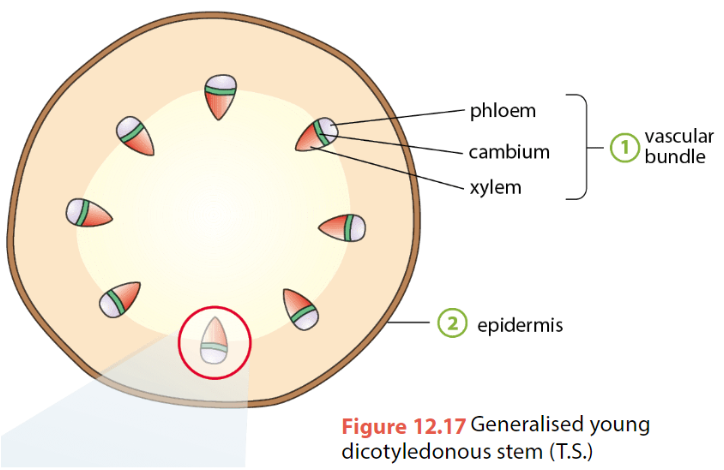 Vascular Tissue in leaves
⇒ found along spongy mesophyll
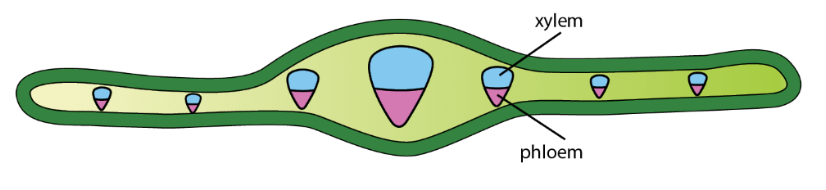
⇒ within vascular bundle ⇒ xylem is closer to upper surface of leaf and phloem closer to lower surface of the leaf.
Vascular Tissue in leaves
⇒ found along spongy mesophyll
⇒ within vascular bundle ⇒ xylem is closer to upper surface of leaf and phloem closer to lower surface of the leaf.
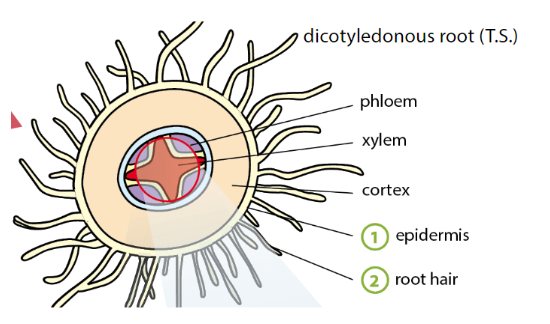
 Vascular Tissue in Roots
 -
Epidermis of root is the outermost layer of cells. It bears root hair
-
Each root hair → long narrow extension growing out of an epidermal cell Long and narrow extension of root hair increases SA to V ratio of root hair cell ⇒ Rate of absorption of water and mineral salts is increased thru this adaptation
Photosynthesis
Photosynthesis Sub notes:
- Limiting Factors in Photosynthesis
- What Happens to Glucose Formed during Photosynthesis
- Importance of Photosynthesis
How can we Study Movement of Substances in Plants
How can we Study Movement of Substances in Plants
How does Water Enter a Plant + Move up a Plant
How does Water move up a Plant
⇒ main force that moves water up a plant is known as transpiration pull ⇒ created from a process known as transpiration Transpiration
Wilting
Other Important Info
Sodium hydroxide solution: alkaline solution which reacts with CO2 (acidic gas) hence removing CO2 from air
Hydrogen carbonate indicator: PH indicator which changes color with respect to PH of a solution.
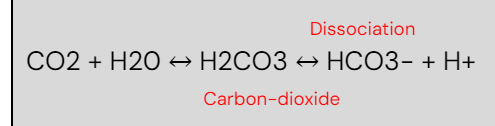
CO2 dissolves in water to produce carbonic acid - which increases concentration of H+ ions in solution. PH - indication of concentration of H+ in the solution
Higher PH - lower the H+ (alkaline) Lower PH - higher the H+ (acidic)
When rate of P > rate of R, more CO2 taken in than given out At The rate of R > P, more CO2 is given off than taken in.
Important
need to state chlorophyll