| Structure | Elaboration |
|---|---|
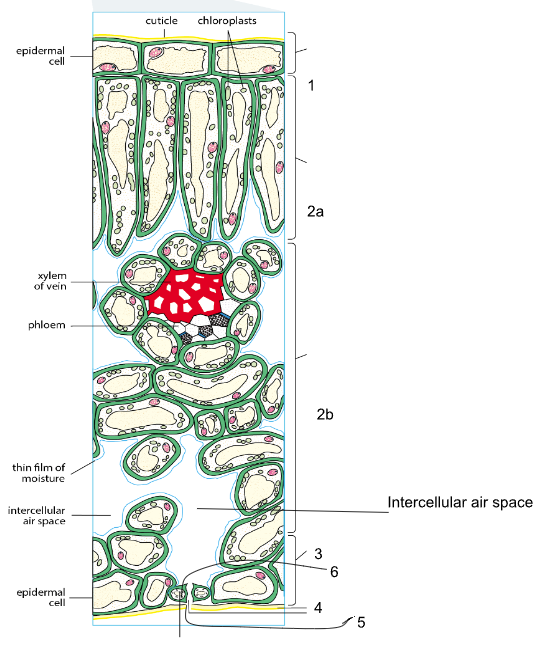
| 1. Upper Epidermis | Leaf blade ⇒ has an upper epidermis made up of a single layer of closely packed cells. ⇒ upper epidermis is covered on the outside by a transparent and waxy cuticle. |
| 2. Mesophyll | Mesophyll ⇒ lies just between upper and lower epidermis → main site for photosynthesis → contain 2 types of tissue → palisade mesophyll and spongy mesophyll 2a) Palisade Mesophyll - consists of 1-2 layers of closely packed, long and cylindrical cells → so that more cells can be contained per unit area. - Contains numerous chloroplasts - it is specialized for photosynthesis. 2b) Spongy Mesophyll - Contains cells with an irregular shape - Numerous large intercellular air spaces between loosely packed cells. - carries out photosynthesis ⇒ but contains fewer chloroplasts than the palisade mesophyll. - cells are covered with a thin film of moisture - Contains transport tissue - phloem and xylem → which are grouped together to form the vascular bundle |
| 3. Lower Epidermis | Beneath mesophyll is the lower epidermis → also consists of a single layer of closely packed cells. contains many minute openings called the stomata |
| 4. Cuticle | Cells are covered by outer layer of cuticle (waxy and transparent) ⇒ reduces water loss from epidermis cells through evaporation ⇒ transparent so that light can pass through |
| 5. Stomatal Pore (stoma) | Lower Epidermis ⇒ contains many minute openings called stomata. |
| 6. Guard Cell | Found in lower epidermis ⇒ a pair surrounds each stoma ⇒ helps to regulate rate of transpiration by opening and closing stoma. contains chloroplasts (chlorophyll) ⇒ which are not present in other epidermal cells. >Exam Phrasing: Guard cells control the size (opening and closing is rejected) of stomata. They also regulate gaseous exchange (intake and release of oxygen and carbon dioxide, as well as loss of water vapor) between leaves and the environment. |
| Adaptations of Leaf for Photosynthesis |