Not all water absorbed is used by leaves of the plant ⇒ some water is removed when it is evaporated from aerial parts of the plant
Definition
Transpiration is the loss of water vapor from the aerial parts of the plant, mainly through the stomata of the leaves #BiologyDefinitions
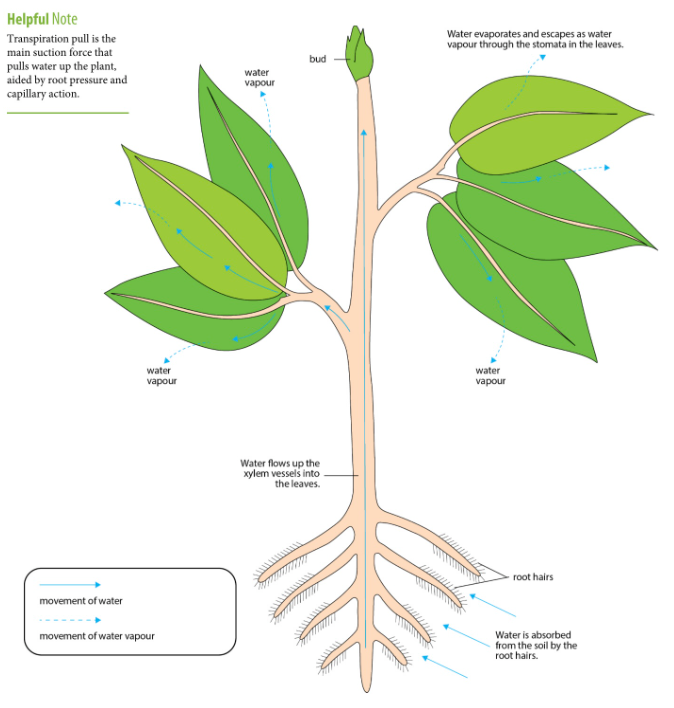
How is transpiration involved in moving water against gravity
Evaporation of water ⇒ from leaves ⇒ removes water from xylem vessels
- results in suction force which pulls water up the xylem vessels
- Suction force due to transpiration ⇒ known as transpiration pull
- It is the main force in drawing water and mineral salts up the plant
 Why is water uptake calculated not necessarily equal to rate of water loss thru transpiration
⇒ Water molecules taken in by transpiration pull will not be all lost through stomata during transpiration.
Some water molecules ⇒ will be used for other processes ⇒ such as photosynthesis and maintaining cell turgor
Why is water uptake calculated not necessarily equal to rate of water loss thru transpiration
⇒ Water molecules taken in by transpiration pull will not be all lost through stomata during transpiration.
Some water molecules ⇒ will be used for other processes ⇒ such as photosynthesis and maintaining cell turgor
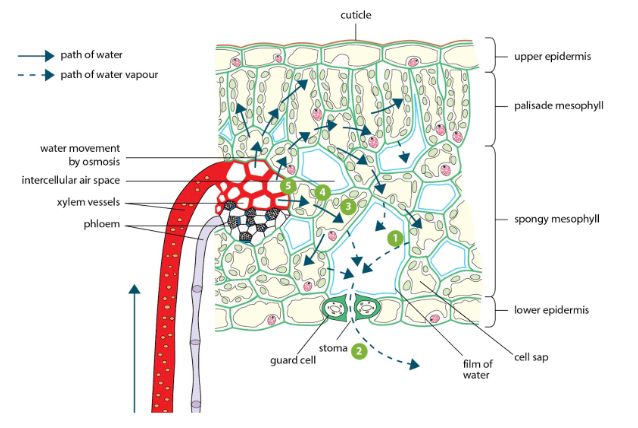 | 1. Thin Film of moisture ⇒ surrounds the mesophyll cell. → water evaporates from this thin film → to form water vapor intercellular air spaces. 2. Water vapor ⇒ diffuses through (intercellular air spaces) stomata (higher concentration) → to the drier air outside the leaf (lower concentration). This is transpiration. 3. As water evaporates from thin film of moisture ⇒ more water moves out from mesophyll cells via osmosis to replenish it. ⇒ as water is lost from mesophyll cells ⇒ WP of cell sap decreases ⇒ becomes lower tha that of their neighboring mesophyll cells. 4. Mesophyll cells ⇒ draw water from cells deeper inside leaf by osmosis. 5. Cells deeper inside leaf ⇒ draw water from xylem by osmosis. ⇒ creates a suction force which pulls a whole column of water up the xylem vessels. Known as transpiration. |
| Transpiration ⇒ occurs mainly through stomata ⇒ linked to gas exchange between plant and env. | |
| ⇒ in daylight when stomata open to allow to diffuse into the leaf for photosynthesis. | |
| Oxygen and water vapor ⇒ more concentrated in intercellular air spaces ⇒ diffuse out of the leaf through stomata. |
Why is transpiration inevitable in daylight ⇒ photosynthesis occurs. Stomata open ⇒ to allow diffusion of carbon dioxide into the leaves + oxygen to diffuse out of the leaves. Since concentration of Water vapor ⇒ is high in the intercellular air spaces compared to external environment ⇒ water vapor will also diffuse out of the leaves ⇒ which results in transpiration.
Importance of Transpiration
Although excessive transpiration is harmful to the plant ⇒ transpiration has certain uses:
- Transpiration pull ⇒ is a major suction force for moving water and mineral salts up the xylem from the roots to the stem and the leaves. (aerial parts of the plant)
- Evaporation of water from surface of cells in leaves ⇒ cools the plant ⇒ preventing it from being scorched by the hot sun
- Water transported to leaves ⇒ can be used in photosynthesis → to keep cells turgid → and to replace water lost by cells. Turgid cells ⇒ keep leaves spread out widely to trap most amount of light for photosynthesis.
How to measure rate of transpiration under Diff Conditions
Potometer ⇒ used to measure rate of absorption of water by plant. ⇒ assuming rate of water absorption ⇒ is directly proportional to the rate of transpiration > potometer can then be used to measure rate of transpiration. Shoots that are used in potometer ⇒ must be cut under water. Cut end ⇒ kept immersed in water for a few hours before use. Allows shoots to adjust to the conditions of the potometer
Potometer ⇒ can also be used to determine effects of diff. environmental conditions on rate of transpiration.
- investigate effect of temperature ⇒ can compare rate of transpiration in room with an air conditioner ⇒ where temp can be controlled
- Investigate effect of wind speed⇒ compare rate of transpiration ⇒ in room with ceiling fan switched on and switched off
- Investigate effect of light intensity ⇒ compare rate of transpiration in dark room with table lamp at various distances from plant.
Factors that Affect Rate of Transpiration
transpiration ⇒ involved evaporation ⇒ any factor that affects ROE affects ROT.
-
Wind of air movement Affects concentration of water vapor ⇒ in air around stomata Stronger wind ⇒ water vapor ⇒ that diffuses out of stomata is blown away ⇒ steeper concentration gradient of water vapor → inside and outside the leaf → higher ROT. Still air ⇒ water vapor accumulates ⇒ outside the leaf → decreased concentration gradient of water vapor → lower ROT.
-
Temperature of Air Assuming other factors remain constant ⇒ rise in temperature of surroundings ⇒ increase rate of evaporation of water from cell surface. ROT ⇒ is higher at higher temperatures Increasing temperature ⇒ causes water from thin film of moisture ⇒ to evaporate faster ⇒ more water vapor ⇒ accumulates in the intercellular air spaces in the leaf. Concentration gradient of WV ⇒ between intercellular air spaces and surrounding air ⇒ is steeper → WV thus diffuses out from stomata faster
-
Light Light ⇒ affects size of stomata on leaves therefore it affects ROT. In presence of light ⇒ stomata open and become wider ⇒ increases ROT in dark ⇒ stomata closes and becomes smaller in size ⇒ less water is lost from the leaf
-
Humidity of the air Affects WV concentration gradient between leaf and surr. air. Low humidity → less WV in the surr. air ⇒ steeper CG ⇒ higher rate of transpiration High Humidity ⇒ more WV in the surr. air ⇒ less steep WV CG ⇒ lower rate of transpiration
Plants living in dry conditions ⇒ special structures that help them control transpiration rate
Marram grass ⇒ sunken stomata ⇒ lie in grooves in the upper surface of leaves
- grooves contain tiny hairs ⇒ that trap WV diffusing out of the stomata
- increases humidity around stomata ⇒ reduces ROT.