Definition
Phloem transports Sucrose and Amino acids between leaves and other parts of the plant #BiologyDefinitions
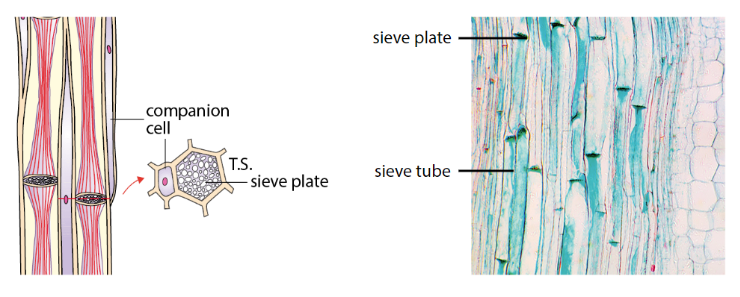
- Consists mainly of sieve tubes and companion cells
- Each sieve tube ⇒ consists of a column of elongated, thin walled living cells called sieve tube cells or sieve tube elements
- A sieve tube is made up of sieve tube cells that are joined end to end to form a continuous column with sieve plates in between
- Cross walls ⇒ separating cells ⇒ have a lot of minute pores. they look like a sieve and are called sieve plates
- Phloem sieve tube elements have very little protoplasm ⇒ and are arranged to form a continuous column.
- Mature sieve tube cell ⇒ only has a thin layer of cytoplasm inside the cell ⇒ that is connected to cells above and below it through holes in the sieve plates
- No vacuole, nucleus or most organelles
→ pores in the sieve plates allow for rapid and smooth flow of manufactured food substances from the leaves to the other parts of the plant through sieve tubes
- each sieve tube cell ⇒ also has a companion cell beside it that provide nutrients + helps the sieve tube cell to transport manufactured food
- Each companion cell → narrow thin walled cell with many mitochondria, cytoplasm and a nucleus
→ companion cell → carries out metabolic processes needed to keep the sieve tube cell alive
→ Numerous mitochondria in the companion cells → allow faster rate of respiration → release more energy for companion cells → to transport and load sieve tubes with sugar from mesophyll cells by active transport.