Definition
Assimilation is the process whereby some of the absorbed nutrients are converted into new cytoplasm or used to provide energy #BiologyDefinitions
How are glucose and amino acids transported and utilized after absorption - blood in the villi is now rich in nutrients. Blood capillaries - unite to form larger blood vessels → which in turn unite to form a large vein → the hepatic portal vein. ⇒ transports nutrients from the small intestine to the liver
In liver → most of the absorbed sugars are converted into glycogen and stored.
Some glucose → transported by blood leaving liver and distributed around the body
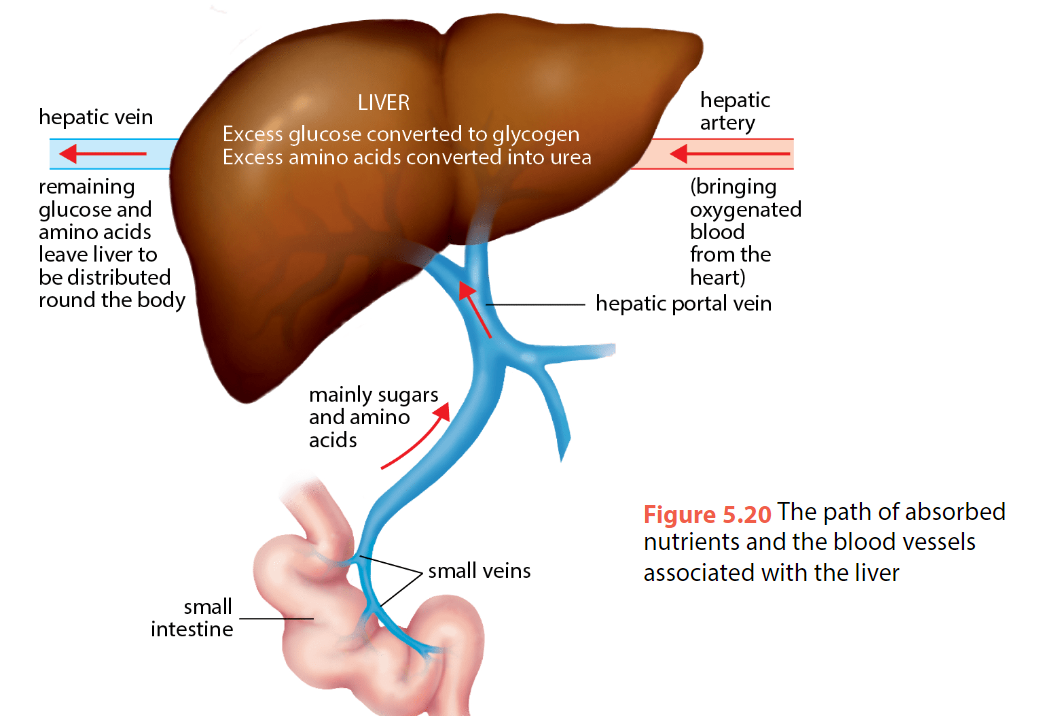
- All cells use glucose as a source of energy. Glucose is assimilated → then broken down during tissue respiration to release energy → for vital activities in cells.
- Excess glucose → returned to liver → converted to and stored as glycogen. Hormone called insulin → produced by islets of Langerhans in Pancreas → stimulates liver cells → to convert excess glucose into glycogen.
- When the body needs energy → the liver converts stored glycogen back into glucose by hormone glucagon(secreted by islets of Langerhans). Glucose → then transported by blood to cells.
- Amino acids that enter body cells → are converted to new cytoplasm → used for growth and repair of worn out parts of the body
- Amino acids → also use to form enzymes and hormones.
- Excess amino acids are deaminated in the liver.
How are fats transported and Utilized Fats → absorbed into lymphatic capillaries. Lymphatic capillaries → join to form larger lymphatic vessels → which discharge fats into the bloodstream. blood → carries fats to all parts of the body especially the liver. here → fats are converted to forms that can either be broken down or stored.
- Under normal conditions → when there is sufficient glucose → fats are not broken down. they are used to build protoplasm → example in cell membranes.
- When glucose is short in supply → during fasting → fats broken down to provide energy needed for vital activities of the body.
- excess fats → stored in special tissues → adipose tissues → which can be found beneath skin, and around heart and kidneys.
- Adipose tissues → protect these organs by acting as shock absorbers.