Metal atoms - held strongly together by metallic bonding. In solid state - these atoms form a giant metallic lattice structure.
- Metal atoms lose their valence electrons and become cations.
- These electrons no longer belong to any metal atom and are said to be delocalized.
- They can move freely between the metal ions like a cloud of negative charges
Giant Metallic lattice structure - described as a lattice of positive ions surrounded by a ‘sea of mobile electrons’.
Definition
Metallic bonding is the strong electrostatic forces of attraction between positively charged ions in metal and negatively charged ‘sea of mobile’(delocalized) electrons. #ChemistryDefinitions
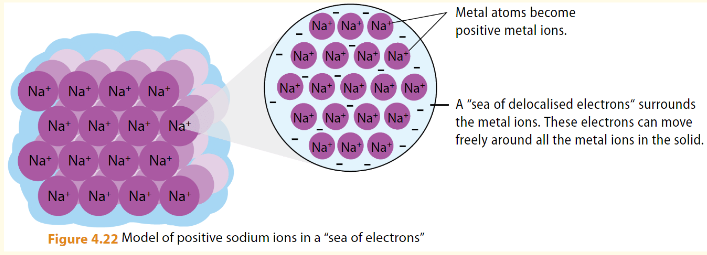 *Most metals are solid @r.t.p hence the metal ions must be orderly arranged in the lattice structure.
However, there must be some spaces between the ions as the space is occupied by the sea of delocalized mobile valence electrons. Ensure that you draw the correct number of electrons in the sea of delocalized electrons. Number has to be equal to the number lost by all the atoms combined.
Solid metals → have a giant metallic lattice structure held together by positive ions in a ‘sea of mobile (delocalised) electrons. The important part here is that there is free movement of electrons amongst the evenly distributed metal ions.