High melting and boiling points Atoms are held together in a lattice by strong metallic bonds group 2, group 13, and transition elements such as calcium aluminum, copper.
Exceptions:
- Group 1 elements (alkali metals)
- Mercury
High density
Exceptions:
Group 1 elements (alkali metals)
Good electrical conductivity The sea of delocalized electrons found in metals make them good conductors of electricity.
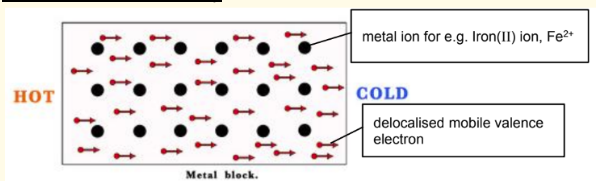
Good Heat Conductivity
Malleability and Ductility
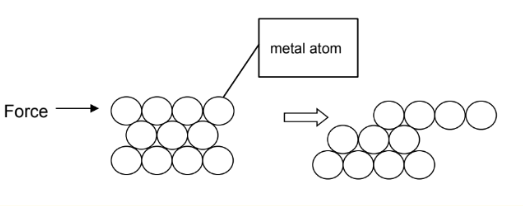 Malleability - ability of a material to be hammered into different shapes without breaking
Ductility - ability of material to be drawn into wires
Malleability - ability of a material to be hammered into different shapes without breaking
Ductility - ability of material to be drawn into wires
In the giant metallic lattice structure of pure metal - metal atoms which have the same atomic size are very closely packed and orderly arranged in layers. When enough force is applied - layers of atoms can slide over one another easily.
They can also be pulled into a wire without breaking (ductile) → the sea of delocalized electrons will continue to hold the metal ions together unless a much greater force is applied.
Answer Techniques for Properties of Metals
Explain in terms of structure why aluminum is solid at r.t.p • Aluminum (or Al) is a metal with a giant metallic lattice structure.(1) • In this structure, there is strong electrostatic forces of attraction between fixed positively charged aluminum ions (or Al3+ ions) and negatively charged sea of delocalized mobile valence electrons (1) • A large amount of energy is required to overcome these strong forces to melt Al. Hence Al has a high melting point and is a solid at r.t.p.
Explain why iron has high density while oxygen has low density at r.t.p
| Substance | Fe | O2 |
|---|---|---|
| Physical state at RTP | solid | gas |
| Arrangement of Particles | iron atoms are very closely packed together | Oxygen molecules are spaced far apart from each other |
| Density of Substance & Reasoning | High due to iron atoms are closely packed resulting in a smaller volume in the same mass (state how this affects density with reference to formula | Low due to oxygen molecules being far apart resulting in bigger volume in the same mass. (state how this affects density with reference to formula) |
Explain why sodium is a good conductor of electricity
- Sodium is a metal with a giant metallic lattice structure. In this structure, there is strong electrostatic attraction between positive sodium ions (cations) and the sea of delocalised electrons. Sodium has delocalised valence electrons which can move freely throughout the giant metallic lattice structure and act as charge carriers. . (1) When connected to an electrical circuit, these delocalized valence electrons are able to move from the negative terminal to the positive terminal. (Type of particles : (1))
Explain why iron is a good conductor of heat
- Iron is a metal with a giant metallic lattice structure. In this structure, there is strong electrostatic attraction between positive iron ions (cations) and the sea of delocalised electrons. Iron has delocalised valence electrons which can move freely throughout the giant metallic lattice structure. .(1) When heated, these electrons absorb heat, gain kinetic energy and move rapidly from the hotter end to the colder end, carrying the energy with them.(1) Hence, heat energy is transferred easily by these delocalised electrons in the structure.
Explain why aluminum is malleable and ductile
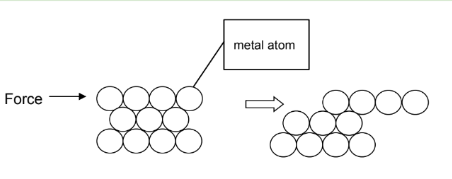 In the giant metallic lattice structure of aluminum, aluminum atoms which have the same atomic size are very closely packed and orderly arranged in layers. (1) When a force is applied, the layers of aluminum atoms can slide over one another easily. & Thus aluminum is soft and hence malleable and ductile. (1)
Alloys
Definition
Alloy is a mixture of a metal with 1 or more other elements #ChemistryDefinitions
Since alloys are mixtures → exact number and distribution of atoms are not known.
We only know the approximate percentage of each element by mass
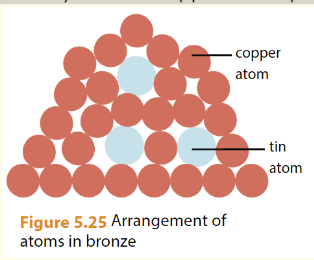 Bronze → alloy that is about 90% copper and 10%.
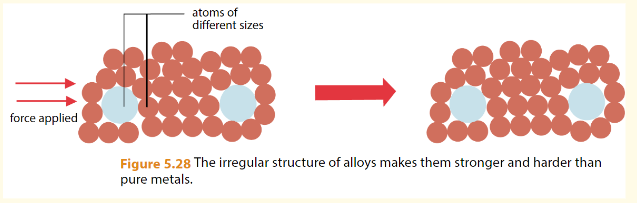
Regular arrangement of copper atoms is disrupted by the randomly distributed tin atoms, which are about 1.6 times the size of a copper atom.
Bronze → alloy that is about 90% copper and 10%.
Regular arrangement of copper atoms is disrupted by the randomly distributed tin atoms, which are about 1.6 times the size of a copper atom.
The irregular lattice arrangement in alloys leads to differences in properties between alloys and pure metals.
In an alloy → atoms are of different sizes. ⇒ regular lattice arrangement in the pure metal is disrupted, so a larger force is needed to make the layers slide over each other.
- Alloys tend to be less malleable and less ductile than the pure metals they are made from
- Alloys are harder and stronger than pure metals
Melting and boiling points Alloys are mixtures - usually melt over a range of temperatures, unlike pure metals which have fixed melting points. Alloys are also good conductors of heat as the delocalised valence electrons allow efficient transfer of thermal energy throughout the giant metallic lattice (same explanation as for metals)
Electrical conductivity Sea of delocalised electrons → in alloys make them good electrical conductors. (same explanation as metals)
Choosing Between Alloys and Metals
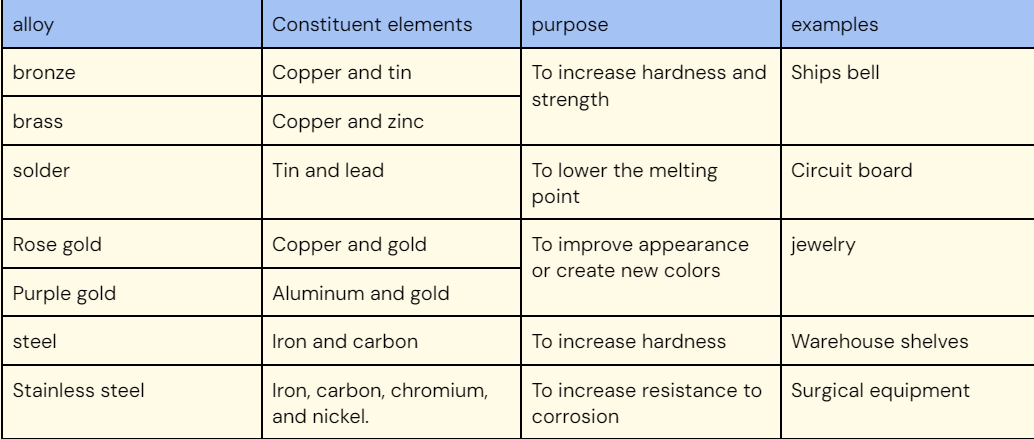
Answer Techniques for Alloys
Why are alloys preferred over pure metals Alloy are used instead of pure metals as it is harder and stronger than pure metals as the added element disrupt the orderly arrangement of the layers of metal atoms due to the different atoms having different sizes, making it more difficult for the layers of metal atoms to slide past each other when a force is applied.