Note
Details of construction and operation of fuel cell are not required
Definition
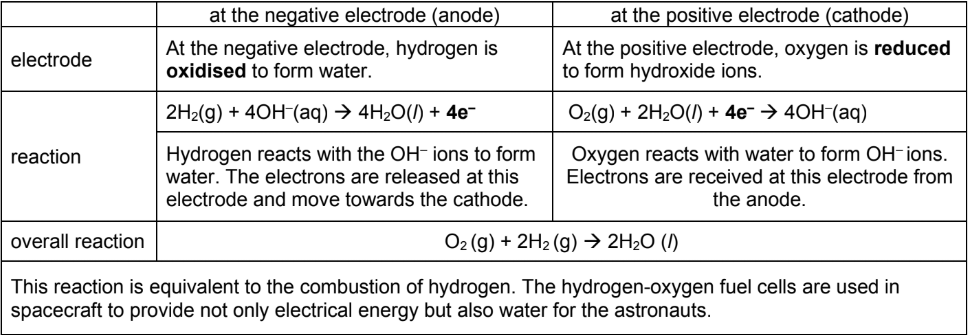
fuel cell is a chemical cell in which reactants, usually fuel and oxygen, are continuously supplied to produce electricity directly
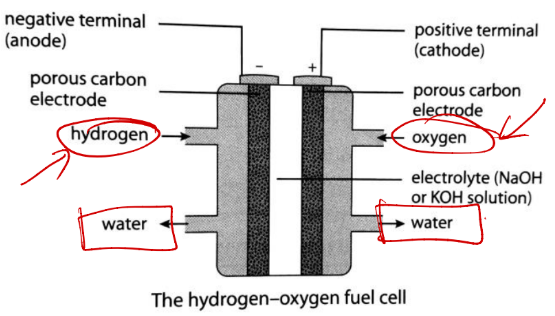
- in hydrogen - oxygen fuel cell → one electrode → supplied with fuel, hydrogen and other electrode is supplied with . 2 electrodes are immersed in electrolyte
- Requires constant supply of suitable fuel at anode and an oxidising agent at the cathode.
- hydrogen-oxygen fuel cell → uses hydrogen as fuel and oxygen from air as the oxidising agent. Hydrogen used can be obtained from water by electrolysis, or from hydrocarbons by cracking. Producing Alkanes and Alkenes by Cracking
- electrodes used → inert electrodes
- acidic electrolyte (e.g. acid) or alkaline electrolyte (e.g. potassium hydroxide) can be used.
Chemicals in fuel cell are continuously replaced as they are used up. hydrogen oxygen fuel cell → is used as a source of electrical power in space vehicles
Important
carbon electrodes are porous → allow hydrogen and oxygen gases → to be in contact with electrolyte, potassium hydroxide solution
| Advantages | Disadvantages |
|---|---|
| 1. It is a renewable energy resource. 2. It is also pollution-free → only water produced when hydrogen reacts with oxygen. 3) Hydrogen → efficient source of energy →provides twice the amount of energy compared to the same quantity of many other fuels. | 1. Difficult to find a cheap source of hydrogen. Obtaining hydrogen from electrolysis is an expensive process 2. Hydrogen is extremely flammable + explosive. Special precautions must be taken in the storage and transport of the gas. 2. Hydrogen exists as a gas, and thus requires larger storage volume compared to other fuels which are usually liquids. |