after fractional distillation of crude oil Separation of Crude Oil → fractions which contain alkenes with more carbons are usually not very useful.
- hence cracking carried out to obtain shorter chain alkanes and alkenes from these fractions
Definition
Cracking is a process in which larger hydrocarbon molecules, usually alkanes, are broken down into smaller hydrocarbon molecules #ChemistryDefinitions
hydrogen gas can also be obtained in some cracking processes.
different reactions take place in the cracking process. One possible reaction involving hexane () could be:
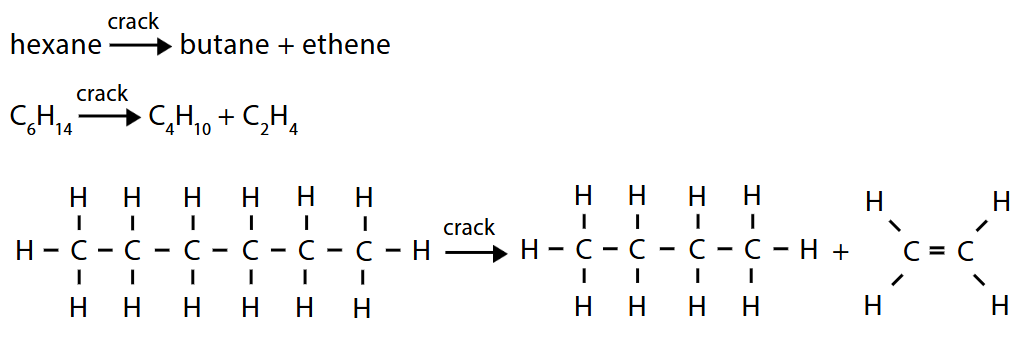
to speed up process of cracking → catalyst can be used
- known as catalytic cracking
What is Catalytic Cracking
-
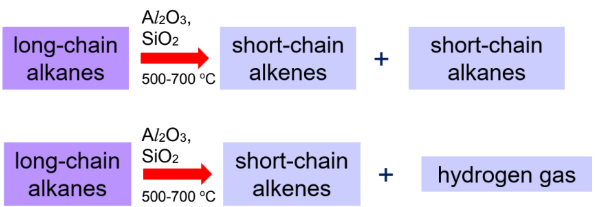
process of breaking down long chain hydrocarbon molecules into a mixture of short chain alkane and alkene molecules in the presence of a catalyst.
-
hydrogen gas may also be produced in this reaction
-
petroleum → mixture of long and short chain hydrocarbons. other substances that can be cracked include diesel, lubricating oil and paraffin fractions which are mixture of long chain hydrocarbons.
-
reactant: petroleum / diesel / lubricating oil / paraffin.
-
conditions: aluminium oil and silicon(IV)oxide (or silicon dioxide) as catalyst + high temperature of about 500-700
Equation
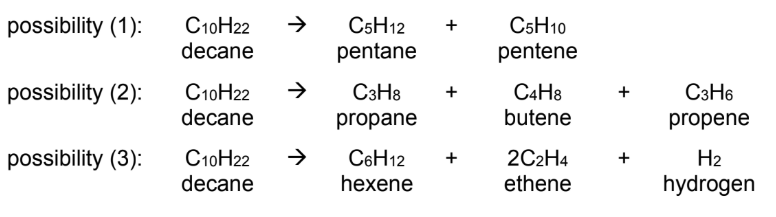
- for example, cracking may take place at various/any points along the decane chain,
Note
- total number of carbon and hydrogen atoms in both reactants and products must remain this same after reaction (balanced equation)
- products obtained on cracking depend on the conditions used
Important
short chain alkanes / alkene → 1-4 carbon atoms
In industries →catalytic cracking is carried out in following conditions:
- presence of catalyst such as aluminium oxide () and silicon dioxide ()
- high temperature of about to
- pressure of about 1atm
Equation
General equation for catalytic cracking is as follows:

Catalytic Cracking of paraffin carried out in school laboratory
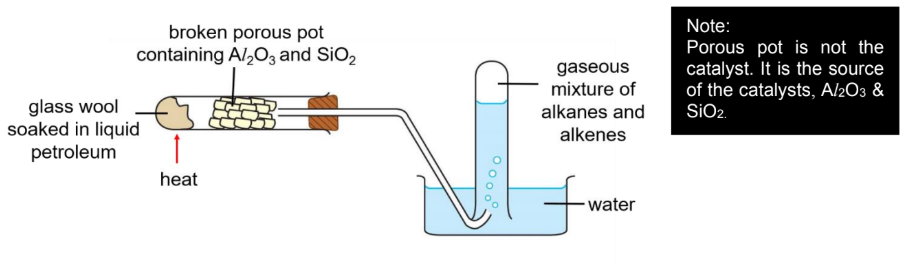
Sample
suggest a method to separate the gaseous mixture of alkanes and alkenes.
- condense this mixture and carry out fractional distillation of the liquid mixture
- these alkanes and alkenes have different molecular sizes thus they will have different boiling
Importance of Cracking
cracking converts less useful components of crude oil, usually long chain alkenes into:
- shorter chain alkenes, such as ethene and propene, which are starting materials for many important industrial processes
- shorter chain alkanes, such as petrol → which are in high demand as fuel
cracking allows supply from refining crude oil to match the industrial demand of shorter chain alkanes and alkenes. cracking also produces hydrogen as a by-product → which can be used in important industrial reactions such as production of ammonia.
i) Production of Petrol
- our demand for petrol which is a mixture of short chain hydrocarbon molecules exceeds the supply from fractional distillation of crude oil
- diesel oil and lubricating oil are less useful fractions than petrol
- these substances which are made up of long chain alkanes can be converted by catalytic cracking into smaller molecules, petrol, which are higher in demand.
ii) Source of Alkenes
- short chain alkenes such as ethene and propene are used as starting materials for making ethanol and plastics
iii) Production of hydrogen gas which is a raw material for Haber process which manufactures ammonia gas.
- cracking of petroleum.
Production of Alkenes - Catalytic Cracking of Petroleum
- alkenes and hydrogen gas can be manufactured by catalytic cracking of petroleum.