Separating Funnel
Separating funnel is used to separate 2 immiscible liquids When a heterogenous mixture is left to settle into separate layers, each component can be removed by opening the tap at the bottom and collecting it in separate flasks or beakers.
Chromatography
- chromatography is used to separate a mixture of substances which have different solubilities in a given solvent
start line → always marked with a substance that is insoluble in solvent → like graphite pencil
- chromatograms show the separated substances on a paper after chromatography
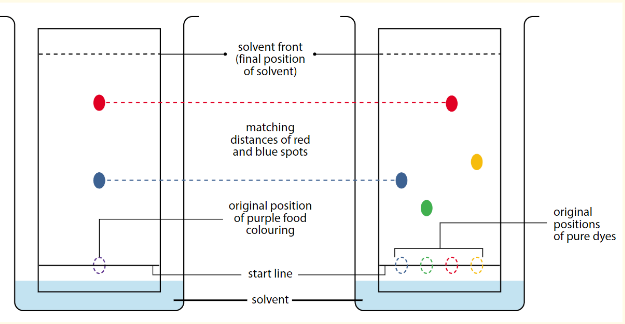
- Works based on solubility of dye in the solvent
- Spot of the sample to be tested is applied on the chromatography paper.
- Chromatography paper is dipped into the solvent
- Solvent will travel up the chromatography paper and dissolve the dyes in the food coloring.
- As it continues to travel up, it carries the dyes along
- A dye that is more soluble in the solvent will travel further up the paper than the less soluble dye.
- Chromatography paper with the separated components is called a chromatogram.
- If there is only 1 spot, it means the substance is pure.
- If there is no spot, the substance is insoluble in the solvent.
More soluble substances → move more rapidly towards the solvent front. Less soluble substances → move at slower rate. This will separate the mixture into its components
Distance a particular substance moves compared to the solvent front is constant for the same solvent. Ratio of these two distances is called the retention factor, or value of the substance.
→ value allows us to compare chromatograms which have been run for different durations using the same solvent, under the same temperature.
- If different solvent is used, values of a given substance may change.
- Hence, values for chromatograms obtained with different solvents should not be used for comparison.
Chromatogram is usually removed from solvent when the solvent front is near the top of the paper and then dried. If solvent is allowed to reach the top of paper, separate coloured components will continue to move up the paper, especially if more time has elapsed after solvent reached the top. This makes the comparison with chromatograms of known substances difficult.
Baseline is below the solvent → baseline should be above the solvent to prevent the dyes from being dissolved in the solvent before the chromatography can take place.
Should not use a black ink ball pen to draw the start lie. We should use pencils instead. Black ink is a mixture of dyes. The dyes will dissolve in the solvent, separate and spread interfering with the results of the chromatography. Pencil lead → made of graphite → graphite is a covalent substance with the giant molecular structure and is insoluble in water and organic solvents (alcohol) → hence it will not interfere with the results of the chromatogram.
Chromatography of Colorless Substance One way to identify them is to use locating agents - which are chemicals that react with the colorless substances to form coloured spots. Can also examine chromatograms under UV light if these substances are visible under this condition.
Some cases - you have to use combination of locating agent and UV light ⇒ locating agent bands or reacting with colorless substances but it can only be seen under UV light.
Applications of chromatography
- Identify unauthorized substances like pesticides and poisons in food
- Detect small quantities of banned substances in an athletes urine or blood sample
- Separate components like DNA fragments in sample for forensic investigations
Advantage of paper chromatography → only small amounts of sample is required
Fractional Distillation
When two liquids are miscible → and form a homogenous mixture → separating funnel cannot be used to separate them. Difference in boiling points between 2 liquids may also not be as large as that between a liquid and solid to allow simple distillation to work.
To separate 2 liquids with different boiling points - fractionating column is added to simple distillation set up. Column contains glass beads or other small solid objects which provide a larger surface area for the vapors to condense on.
- fractional distillation is used to separate miscible liquids with diff. boiling points
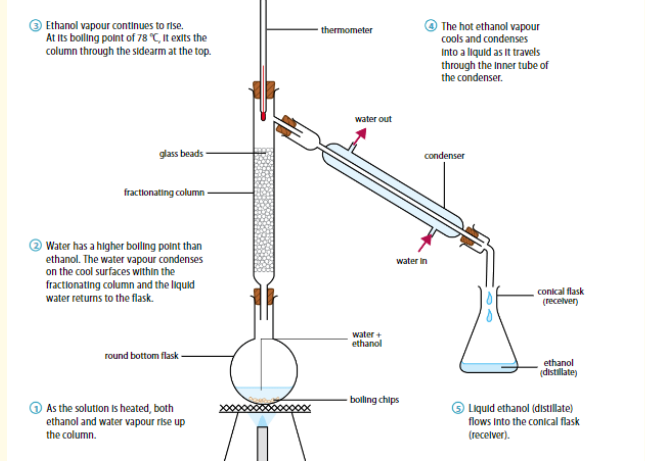 Fractionating column → filled with glass beads that provide cool surfaces for the rising water vapor to condense.
⇒ liquid with lower boiling point will distill over to the condenser first.
⇒ vapors of liquids with higher boiling points condense a long fractionating column and re-enter the round bottomed flask.
⇒ repeated condensation and vaporization occurs inside the column.
⇒ thermometer with its mercury bulb places next to mouth of the condenser that is connected to the distillation flask, reads the boiling point of the distillate (substance with lower boiling point
Fractionating column → filled with glass beads that provide cool surfaces for the rising water vapor to condense.
⇒ liquid with lower boiling point will distill over to the condenser first.
⇒ vapors of liquids with higher boiling points condense a long fractionating column and re-enter the round bottomed flask.
⇒ repeated condensation and vaporization occurs inside the column.
⇒ thermometer with its mercury bulb places next to mouth of the condenser that is connected to the distillation flask, reads the boiling point of the distillate (substance with lower boiling point
Initial distillate collected - will contain the substance with lower boiling point To avoid contaminating the distillate with a substance with a higher boiling point → conical flask (receiver) must be removed once thermometer reading rises above the boiling point of the initial distillate. Round bottom flask → will then contain the substance with the higher boiling point and the boiling chip. Because separation of liquids - depending on difference in their boiling points → length of fractionating column determines its ability to separate substances with boiling points that are close together. Liquids with similar boiling points - require longer fractionating columns for better separation.
Industrial Applications for Fractional Distillation
- Oil refineries - separate different substances from crude oil, which are further processed into useful chemicals like petrol, kerosene and lubricating oils
- Liquified air is separated to produce nitrogen, oxygen, and argon gas for industrial applications
- Ethanol produced by glucose fermentation is excreted in breweries.
- Separation of crude oil/petroleum into its components(fractions). Each of these useful products can be obtained as different fractions by fractional distillation. Separation of Crude Oil
- Can be used in industries to obtain gasses such as nitrogen, argon and oxygen.**
Important
fractional distillation used for liquids with temperature diff less than 25 degrees