Measurement of Time → digital or analogue stopwatch
| Apparatus | Smallest Division of Apparatus |
|---|---|
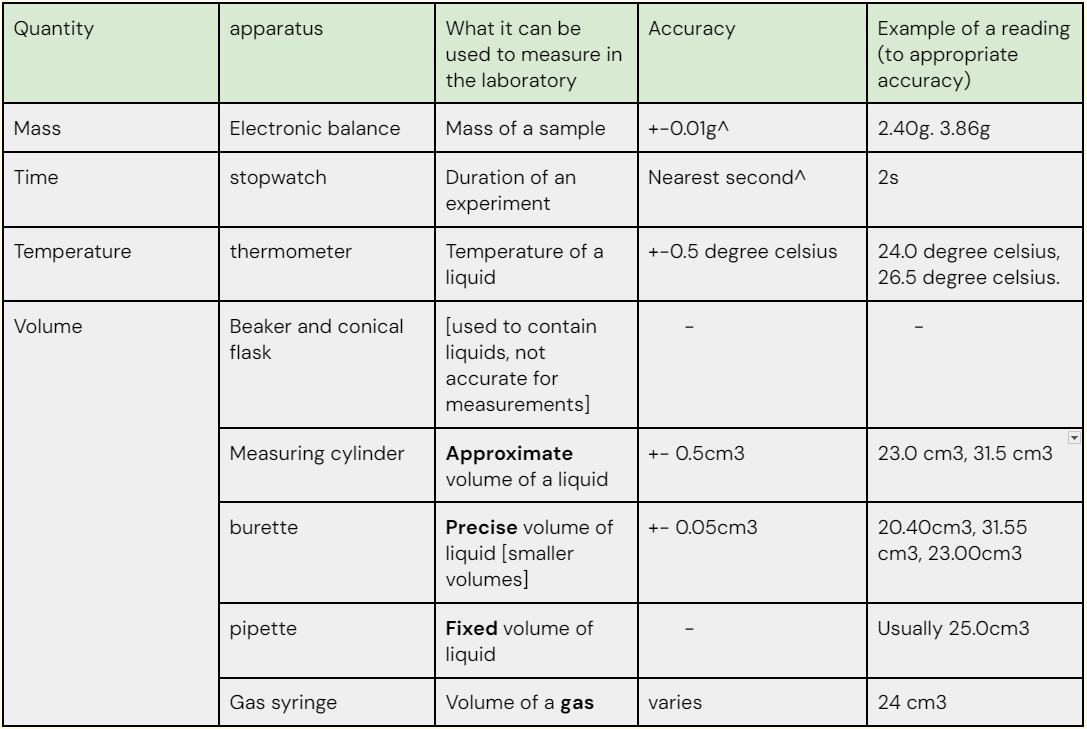
| Digital Stopwatch | +— 0.01s (hundredth of a second) |
| Analogue stopwatch | +— 0.1s (tenth of a second) |
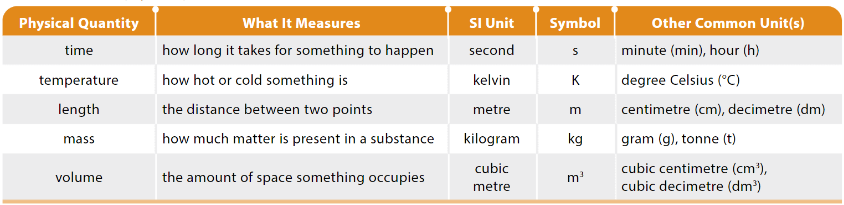
Measurement of Temperature SI Unit: Kelvin. commonly measured in Degree Celsius
Temperature in K = temperature in degree Celsius + 273
2 types of thermometer → alcohol and mercury. Sometimes digital thermometers are used, as they have wider temperature range.
- can be connected to data loggers to measure temperature and collect data automatically + plot graph
Measurement of Length SI unit - meter(m). For shorter lengths, millimeter(mm), centimeter(cm) or decimeter(dm) may be used 1m = 10dm = 100cm = 1000mm
Common apparatus - meter rule and measuring tape
- Meter rule - accuracy of +-0.1cm while measuring tapes come in diff. Forms and lengths, with accuracies ranging from +-0.1cm to +-0.5cm
- Apparatus you use depends on length being measured, as well as the accuracy required.
Measurement of Mass SI unit - kilogram (Kg). for measurement of smaller masses - gram(g), milligram(g) is used instead Chemical factories and refineries work with much larger quantities - measure mass in tones(t) or kilotons(Kt)
1kg = 1000g = 1 000 000 mg 1t = 1000kg = 1 000 000g 1kt = 1000t = 1 000 000 kg
Apparatus was traditionally a beam balance. Today, we usually use electronic balance with a digital display.
- Accuracy of beam balance varies depending on its calibration marks and the counterweights used.
- Accuracy of electronic balance is about +-0.01g
Measurement of Volume SI unit - cubic meter (m3) 1m3 = 1000dm3 = 1 000 000 cm 3
Volume of liquid Choose appropriate instrument based on volume to be measured and accuracy required
- Volumetric flask
- Measuring cylinder
- Pipette
- Burette
| Apparatus | What it Measures |
|---|---|
| pipette | Accurate fixed volumes (1d.p) (eg: 10.0cm3 or 25.0cm3) Capacity of: 10cm3, 25cm3 |
| Volumetric flask | Accurate fixed volumes that are larger (eg: 100cm3 or 250cm3) |
| Measuring cylinder | Range of volumes to the nearest 0.5cm3 (eg: 31.5cm3 or 23.0cm3) Capacity of: 10cm3, 50cm3, 100cm3. |
| burette | Range of volumes to the nearest 0.05cm3 (eg: 31.55cm3 or 23.00cm3) [smaller volumes] One type of burette with a capacity of 50cm3. |
| When reading the volume of liquid - we should position our eyes at the meniscus. To avoid parallax error | |
| (refer to physics phrasing) |
Measuring volume of gas
- gas syringe is used
- typical gas syringe in laboratory measures volumes up to 100cm3
Summary Table
Gasses
How are Gasses Collected Methods for Drying Gasses
Separation Techniques
| Solid-Solid Mixture | Solid-Liquid Mixture | Liquid-Liquid Mixture |
|---|---|---|
| magnetic attraction | filtration | separating funnel |
| sieving | evaporation of dryness | chromatography |
| using suitable solvents | crystallization | fractional distillation |
| sublimation | simple distillation |
Separating Solid-Solid Mixture
Separating Solid-Solid Mixture
Separating Solid-Liquid Mixture
Separating Solid-Liquid Mixture
Separating Liquid-Liquid Mixtures
Separating Liquid-Liquid Mixtures
How can Purity of Substance be Determined
besides chemical properties → physical properties can be used to determine purity of a substance.
Pure substance → has specific melting and boiling points under fixed conditions. mixtures melt or boil over a range of temperature MUST SAY THIS PHRASING IN EXAM
Impurities in substance ALWAYS lowers the melting point and increases the boiling point.
Other than chromatography, melting or boiling point data can be used to determine the purity of a substance.
Pure substance → consists of only ONE substance. ⇒ all pure substances can be described using a chemical formula
Mixture → consists of 2 or more substances not chemically combined.
Components of mixture can be in any ratio → mixture does not have a chemical formula.
Pure substances → fixed melting and boiling points.