Important
vegetable oils are liquid at r.t.p. vegetable oils (sunflower oil or coconut oil) contains many long chains of polysaturated oil molecules
in industries → margarine which is solid at r.t.p → can be obtained fromhydrogenation of vegetable oil.
- compared to vegetable oil → solid product is more convenient to use and can usually be kept longer.
to produce margarine from vegetable oil (e.g. palm oil) → hydrogen is added at temp. of in presence of catalyst such as nickel.
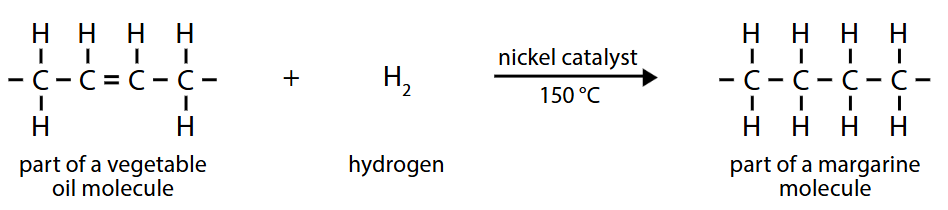 What happens during hydrogenation of vegetable oil?
- when hydrogenation of these polysaturated molecules takes place, some of the carbon-carbon double bonds become carbon-carbon single bonds and saturated (or less unsaturated) fat molecules are formed
- fat molecules which are straight chained and thus can be packed more closely together. hence the margarine produced in this reaction is in solid state.
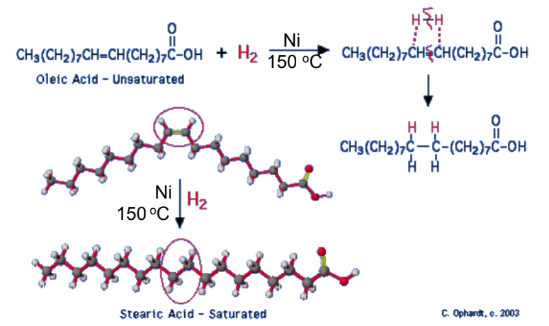
- the greater the amount of hydrogen gas used, the greater the number of moles of polyunsaturated oil molecules (and carbon-carbon double bonds) that undergo addition reaction, thus the more solid the margarine becomes as the percentage of less unsaturated fat molecules in margarine increases.
as more hydrogen molecules are added into oil molecule → there are fewer carbon-carbon double bonds + melting point of the oil increases. hence vegetable oil exists as liquid whereas margarine exists as solid at r.t.p.
Recent research shows → this process often leads to partial hydrogenation of vegetable oils → which means margarine produced still contains some unsaturated hydrocarbons. in addition → trans fats may be formed due to side reaction of hydrocarbon chain with the catalyst.
- trans fats have been associated with heart diseases.
- consumption of food products containing trans fats has been greatly discouraged.
Important
oils are more unsaturated than fats
Important
polysaturated oils contain many double bonds