Combustion
Like alkenes → alkenes burn in excess oxygen to produce carbon dioxide and water (both alkene and alkane undergo combustion)
i) Complete Combustion of Alkenes
- reactants: alkenes(fuel) and oxygen gas
- condition: excess supply of oxygen
Equation
General Equation: Alkene + Oxygen gas → carbon dioxide gas + water
e.g. ethene burns in excess oxygen as follows: ethene + oxygen → carbon dioxide + water
ii)Incomplete Combustion of Alkenes
- reactants: alkenes(fuel) and oxygen gas
- condition: insufficient supply of oxygen
Equation
General word equations:
- alkene + oxygen gas → carbon monoxide gas + water + soot
- alkene + oxygen gas → carbon monoxide gas + water
- alkene + oxygen gas → water + soot
compared to alkanes → percentage by mass of carbon in alkene molecules is higher
- alkenes are more likely to undergo incomplete combustion → producing carbon monoxide and carbon (soot).
- hence alkenes usually burn with a sootier flame than alkenes. (like brown smoke formed above the flame)
Sample
Why do alkenes burn with sootier flame compared to alkanes?
alkenes will burn with sootier flame compared to corresponding alkanes who have same number of carbon atoms due to higher chances of incomplete combustion.
this is because alkenes have a relatively higher percentage by mass of carbon than its corresponding alkanes.
thus soot maybe produced on incomplete combustion of alkenes due to insufficient oxygen gas for reaction.
during incomplete combustion, some of the alkanes might not undergo combustion, resulting in release of unburnt hydrocarbons to env.
Addition Reactions
- alkenes take part spontaneously in addition reactions → as they have carbon carbon double bonds which are *very reactive functional groups. *
What is addition reaction?
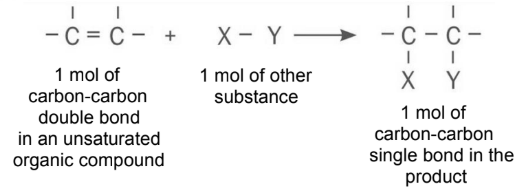
- chemical change in which unsaturated organic compound combines with another substance → to form a single new product
- the carbon-carbon double bond breaks and becomes carbon-carbon single bond and other new single bonds are formed.
- ^ these substances include halogens, hydrogen gas, steam.
Note
an unsaturated organic compound whose molecules have at least 1 carbon-carbon double bond with undergo addition reactions
2 types of unsaturated compounds:
- monounsaturated
- molecules contain only 1 carbon-carbon double bond
- polyunsaturated
- molecules contain more than 1 carbon-carbon double bonds.
Equation
General equation as is follows:
Important
Addition reactions take place at the carbon carbon double bond and both carbon atoms will form new single bonds with the other reactant
Sample
based on general equation, compare degree of unsaturated in the unsaturated organic compound and the product of an addition reaction
- degree of unsaturated is lower in the product compared to the unsaturated organic compound.
carbon carbon double bonds breaks to form new single bonds.
- as a result → each carbon atom which was originally party of the C=C bond forms 4 single covalent bonds instead
Not all reactants can be added across the carbon carbon double bond. e.g. of reactants that can be added to alkenes include:
- hydrogen
- bromine
- steam
- other alkenes.
Adding of Hydrogen (Hydrogenation)
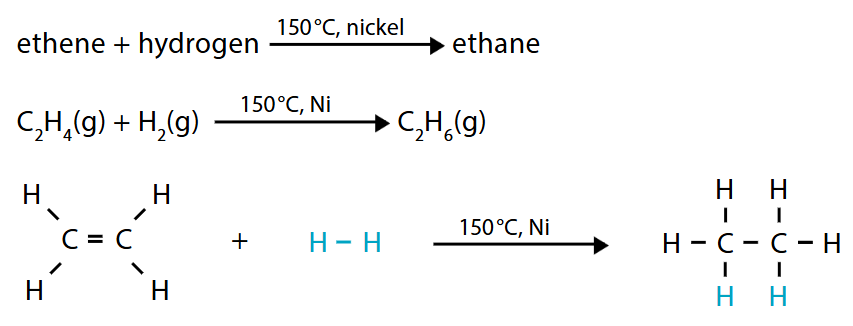
at and in presence of catalyst such as nickel → alkenes can react with hydrogen to form alkanes. this reaction is known as hydrogenation\
- reactants: alkene (or any other unsaturated compound) and hydrogen gas
- conditions: nickel as catalyst, temperature of
e.g. ethene reacts with hydrogen as follows.
Explanation
- the reacting hydrogen molecule is added to alkene (unsaturated organic compound) across the carbon-carbon double bond to form the product.
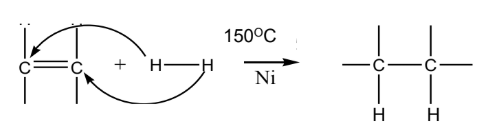
Laboratory application: produce specific alkanes from their corresponding alkenes in the laboratory. Industrial application: Manufacture of Margarine from Vegetable Oils
Adding of Bromine (Bromination)
Alkenes can react with halogens, such as chlorine, bromine, iodine known as bromination
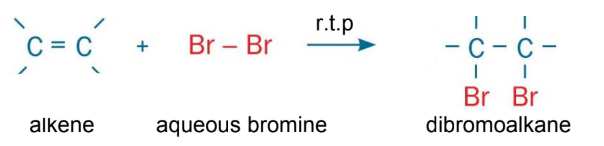
- addition of aqueous bromine to alkenes to form dibromoalkanes.
- this reaction is also known as halogenation as bromine is a halogen
- product is halogenoalkane.
reactants: alkene (or any other unsaturated organic compound) and aqueous bromine conditions: r.t.p ( and 1atm)
Equation
general equation
What happens in bromination reaction?
- reacting bromine molecule is added to alkene (an unsaturated organic compound) across the carbon carbon double bond to form the product.
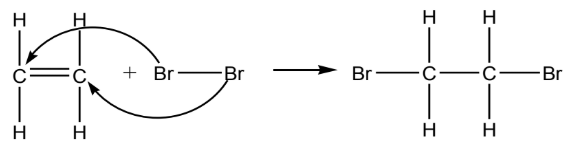
e.g. when ethene is bubbled through liquid bromine → brown colour of bromine disappears (decolourisation). Colourless liquid (1,2 dibromoethane) is formed
equation:
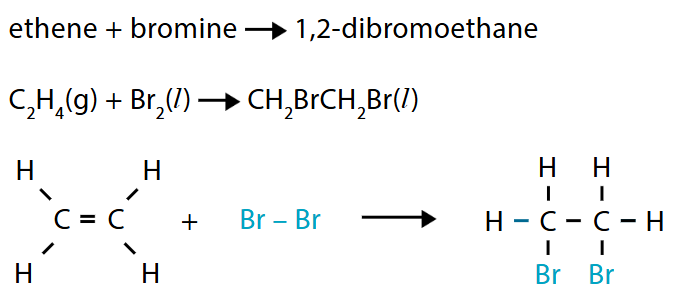
Laboratory application: to distinguish unsaturated hydrocarbons (alkenes) from saturated hydrocarbons (alkanes) Diff Between Saturated and Unsaturated Compounds
Addition of Steam (Hydration)
Alkene can react with steam to produce alcohols. conditions required:
- temperature of
- pressure of 60 atm
- reaction also requires a catalyst (phosphoric(V)acid, )
Equation
general equation

What happens in hydration reaction?
- reacting water molecule (in steam) is added to alkene (an unsaturated organic compound) across the carbon-carbon double bond to form the product.
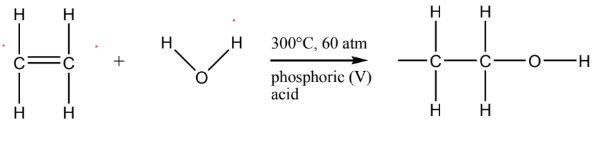
e.g. ethene react with steam to form ethanol
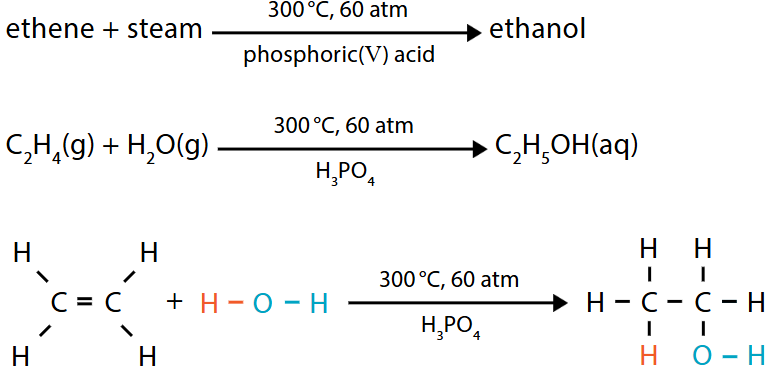
Laboratory application: to produce specific alcohols from their corresponding alkenes.
Addition Polymerisation
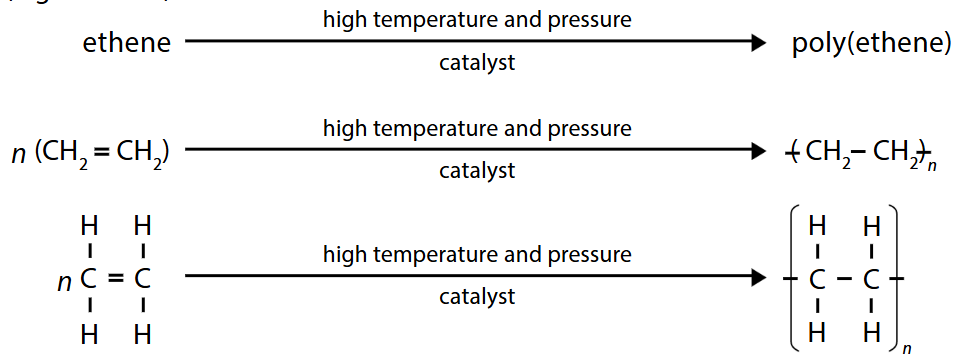
- refer to polymers chapter. At high temperature and pressure, and in presence of catalyst → ethene molecules can react with each other to form a long molecule called poly(ethene)
this process is called addition polymerisation
- use this process to manufacture materials like plastic
Sample
In describing reactions:
- quote the reagents
- quote essential conditions
- detailed conditions involving specific temperature and pressure values are not required