Evaporation:
- Upon heating: particles gain thermal energy
- Thermal energy → converted to KE → particles slides more quickly past each other
- At the surface of liquid in contact with air → some particles - enough energy to overcome attractive forces to escape from liquid as vapor. (can occur at any temperature)
Boiling:
- temperature of liquid - high enough - bubbles of gas formed within liquid as liquid changes into gas
- Thermal energy transferred to liquid - results in substance converting from liquid to gas
- Temp remains constant - until all substances are in gaseous state. (occurs only at boiling point)
Heating Curve
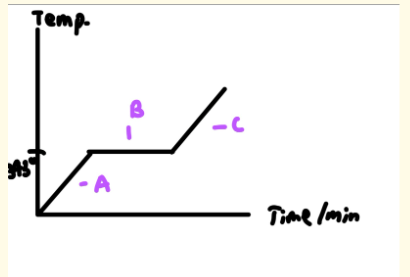 A(Liquid): Heating to 343 Degree Celsius
- Thermal energy - converted to KE of particles
- Particles slide past one another with increasing speed
- Temperature of liquid rises towards 343 degree Celsius
B(liquid gas mixture): Icosane Boils at 343 degree Celsius
- Thermal energy → absorbed from surroundings - temperature of liquid is at its boiling point
- Particles with increased energy → have enough energy to overcome the forces of attraction in the liquid state.
- Particles move further apart - quickly and randomly
- Particles go from closely packed in a disorderly arrangement, and sliding past each other to very far apart and disorderly arrangement, and moving quickly and rapidly in any direction.
- Both liquid and gas → present during boiling process.
- Temp → remains constant throughout the boiling process, until all icosane has boiled. This is because all the energy gained is used to overcome the strong forces of attraction between particles in the liquid state
C(gas) heating beyond 343 degree Celsius
- After all liquid - boiled off at point [] → thermal energy → again converted to kinetic energy of particles
- Particles → move quickly and randomly in any direction
- Temperature of gas rises beyond 343 degrees Celsius.
Cooling Curve
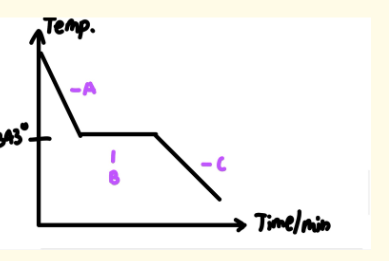 A(Gas): cooling to 343 degree Celsius
- KE of particles - converted to thermal energy → transferred to surroundings.
- With less KE - particles slow down
- Temperature of gas reduces to 343 degree Celsius
B(Liquid gas mixture): Icosane condenses at 343 degree Celsius
- Particles lose energy to surroundings - temperature is at the condensation point
- Particles with less kinetic energy - drawn closer together by forces of attraction between them.
- Arrangement of particles - becomes less far apart and disorderly.
- Both liquid and gas are present during the condensation process
- there isn’t enough energy to overcome the forces of attraction, causing particles to be drawn closer together to each other. [check]
- Temperature remains constant throughout the condensation process until all icosane has condensed as all kinetic energy lost is used to convert from gas to liquid.
- Particles go from very far apart in a disorderly arrangement, and moving quickly and rapidly in any random directions to closely packed in a disorderly arrangement, and sliding past each other.
C(liquid): Cooling below 343 degree Celsius
- After all gas has condensed at point [] → KE of particles again converted to thermal energy + transferred to surroundings
- Particles can slide past each other freely throughout the liquid only
- Temperature of liquid reduces to below 343 degrees Celsius.
Gaseous oxygen ⇒ shrinks almost 900 time sin volume as it cools down and condenses to become a liquid