Definition
Kinetic particle theory states that all matter is made up of tiny particles, and these particles are in constant random motion. #ChemistryDefinitions
Definition of Pure Substance
- contains only 1 type of PARTICLE
- particles can mean → 1 molecule of compound
- cannot stay ATOM
2 compounds can also form another compound btw.
| Solids | Liquids | Gasses |
|---|---|---|
| - very closely packed in an orderly manner - they vibrate or rotate only about their fixed positions → have very low kinetic energy - particles experience very strong forces of attraction → so a lot of energy is needed to break up regular arrangement - thus solids have definite shape and volume | - particle spacing in liquid is larger than in solids → so attractive forces are less strong (but still strong) - Low kinetic energy of particles - Arrangement is disorderly. - particles can slide past each other freely and move throughout the liquid - definite volume but no definite shape | - particle spacing is very large → thus attractive forces between them are very weak - particles found about very far apart in a disorderly manner - particles can move about quickly and randomly in any direction - no definite volume or definite shape. |
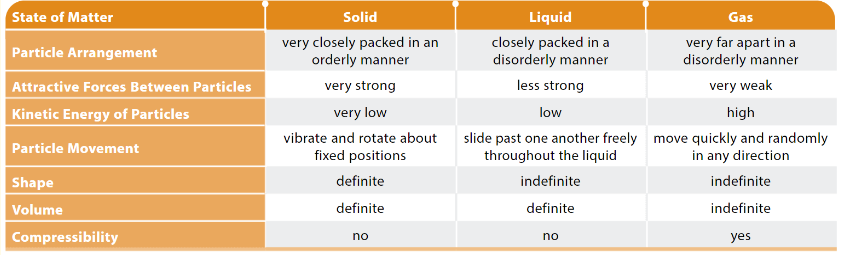 |
Changes of State
When substance is heated - thermal energy is transferred to the substance
- Some energy is converted to kinetic energy of particles
- Increased KE of particles - result in increase in temperature of substance
When substance is cooled - thermal energy is transferred from the substance to the surroundings
- KE of particles in substance - reduced - causes drop in temperature.
Transition temperature freezing, melting, boiling: certain temperature at which heating/cooling results in change of state instead of change in temp.
For a pure substance:
- Melting point = freezing point
- Boiling point = condensation point.
Always state the change from before and after when answering the questions Converting Between Solid and Liquid Converting between liquid and gas Converting Between Solid and Gas
| Expansion and Contraction of Solids | How are solids liquids and gas different |
|---|---|
| Expansion: - Particles gain thermal energy → converted to KE - Vibrate more quickly about their positions - Particles move slightly further apart from each other. - Slightly wider spacing between particles than before Contraction - Thermal energy: transferred from particles to the surrounding. - Particles possess less KE - vibrate slower - Particles come closer compared to before. | Why does ice float on water? - When water freezes - particles - packed more closely than water then ice - Thus ice, less dense than water. |
Boiling VS Evaporation
| Boiling | Evaporation |
|---|---|
| Occurs only at boiling point | Can occur at temp. Below boiling point |
| Occurs throughout liquid | Only occurs at surface of liquid |
| Occurs rapidly | Occurs slowly |
| Bubbles produced. | No bubbles observed |
Movement of Particles
Diffusion
Definition
net movement of water molecules from a region of higher concentration to a region of lower concentration down a concentration gradient. #ChemistryDefinitions
→ due to constant random motion of particles → to fill up any available spaces → resulting in even mixing (only in closed system) → particles of air molecules are in constant random motion* → as they move, they knock into particles of the substance* (MUST INCLUDE IN ANSWER)
note* volatile liquid is one that turns to gas easily note* particle movement does not stop when diffusion is complete
- Particles continue to move in constant random motion with no net change in concentration.
Factors affecting rate of diffusion
- Effect of temperature
- Particles have more KE at higher temperatures.
- Able to move faster → resulting in increased ROD
- Particles in liquid / gas → move more quickly compared to solids
- Also why hot liquids diffuse faster than cold ones (more thermal energy is converted to KE of particles_
- Effect of particle mass Particles with greater mass - > require more KE to move at a given speed. → heavier particles diffuse slower than lighter particles at any given temperature.
| Example of diffusion: 1. When sprayed out → more volatile substances vaporize almost immediately 2. Perfume vapor → diffuses away from bottle through air into nose. [definition of diffusion] |
Example Questions
liquid to gas conversion: When the liquid is being heated, particles gain kinetic energy and slide over each other faster. Particles gain sufficient energy to overcome the strong forces of attraction between particles in liquid substance and break from their closely packed and disorderly arrangement and escape from the surface of the liquid into gaseous state.
Describe how the movement of particles in x changes when x is heated from 25 degrees to 90 degrees. When X is heated from 25°C to 80°C, the particles of X gain energy and vibrate and rotate more vigorously about their fixed positions. ✓ At 80°C, the particles gain enough energy to overcome the forces of attraction between the particles and X starts to melt and turn into a liquid. ✓ When X is heated from 80°C to 90°C, the particles of X slide freely past one another. ✓
Why does the temperature of Y remain constant at 150 degrees Celsius? Note: Y has a melting point of 150 degrees. At 150°C, solid Y is melting. Energy is taken in by the particles in solid Y to overcome the forces of attraction between the particles, and the temperature remains constant. All the thermal energy gained is used to overcome the strong forces of attraction in the solid state.
Blue colored dye was added into a glass of water. Explain why water in glass eventually turned a uniform blue color. The particles of the blue colored dye diffused throughout the water as the particles of the blue colored dye diffused from a region of higher concentration to a region of lower concentration to occupy available spaces due to continuous random motion, resulting in even mixing.