- simplest addition polymer
- commonly known as polyethylene(PE)
- produced by addition polymerisation of ethene monomers.
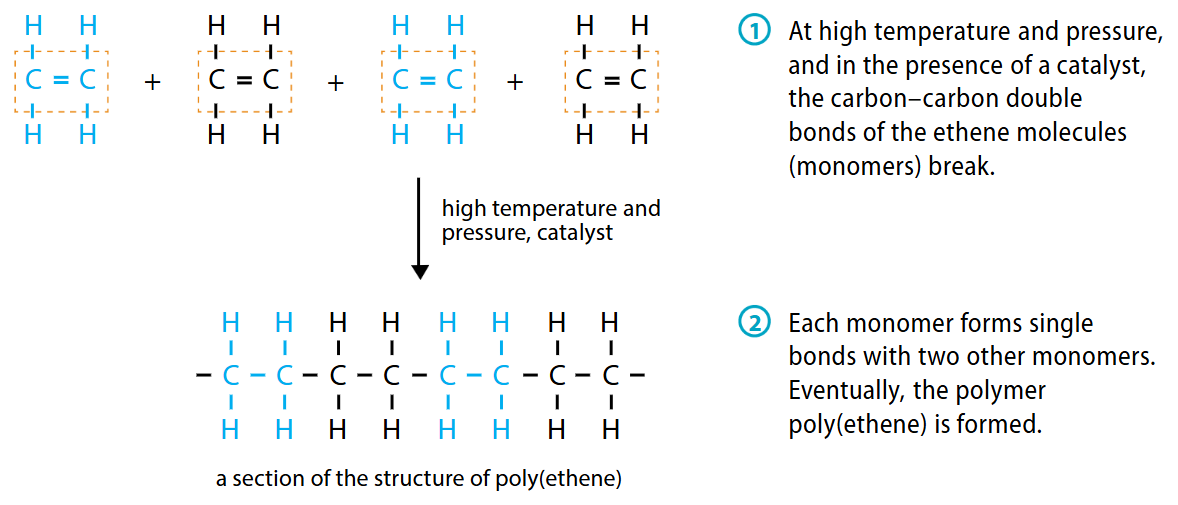
- at high temperature and pressure, and in presence of catalyst → carbon-carbon double bonds of ethene molecules (monomers) break
- each monomer forms single bonds with 2 other monomers. eventually → polymer poly(ethene) is formed
polymer is usually made of similar units joined together. these units are known as repeat units
Definition
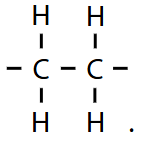
Repeating unit of a polymer is the simplest formula that contains the smallest part of a polymer molecule #ChemistryDefinitions
- repeat unit of polyethene is:
Full Process
| Step | Elaborate | image |
|---|---|---|
| 1 | Write out formula of several monomer molecules (ethene) | 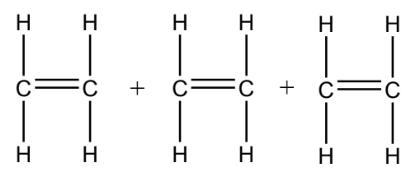 |
| 2 | During addition polymerisation → one of the covalent bonds in the carbon carbon double bond in each monomer molecules breaks → converting monomer molecules to repeat units. | 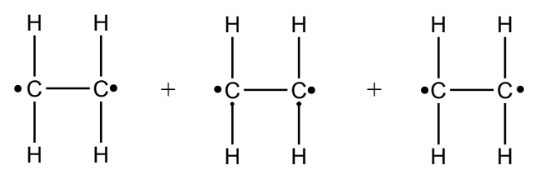 |
| 3 | Repeat units joined together by forming carbon carbon single bonds to form a molecule of addition polymer (macromolecule) | 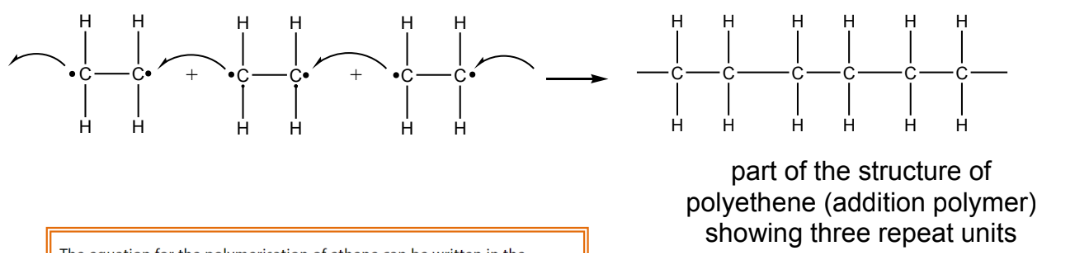 |
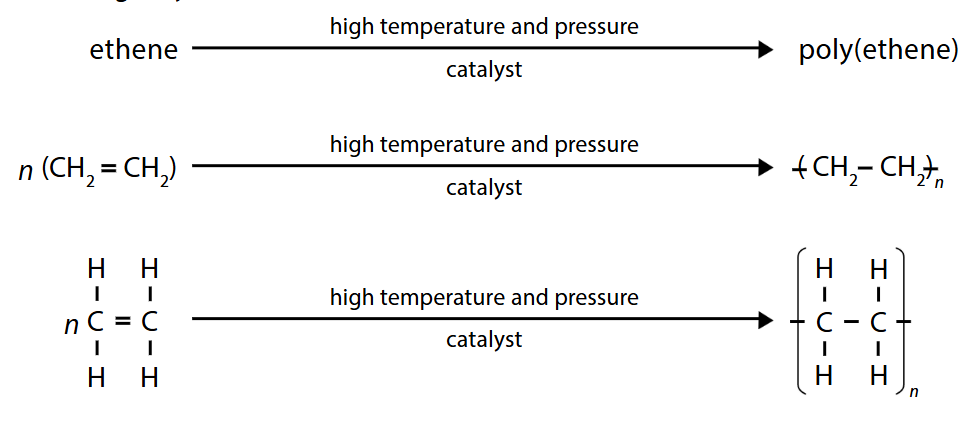
Formula of polymer can be written using its repeating unit.
formula of polyethene can simply be written as:
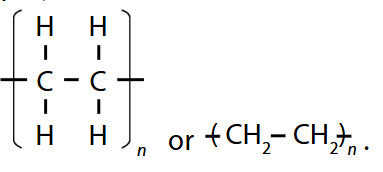 letter n represents a large number. may ethene molecules are required to form each poly(ethene) molecule
Balanced Chemical Equation for Addition Polymerisation of Ethene using Displayed Formula
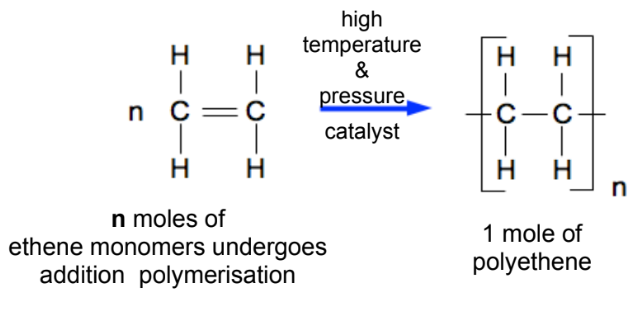
Physical Properties of Polyethene: flexible but difficult to break as it is a strong material Uses of Polyethene: making plastic bottles, plastic bags, pails, toys, cling films.